
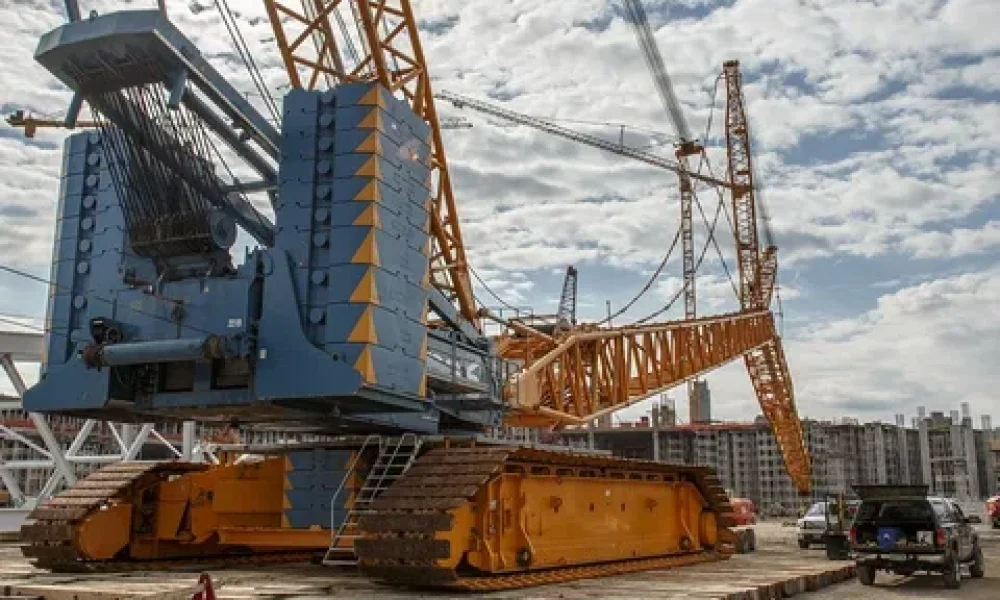
The Germany autonomous crane market will experience a growth at a compound annual growth rate of 4.9% during the years from 2025 to 2035. At an estimated size of about USD 343.3 million in 2035, the overall adoption of AI, machine learning, IoT, and 5G connectivity integrated in crane systems has greatly improved operational productivity, safety, and dependability.
The Germany Autonomous Crane Market is witnessing significant expansion, fueled by rapid industrial automation, technological advancements, and increasing infrastructure development. As Germany continues to lead in Industry 4.0, the adoption of AI-driven, IoT-enabled, and autonomous lifting solutions is transforming material handling across industries. With a strong focus on efficiency, safety, and sustainability, autonomous cranes are becoming an integral part of manufacturing, logistics, construction, and port operations. Government-backed smart infrastructure initiatives and the presence of key players in automation are further accelerating market growth.
Get Ahead with Our Report: Request Your Sample Now!
https://www.futuremarketinsights.com/report-sample#5245502d47422d2e3230323630
Key Takeaways
- Rising Adoption of Industry 4.0: German industries are increasingly integrating AI-powered cranes for smart automation.
- Expansion of Smart Logistics & Warehousing: Growth in e-commerce and manufacturing is driving demand for automated material handling solutions.
- Technological Innovations: Advanced sensors, AI-driven predictive maintenance, and IoT-enabled remote operations enhance efficiency.
- Infrastructure & Construction Boom: Large-scale infrastructure modernization projects fuel the demand for intelligent lifting solutions.
- Sustainability & Safety Focus: Autonomous cranes reduce workplace accidents and contribute to energy-efficient operations.
Key Drivers
- Strong Industrial Automation Trends – Germany’s leadership in smart factories and automated supply chains is driving demand.
- Growth in Construction & Infrastructure – Expansion of urban development and transportation projects increases the need for autonomous lifting equipment.
- Advanced Port & Maritime Operations – Automated cranes play a crucial role in optimizing cargo handling in Germany’s major ports like Hamburg and Bremen.
- Rising Demand for Smart Warehousing – E-commerce, automotive, and logistics industries are integrating autonomous cranes to streamline operations.
- Regulatory Push for Workplace Safety – Adoption of automation reduces human intervention, minimizing risks in heavy-duty operations.
Growth Opportunities
- Integration of AI & Machine Learning – Real-time analytics and AI-driven automation enhance operational efficiency.
- Expansion of Smart Ports – Investments in port automation drive demand for autonomous cranes in maritime logistics.
- Development of Sustainable Cranes – Focus on energy-efficient and electric-powered crane solutions supports green initiatives.
- Collaborations in Robotics & Automation – Partnerships between industrial automation firms and crane manufacturers accelerate market expansion.
- Adoption in Renewable Energy Projects – Autonomous cranes are increasingly used in wind energy and solar power plant construction.
Segment Analysis
By Type
- Tower Cranes (40%): Tower cranes are mostly found in high-rise construction activities for their large capacities and can travel to extreme distances. Such kinds of cranes suit skyscrapers and infrastructure sites where precision as well as high operational efficiency becomes a need.
- Mobile Cranes (60% Market Share): Mobile cranes, given their superior flexibility, are predominant in the German market. Infrastructural developments involving highway construction and bridge building fall under this category, as do renewable energy facilities. Their ease of mobility for transportation between construction sites makes these units ideal for varied applications.
Based on Payload Capacity
- Less than 50 Tons (25% Market Share): Smaller-sized autonomous cranes used for smaller-sized construction work, including residential buildings, infrastructure works, and material handling at factories and warehouses.
- 50-200 Tons (45% Market Share): These are the most common cranes used in infrastructure, logistics, and manufacturing industries. Their capacity is ideal for lifting and transporting mid-weight loads such as beams, concrete panels, and large machinery components.
- More than 200 Tons (30% Market Share): These high-duty autonomous cranes are used for big projects like the installation of wind turbines, heavy civil construction, and significant industrial installation. The high lifts that are performed under extreme conditions with high efficiency make these heavy-duty cranes essential for renewable energy projects and large infrastructure constructions.
By Source of Power
- Diesel (40% Market Share): Diesel-powered cranes remain the strongest in the German market because, in construction and industrial applications, especially those far away where electric charging stations may not be well distributed, they play their robust role well.
- Electric (30% Market Share): This is the latest commitment that Germany is making to sustainability. The cranes will start gaining traction as part of urbanization and in areas with nearby electric grids. Electric cranes produce fewer emissions and have less noise, making them convenient for green construction projects and locations.
- Hybrid (30% Market Share): Hybrid cranes are on the rise with a balanced package, offering high performance and fuel saving of diesel with electric power, especially for specific uses. This setup provides more efficiency and energy benefits, making them suitable for broad usages in building and manufacturing plants.
By Distribution Channel
- OEM (Original Equipment Manufacturer) (70% Market Share): OEMs are the primary source of autonomous crane sales in Germany. The cranes are sold directly by manufacturers and equipped with advanced automation technologies before being shipped to end-users.
- Aftermarket (30% Market Share): This is an after-market segment wherein businesses opt for retrofitting already existing cranes with automation technologies. Retrofitting enables companies to upgrade their fleets without incurring the full expense of entirely new equipment. Businesses that are keen to modernize crane operations prefer this because it costs less.
By End User
- Building & Construction (50% Market Share): The construction sector is the largest end-user of autonomous cranes in Germany, driven by ongoing infrastructure projects, residential and commercial construction, and renewable energy installations. Autonomous cranes are widely adopted for their ability to efficiently handle large loads and reduce labor costs on construction sites.
- Marine & Offshore (20% Market Share): The marine and offshore industries also constitute a large market for autonomous cranes, especially in offshore wind energy projects, where large equipment needs to be lifted and installed in challenging maritime environments.
- Mining & Excavation (15% Market Share): Autonomous cranes are increasingly being used in mining and excavation operations, where their ability to handle heavy loads in rugged terrains is essential for efficiency and safety.
- Other End Users (15% Market Share): Other end users include manufacturing plants, logistics centers, and warehouses, where autonomous cranes play a key role in material handling, assembly line operations, and inventory management.
Detailed Market Study: Full Report and Analysis
https://www.futuremarketinsights.com/reports/germany-autonomous-crane-market
Applications
- Manufacturing & Automotive Industry – Deployment in assembly lines and material handling operations.
- Construction & Infrastructure – Use in high-rise projects, bridges, and urban development.
- Ports & Maritime Logistics – Enhancing efficiency in container handling and cargo movement.
- Warehousing & Distribution Centers – Automating inventory handling for e-commerce and logistics.
- Mining & Heavy Industry – Improving safety and precision in mining and steel plant operations.
Key Players
- Konecranes GmbH
- Demag Cranes & Components
- Liebherr Group
- Siemens AG (Industrial Automation Solutions)
- Schneider Electric (Smart Crane Control Systems)
- ABB Robotics & Automation
- Jungheinrich AG (Material Handling Solutions)
- Gorbel Cranes Europe
Key Segmentations
By Crane Type:
- Overhead Autonomous Cranes
- Mobile Autonomous Cranes
- Tower Autonomous Cranes
By End-User Industry:
- Manufacturing & Automotive
- Construction
- Ports & Logistics
- Energy & Utilities
- Mining & Heavy Industries
About Future Market Insights (FMI)
Future Market Insights, Inc. (ESOMAR certified, recipient of the Stevie Award, and a member of the Greater New York Chamber of Commerce) offers profound insights into the driving factors that are boosting demand in the market. FMI stands as the leading global provider of market intelligence, advisory services, consulting, and events for the Packaging, Food and Beverage, Consumer Technology, Healthcare, Industrial, and Chemicals markets. With a vast team of 400 analysts worldwide, FMI provides global, regional, and local expertise on diverse domains and industry trends across more than 110 countries.




