
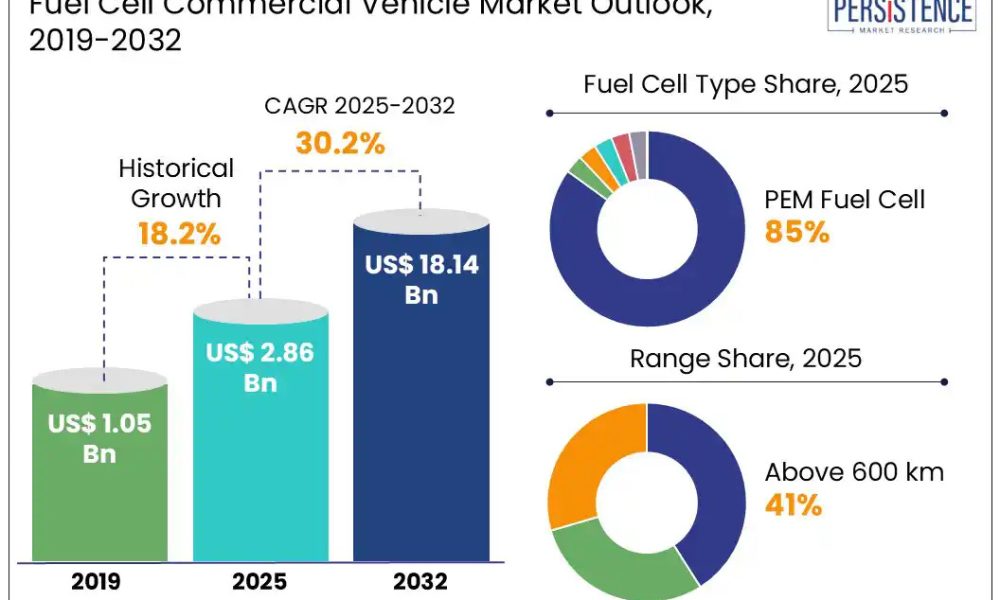
The global fuel cell commercial vehicle market is entering a transformative growth phase, fueled by rising environmental concerns, regulatory mandates, and accelerating investment in hydrogen infrastructure. According to insights from leading market research firms, the market is projected to be valued at US$ 2.86 billion in 2025 and is forecast to reach US$ 18.14 billion by 2032, registering a robust compound annual growth rate (CAGR) of 30.2% during the forecast period of 2025 to 2032. This exceptional growth trajectory underscores the increasing importance of fuel cell technologies in achieving zero-emission commercial transportation.
Fuel cell commercial vehicles utilize hydrogen fuel cells to generate electricity, offering significant advantages over conventional diesel-powered vehicles, including zero tailpipe emissions, faster refueling, longer driving range, and higher operational efficiency. Governments across North America, Europe, and Asia-Pacific are enforcing stringent greenhouse gas (GHG) emission standards, accelerating the shift toward hydrogen-powered mobility solutions. Incentives such as subsidies, tax benefits, hydrogen infrastructure development, and regulatory support are further encouraging manufacturers and fleet operators to adopt fuel cell technologies.
Moreover, the rising demand for sustainable freight transportation, expansion of logistics and e-commerce industries, and increasing investments in hydrogen production and distribution infrastructure are key factors propelling market growth. Fuel cell vehicles are particularly suitable for heavy-duty applications, including long-haul trucks, buses, and delivery fleets, where battery electric vehicles face limitations related to charging time and range.
Get Your FREE Sample Report Instantly Click Now: https://www.persistencemarketresearch.com/samples/35503
Key Highlights from the Report
➤ The global fuel cell commercial vehicle market is expected to grow from US$ 2.86 billion in 2025 to US$ 18.14 billion by 2032, at a CAGR of 30.2%.
➤ Increasing government regulations targeting carbon neutrality and emission reduction are significantly driving the adoption of hydrogen fuel cell vehicles.
➤ Heavy-duty trucks represent the fastest-growing segment due to their high energy requirements and need for long operational ranges.
➤ Asia-Pacific leads the market due to strong government initiatives and hydrogen infrastructure expansion.
➤ Technological advancements in fuel cell stacks, lightweight materials, and digital fleet management are enhancing vehicle performance and efficiency.
➤ Strategic partnerships among automakers, hydrogen providers, and technology companies are accelerating commercialization and infrastructure deployment.
Segmentation Analysis
By Type
The market is segmented into light-duty commercial vehicles, medium-duty commercial vehicles, and heavy-duty commercial vehicles. Among these, heavy-duty commercial vehicles dominate the market and are expected to experience the fastest growth throughout the forecast period. These vehicles, including freight trucks and long-haul transport vehicles, require high energy density and extended range capabilities, making hydrogen fuel cells an ideal solution. Unlike battery electric trucks, fuel cell vehicles offer faster refueling times and greater operational uptime, which is critical for logistics and transportation companies.
Medium-duty commercial vehicles, such as delivery trucks and municipal service vehicles, are also witnessing growing adoption due to increasing urban emission restrictions. Light-duty commercial vehicles are gaining traction in last-mile delivery applications, particularly in urban areas focused on sustainability.
By Vehicle/Product/Service Type
Based on vehicle type, the market includes fuel cell buses, trucks, vans, and specialty vehicles. Fuel cell trucks hold the largest share due to their extensive use in logistics, freight, and industrial transportation. Major logistics companies are transitioning toward hydrogen-powered fleets to meet sustainability goals and reduce operational emissions.
Fuel cell buses represent a significant segment, particularly in public transportation systems. Many cities worldwide are deploying hydrogen-powered buses to reduce air pollution and comply with environmental regulations. These buses offer quiet operation, zero emissions, and operational flexibility, making them ideal for urban transit.
By Propulsion and Technology
Proton exchange membrane fuel cells (PEMFC) dominate the technology segment due to their high efficiency, compact size, and suitability for automotive applications. Ongoing advancements in fuel cell stack durability, efficiency, and cost reduction are further enhancing adoption. Integration of digital technologies, including smart energy management systems and predictive analytics, is improving operational efficiency and reliability.
Regional Insights
Asia-Pacific currently leads the global fuel cell commercial vehicle market, driven by strong government support, large-scale hydrogen infrastructure investments, and proactive initiatives by leading economies such as Japan, South Korea, and China. National hydrogen strategies, subsidies for fuel cell vehicles, and infrastructure expansion programs have accelerated adoption across commercial fleets.
Europe represents the second-largest market, supported by aggressive decarbonization goals, strict emission standards, and large-scale hydrogen mobility initiatives. Countries such as Germany, France, and the Netherlands are investing heavily in hydrogen-powered transportation.
North America is expected to emerge as the fastest-growing region during the forecast period. The United States and Canada are witnessing increased investments in hydrogen infrastructure, zero-emission vehicle mandates, and growing partnerships between automakers and hydrogen suppliers. Expanding logistics networks and sustainability commitments by major fleet operators are further driving market growth.
Customize This Report for Your Exact Requirements: https://www.persistencemarketresearch.com/request-customization/35503
Unique Features and Innovations in the Market
Fuel cell commercial vehicles offer distinct advantages over conventional and battery electric vehicles, including longer driving ranges exceeding 500 miles, rapid refueling times comparable to diesel vehicles, and consistent performance across varying environmental conditions. These benefits make fuel cell vehicles particularly suitable for heavy-duty and long-distance applications.
Modern fuel cell vehicles are increasingly integrating advanced digital technologies such as artificial intelligence (AI), Internet of Things (IoT), and 5G connectivity. These technologies enable real-time vehicle monitoring, predictive maintenance, and optimized fleet management. AI-powered analytics help identify performance inefficiencies, while IoT sensors monitor fuel cell health, hydrogen consumption, and operational efficiency.
Additionally, advancements in hydrogen storage systems, lightweight composite materials, and modular fuel cell architectures are improving vehicle performance while reducing costs. These innovations are making fuel cell vehicles more commercially viable and competitive.
Market Highlights
The adoption of fuel cell commercial vehicles is driven primarily by sustainability goals and regulatory requirements. Governments worldwide are implementing stricter emission regulations to combat climate change and improve air quality. Hydrogen fuel cell vehicles offer a viable solution for achieving zero-emission transportation while maintaining operational efficiency.
Cost reductions in fuel cell components, increased hydrogen production, and infrastructure expansion are making fuel cell vehicles more accessible. Large-scale investments by public and private stakeholders are accelerating commercialization, while technological advancements continue to improve performance and reliability.
Furthermore, fuel cell vehicles support energy diversification by reducing dependence on fossil fuels and enabling the use of renewable hydrogen produced from solar, wind, and other sustainable sources.
Key Players and Competitive Landscape
The fuel cell commercial vehicle market is highly competitive, with leading automotive manufacturers, fuel cell technology providers, and hydrogen infrastructure companies actively investing in innovation and expansion.
✦ Toyota Motor Corporation is focusing on expanding its fuel cell module production and integrating hydrogen systems into heavy-duty commercial trucks and buses.
✦ Hyundai Motor Company is leading the commercialization of hydrogen-powered trucks through its XCIENT fuel cell platform and expanding deployment across global markets.
✦ Ballard Power Systems specializes in developing advanced fuel cell stacks and partnering with vehicle manufacturers to enable hydrogen mobility solutions.
✦ Plug Power Inc. is investing in hydrogen production infrastructure and fuel cell solutions to support commercial transportation and logistics applications.
✦ Nikola Corporation is accelerating deployment of hydrogen-powered trucks and expanding hydrogen refueling networks across North America.
✦ Daimler Truck AG is developing advanced hydrogen trucks and collaborating on fuel cell production through strategic joint ventures.
✦ Volvo Group is investing heavily in hydrogen fuel cell development and expanding its sustainable commercial vehicle portfolio.
Recent Developments
- Hyundai Motor Company expanded deployment of hydrogen-powered XCIENT trucks across Europe and North America, strengthening its leadership in hydrogen commercial mobility.
- Daimler Truck AG and Volvo Group accelerated fuel cell production through their joint venture, focusing on scaling hydrogen-powered heavy-duty truck manufacturing.
Ready to Dive Deep? Buy Full Report Today: https://www.persistencemarketresearch.com/checkout/35503
Future Opportunities and Growth Prospects
The future of the fuel cell commercial vehicle market remains highly promising, driven by rapid advancements in hydrogen production, infrastructure expansion, and fuel cell technology. Increasing investments in green hydrogen production are expected to significantly reduce hydrogen costs, making fuel cell vehicles more economically viable.
Technological advancements in fuel cell durability, efficiency, and system integration will further enhance performance and reduce operational costs. Governments worldwide are expected to continue implementing supportive policies, including subsidies, infrastructure investments, and regulatory mandates, accelerating market growth.
As industries prioritize sustainability and carbon neutrality, fuel cell commercial vehicles are expected to play a critical role in transforming the global transportation sector. Strategic collaborations, technological innovation, and expanding hydrogen ecosystems will continue to shape the future of this rapidly evolving market, positioning fuel cell commercial vehicles as a cornerstone of zero-emission logistics and transportation.




