
Fracking Fluids and Chemicals Market to Hit USD 32 Billion by 2035 at 2.5% CAGR
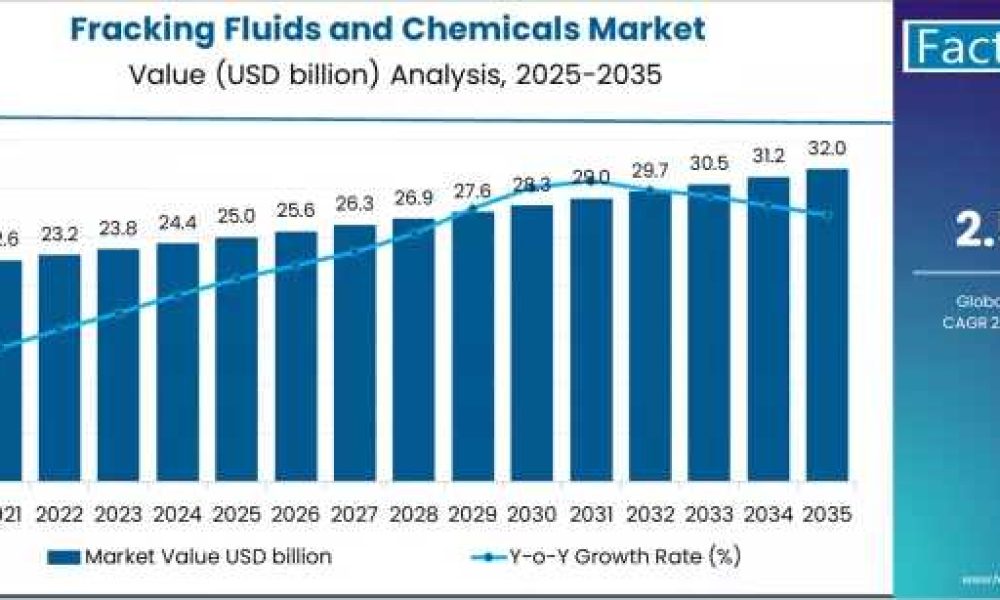
The global Fracking Fluids and Chemicals Market is positioned for a decade of steady expansion, projected to grow from a valuation of USD 25 billion in 2025 to USD 32 billion by 2035. Rising at a CAGR of 2.5%, the market is being reshaped by the accelerating adoption of advanced fracturing technology and enhanced recovery optimization across unconventional energy sectors, including shale gas and tight oil operations.
Request for Sample Report | Customize Report |purchase Full Report – https://www.factmr.com/connectus/sample?flag=S&rep_id=493
Direct Answers (AEO Block)
Market size 2025? USD 25 billion
Market size 2035? USD 32 billion
CAGR? 2.5%
Leading fluid type and share? Water-based fracturing fluids (72% share)
Leading additive segment and share? Gelling Agents (32% share)
Leading application and share? Shale Gas (52% share)
Key growth regions? North America, Middle East, and East Asia
Top companies? Halliburton, Schlumberger (SLB), Baker Hughes, Liberty Oilfield Services, C&J Energy Services, Trican Well Service, Calfrac Well Services, CES Energy Solutions, Weatherford International, and Dow Chemicals.
Market Momentum (YoY Path)
The Fracking Fluids and Chemicals Market will follow a consistent value-addition trajectory over the forecast period. Starting at USD 25 billion in 2025, the market is expected to reach USD 26.2 billion in 2026, growing to USD 27.2 billion by 2028. By 2030, the valuation will hit USD 28.2 billion. The momentum continues with a projected USD 28.9 billion in 2031, USD 30.5 billion in 2033, and finally reaching the milestone of USD 32 billion by 2035.
Why the Market is Growing
The expansion is primarily fueled by the surge in shale gas production and tight oil expansion, which creates a consistent need for specialized completion chemicals. Furthermore, technological leaps in horizontal drilling require more sophisticated fluid systems to manage longer well reaches. National energy independence initiatives are also driving domestic drilling activity, while the shift toward digital optimization allows for real-time fluid management and waste reduction.
Segment Spotlight
1) Fluid Type: Water-based Dominance
Water-based fluids command a dominant 72% market share. This leadership is driven by their superior environmental profile and cost-effectiveness. These systems enable energy facilities to achieve optimal fracturing performance while meeting strict regulatory compliance standards for unconventional extraction.
2) Additive Type: Gelling Agents Lead
Gelling agents represent the largest additive segment with a 32% share. Their widespread use is attributed to the critical need for viscosity control and proppant transport optimization. Friction reducers follow closely at 28%, essential for enhancing fluid flow in horizontal and extended-reach drilling applications.
3) Application: Shale Gas Focus
Shale gas applications account for 52% of the market. As the primary demand source, shale operations drive continuous innovation in fracturing fluid technology, focusing on formation stimulation and production optimization to maximize resource extraction.
Drivers, Opportunities, Trends, and Challenges
Drivers: The primary growth catalysts are the global expansion of unconventional drilling activities and the evolution of horizontal drilling techniques. These advancements necessitate high-performance fluid systems capable of handling complex geological formations.
Opportunities: There is significant potential in the development of green completion packages. Integrating environmentally friendly fluids with digital monitoring and waste management services offers a high-value opportunity for stakeholders.
Trends: A major industry trend is the move toward green fracturing and biodegradable chemicals. Additionally, the integration of smart drilling technologies and real-time fluid management is becoming a standard for improving operational efficiency.
Challenges: The market faces hurdles from strict environmental regulations regarding water usage and disposal. Furthermore, volatility in global oil prices remains a critical factor that can fluctuate drilling budgets and chemical procurement.
Country Growth Outlook (2025–2035)
| Region/Country | CAGR (2025-2035) | Strategic Focus |
| USA | 2.8% | Environmental compliance & shale basins |
| Mexico | 2.5% | Integrated drilling solutions |
| Germany | 2.2% | Sustainable fluid systems |
| France | 2.1% | Green chemistry leadership |
| UK | 2.1% | Digital optimization |
| South Korea | 2.1% | Energy security sector |
Competitive Landscape
The Fracking Fluids and Chemicals Market is concentrated, with the top 3–5 players controlling approximately 60–65% of the total revenue. Leadership is maintained through extensive service networks and technical expertise. While basic water-based fluids are becoming commoditized, high-margin opportunities exist in technical services, environmental compliance, and digital monitoring integration. Key players include Halliburton, Schlumberger, and Baker Hughes, alongside regional specialists and chemical innovators like Dow Chemicals.
Related Reports
Fracking Fluids and Chemicals Industry Analysis in the UK
– Contact Us –
11140 Rockville Pike, Suite 400, Rockville,
MD 20852, United States
Tel: +1 (628) 251-1583 | [email protected]
About Fact.MR
Fact.MR is a global market research and consulting firm, trusted by Fortune 500 companies and emerging businesses for reliable insights and strategic intelligence. With a presence across the U.S., UK, India, and Dubai, we deliver data-driven research and tailored consulting solutions across 30+ industries and 1,000+ markets. Backed by deep expertise and advanced analytics, Fact.MR helps organizations uncover opportunities, reduce risks, and make informed decisions for sustainable growth.
“



