
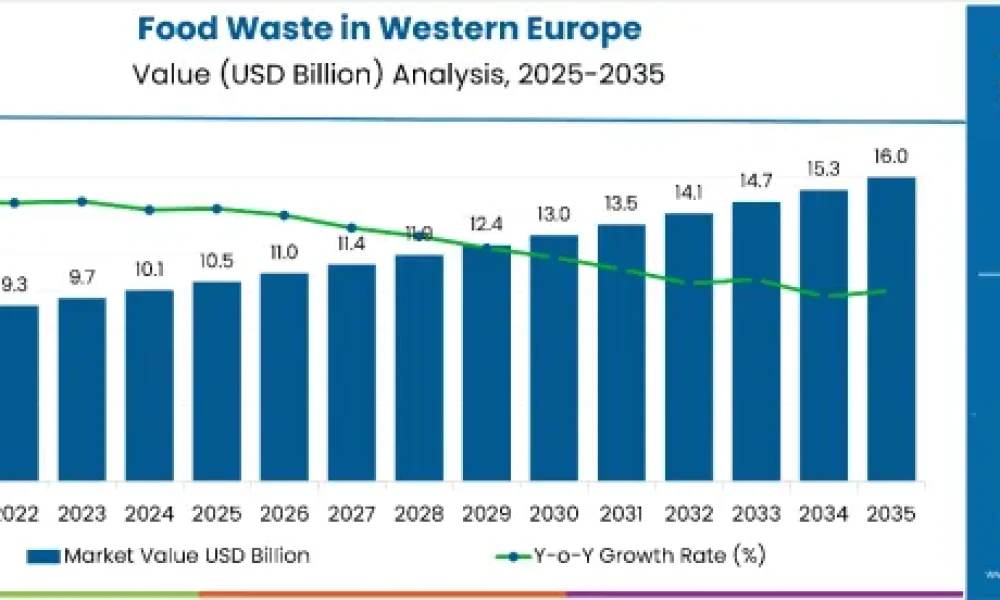
The Western Europe products-from-food-waste market is entering a decisive growth phase as sustainability transitions from policy ambition to commercial reality. Sales of products derived from food waste in the region are estimated at USD 10.5 billion in 2025 and are projected to reach USD 16 billion by 2035, expanding at a compound annual growth rate (CAGR) of 4.3% over the forecast period.
This growth reflects a convergence of stricter environmental regulations, rising corporate commitments to circular economy models, and rapid technological advances in waste valorization. Food waste is no longer viewed as a cost burden but increasingly as a scalable raw material for value-added products across food processing, beverages, cosmetics, animal feed, and nutraceutical applications.
Environmental Regulation and Technology Drive Structural Demand
Western Europe continues to lead globally in waste reduction frameworks and circular economy adoption. Government mandates aimed at landfill diversion, emissions reduction, and resource efficiency are pushing food manufacturers and processors to integrate waste valorization into core operations.
At the same time, technological progress in extraction, bioconversion, and biorefinery processes has significantly improved yield efficiency, product consistency, and cost competitiveness. These advances are enabling broader commercial adoption, even in applications that previously faced economic or quality constraints.
Market Snapshot: Western Europe Food Waste Valorization
- Market Value (2025): USD 10.5 billion
- Forecast Value (2035): USD 16 billion
- Forecast CAGR (2025–2035): 4.3%
- Leading Source Segment (2025): Citrus fruits (19% share)
- Leading Application Segment (2025): Food processing (24% share)
- Fastest-Growing Countries: United Kingdom, Spain
Request for Sample Report | Customize Report | Purchase Full Report – https://www.futuremarketinsights.com/reports/brochure/rep-gb-18275
Food Processing Anchors Market Stability
Food processing remains the largest application segment, accounting for 24% of total sales in 2025. Regulatory pressure to reduce waste, combined with strong cost-efficiency incentives, continues to drive recovery of fibers, pectin, antioxidants, and functional ingredients from food waste streams.
Beverage processing follows closely, supported by demand for natural flavors and functional compounds. Meanwhile, cosmetics, personal care, and nutraceutical applications are expanding rapidly, benefiting from rising consumer preference for plant-based, eco-friendly, and traceable ingredients.
Citrus Waste Leads by Source
By source, citrus fruits hold a dominant 19% value share in 2025, driven by high waste volumes generated from juice production and mature extraction technologies. Citrus waste is widely used to produce essential oils, pectin, dietary fibers, and bioactive compounds.
Other significant contributors include:
- Apples (16%), leveraging established pomace processing for fibers and antioxidants
- Grapes (14%), driven by wine industry waste used in polyphenol and grape seed oil extraction
- Carrots (12%), supporting carotenoid recovery for functional foods and supplements
- Mango (11%), benefiting from expanding tropical fruit processing and improved extraction methods
Country-Level Growth Shows Diverging Momentum
Demand for products from food waste is expanding across all major Western European markets, though growth rates vary based on infrastructure maturity and innovation intensity.
- United Kingdom: Fastest growth at 5.6% CAGR, driven by rapid technology adoption, anaerobic digestion expansion, and strong startup activity
- Spain: 4.8% CAGR, supported by fruit processing expansion and renewable energy integration
- Italy: 4.5% CAGR, leveraging agricultural waste utilization and Mediterranean product specialization
- France: 4.2% CAGR, focused on premium food, cosmetic, and gourmet ingredient applications
- Germany: 3.4% CAGR, reflecting a mature market with growth driven by optimization rather than capacity expansion
Germany remains the region’s largest processing hub, with per capita valorization projected to rise from 18.7 kg in 2025 to 28.4 kg by 2035, supported by strong regulatory enforcement and advanced infrastructure.
Innovation Expands Application Scope
Continued innovation in biorefinery technology is widening the commercial scope of food waste valorization. Applications are expanding beyond food and feed into cosmetics, pharmaceuticals, biofuels, and bioplastics, enhancing revenue diversification and long-term market resilience.
Per capita consumption of food waste-derived products across leading Western European countries is expected to rise from 15.2–18.7 kg in 2025 to 23.1–28.4 kg by 2035, highlighting growing acceptance across both industrial and consumer markets.
Competitive Landscape: Scale Meets Innovation
The competitive environment combines large-scale waste management leaders with agile technology-driven innovators. Major players such as Veolia Environment, SUEZ, Renewi, Biogen, and ReFood leverage integrated collection, processing, and valorization capabilities to serve diverse end-use industries.
At the same time, startups including Bio-bean Ltd., GroCycle, and Toast Ale Ltd. are pushing innovation in niche applications, from coffee waste upcycling to brewing by-product utilization, accelerating commercialization of circular business models.
Outlook
Between 2025 and 2035, Western Europe’s products-from-food-waste market is expected to transition from early-stage adoption to mainstream industrial integration. As regulation tightens, technology matures, and sustainability becomes a competitive differentiator, food waste valorization will play a central role in shaping the region’s circular economy. The market’s steady growth trajectory underscores its importance not only as an environmental solution, but as a durable, revenue-generating industry.
About Future Market Insights (FMI)
Future Market Insights, Inc. (FMI) is an ESOMAR-certified, ISO 9001:2015 market research and consulting organization, trusted by Fortune 500 clients and global enterprises. With operations in the U.S., UK, India, and Dubai, FMI provides data-backed insights and strategic intelligence across 30+ industries and 1,200 markets worldwide.
Contact Us:
Future Market Insights Inc.
Christiana Corporate, 200 Continental Drive,
Suite 401, Newark, Delaware – 19713, USA
T: +1-347-918-3531
For Sales Enquiries: [email protected]



