
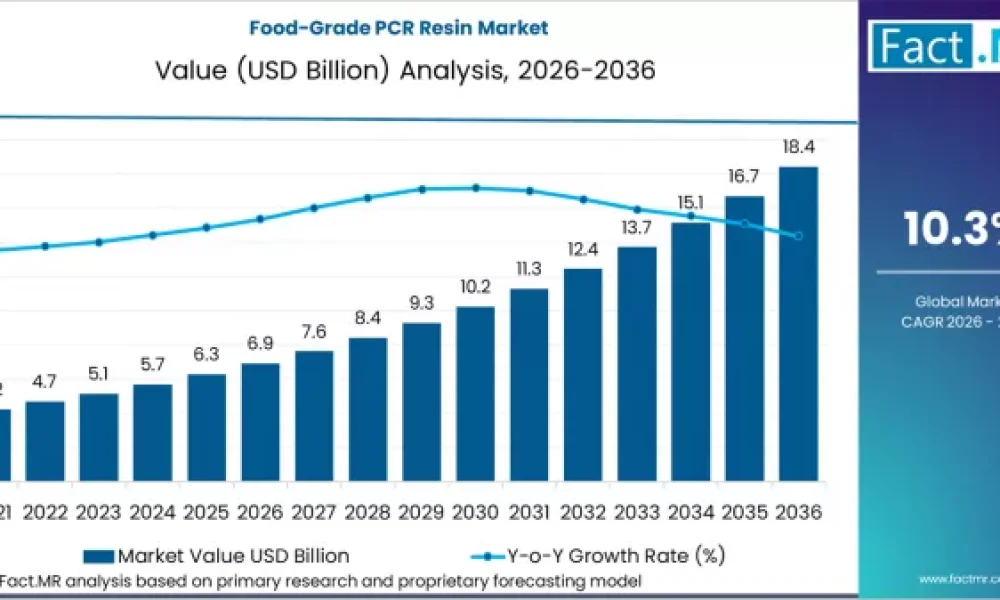
The global food-grade post-consumer recycled (PCR) resin market is entering a pivotal year of expansion, driven by the convergence of aggressive corporate sustainability deadlines and a wave of new government mandates for recycled plastic content. As major beverage and food brands race to fulfill 2025–2026 “circularity pledges,” the market is projected to reach an estimated USD 6.9 billion by the end of 2026, growing toward a projected USD 18.4 billion valuation by 2036.
The “Who, What, and How” of the 2026 market reflects a fundamental shift from voluntary environmentalism to high-stakes compliance. Leading manufacturers such as Amcor, Alpla, Berry Global, and Dow are currently spearheading the deployment of food-safe recycled PET, HDPE, and PP, utilizing advanced mechanical and chemical decontamination technologies to meet rigorous FDA and EFSA safety standards.
Request for Sample Report | Customize Report |purchase Full Report – https://www.factmr.com/connectus/sample?flag=S&rep_id=13897
Regulatory Catalysts: The 2026 Compliance Deadline
The primary driver behind this year’s market surge is the enforcement of minimum recycled content laws. In the United States, several state-level mandates are hitting critical thresholds:
- Washington (SB 5022): Requires plastic beverage bottles to contain at least 25% PCR starting in 2026.
- Maine (LD 1467): Joins the 25% mandate for beverage containers effective this year.
- California (AB 793): Maintains its 25% requirement for beverage bottles while expanding Extended Producer Responsibility (EPR) reporting.
“The market is moving from a ‘nice-to-have’ feature to a ‘license-to-operate’ requirement,” says a lead industrial analyst. “For global CPGs, the inability to secure food-grade PCR in 2026 doesn’t just impact their green credentials—it leads to direct financial penalties and market-access restrictions.”
Technological Shift: Beyond Traditional PET
While Recycled PET (rPET) continues to dominate the market with a 46.5% share due to its established bottle-to-bottle loops, 2026 marks the “breakout year” for polyolefins.
- Food-Grade Polypropylene (PP): New “Advanced Recycling” (chemical recycling) facilities are finally reaching commercial scale, unlocking food-safe rPP for dairy tubs and snack packaging that mechanical recycling previously couldn’t achieve.
- High-Purity Decontamination: Next-generation washing and extrusion systems have reduced “sensory drift” (odors and discoloration), allowing PCR to be used in sensitive applications like baby food and dairy packaging.
- Traceability: The integration of blockchain and third-party certifications, such as APR PCR Certification, is now standard to prevent the “greenwashing” of non-food-grade materials into the food supply chain.
Market Dynamics: Regional Growth and Supply Gaps
The Asia-Pacific region has emerged as the largest market, commanding 38.5% of global demand, driven by massive e-commerce growth in India and China. However, Europe remains the leader in regulatory sophistication and high-purity resin adoption.
Despite the growth, the industry faces a “bottleneck of abundance”—there is high demand, but a persistent shortage of high-quality feedstock. By 2026, recycled food-grade resins are projected to maintain a 20% price premium over virgin plastics, as procurement teams shift toward long-term contracts to secure guaranteed volumes of audited material.
Future Outlook: Toward a 25% Global Standard
As the industry moves through 2026, the focus is shifting toward “B2B closed loops,” where brands partner directly with recyclers to reclaim their own packaging. With the global consumption of food-grade PCR material projected to hit 6.69 million tonnes by 2029, the focus for the next 24 months will be on scaling collection infrastructure to feed the massive decontamination capacities currently coming online.
About the Market Report: This summary provides an authoritative overview of the food-grade PCR resin sector, synthesizing current 2026 market data, regulatory timelines, and technological benchmarks. The information reflects the intersection of chemical engineering, global logistics, and environmental policy.
About Fact.MR
Fact.MR is a global market research and consulting firm, trusted by Fortune 500 companies and emerging businesses for reliable insights and strategic intelligence. With a presence across the U.S., UK, India, and Dubai, we deliver data-driven research and tailored consulting solutions across 30+ industries and 1,000+ markets. Backed by deep expertise and advanced analytics, Fact.MR helps organizations uncover opportunities, reduce risks, and make informed decisions for sustainable growth.



