
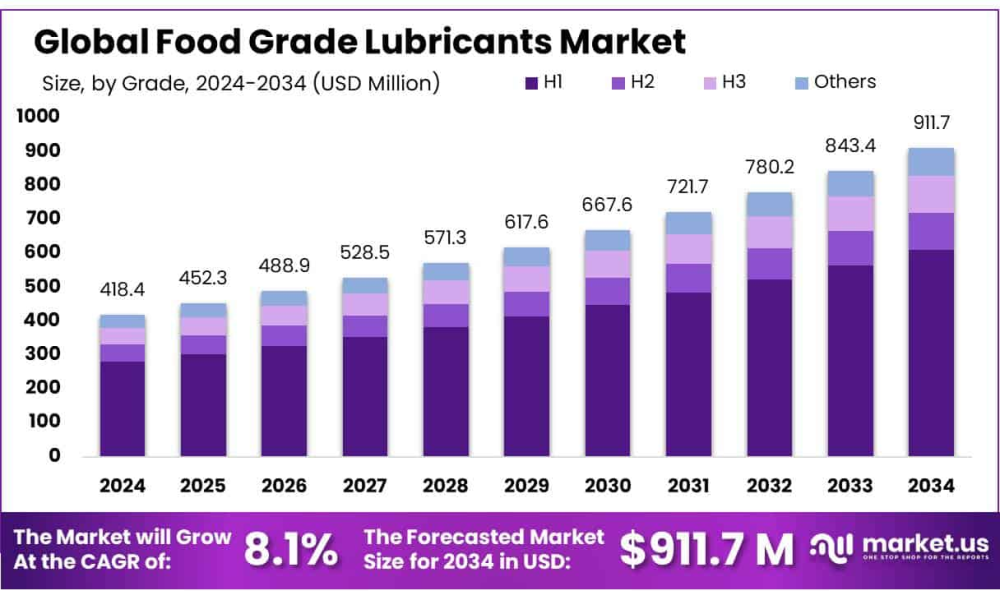
New York, NY – July 11, 2025 – The Global Food Grade Lubricants Market is growing fast, driven by strict food safety rules and the rising demand for processed foods. In 2024, the market was valued at USD 418.4 million and is expected to reach USD 911.7 million by 2034, growing at a strong 8.1% CAGR from 2025 to 2034.
These lubricants are specially made to be safe for food production, preventing contamination while keeping machines running smoothly. The market is expanding due to increasing hygiene standards in food processing, especially in the dairy, meat, and beverage industries. Growth is also supported by the rising popularity of packaged and ready-to-eat foods, which need safe lubrication in manufacturing.
Opportunities are growing in emerging markets where food processing industries are expanding, along with advancements in bio-based and synthetic lubricants. Companies are investing in R&D to create more efficient, eco-friendly products, further boosting market demand. With stricter regulations and higher consumer awareness, the food-grade lubricants market is set for steady growth, offering significant opportunities for manufacturers and suppliers worldwide.
Important Revelation
- Food Grade Lubricants Market size is expected to be worth around USD 911.7 Mn by 2034, from USD 418.4 Mn in 2024, growing at a CAGR of 8.1%.
- H1 grade food lubricants firmly established themselves at the forefront of the market, securing a commanding 67.20% share.
- Mineral-based food lubricants commanded a significant presence in the market, holding a 43.40% share.
- Food-grade oils held a dominant market position, capturing more than a 44.50% share.
- Low viscosity food grade lubricants market captured a substantial market share of 37.50%.
- The food sector held a dominant position in the food grade lubricants market, capturing a significant 57.50% share.
- Europe demonstrated a robust presence in the food-grade lubricants market, capturing a significant 43.20% share, valued at approximately USD 180.7 million.
➤ Download Exclusive Sample Of This Premium Report (Including Full TOC, Table & Figures): https://market.us/report/global-food-grade-lubricants-market/request-sample/
Report Segmentation
By Grade
- In 2024, H1 grade food lubricants dominated the market, securing a substantial 67.20% share. These lubricants are extensively used in food processing operations due to their compliance with stringent regulatory standards, which allow incidental contact with food without compromising safety.
- Their widespread adoption is driven by their essential role in ensuring smooth machinery performance while adhering to food safety regulations. Growing manufacturer awareness regarding legal and health compliance has further reinforced their demand. The reliability and safety profile of H1 lubricants continue to make them the preferred choice for maintaining hygienic and efficient processing environments.
By Type
- In 2024, mineral-based food lubricants commanded a significant 43.40% share of the global market. Known for their cost-effectiveness and broad availability, these lubricants are commonly utilized in applications involving incidental food contact. Derived from refined petroleum, they provide consistent lubrication performance across a variety of operating conditions.
- Their ability to support machinery reliability while meeting baseline food safety standards makes them an attractive option for manufacturers prioritizing both efficiency and economic value. This strong market presence underscores their continued relevance in routine food processing applications.
By Product Type
- In 2024, food-grade oils emerged as the leading product type, capturing a 44.50% share of the market. Their popularity stems from their versatility and suitability for a broad range of food processing applications, including conveyors, mixers, and cutting machinery.
- These oils are engineered to perform reliably under high-temperature conditions and ensure extended equipment lifespan without compromising safety. Their ability to withstand rigorous operating environments while minimizing contamination risks has made them a crucial component of compliant and efficient food production systems.
By Viscosity Range
- Low viscosity food grade lubricants market held a dominant 37.50% share of the market in 2024, reflecting their widespread use in high-speed, low-load machinery. Their superior flow characteristics and ease of application enable thorough equipment coverage, especially in automated systems.
- These lubricants perform well at lower temperatures and help reduce mechanical wear while preventing residue buildup. Their operational benefits, coupled with compliance with food safety standards, continue to support their growing utilization in modern food processing facilities.
By End-use
- In 2024, the food industry remained the largest end-use segment for food grade lubricants market, accounting for 57.50% of total market demand. This dominance is attributed to the sector’s strict hygiene requirements and the need for lubricants that meet food safety certifications.
- Key industries such as dairy, baking, beverages, and meat processing rely heavily on these lubricants to ensure smooth equipment operation and prevent contamination. Their role in maintaining production continuity and regulatory compliance highlights their indispensable value across food manufacturing operations.
Market Key Segmentation
By Grade
- H1
- H2
- H3
- Others
By Type
- Mineral
- Synthetic
- Polyalphaolefins (PAOs)
- Polyalkylene glycols (PAGs)
- Esters
- Others
- Bio-based
By Product Type
- Oil
- Grease
- Aerosol
By Viscosity Range
- Low
- Medium
- High
By End-use
- Food
- Bakery & Confectionery
- Dairy
- Meat, Poultry, & Seafood
- Animal Feed and Pet Food
- Sugar
- Others
- Beverage
- Carbonated Soft Drinks
- Fruit Beverages
- Sports Drinks
- Alcoholic Beverages
- Others
- Pharmaceuticals
- Cosmetics
- Others
Regional Analysis
In 2024, Europe held a commanding 43.20% share of the global food grade lubricants market, valued at approximately USD 180.7 million. This leadership stems from the region’s rigorous regulatory framework, enforced by bodies like the European Food Safety Authority (EFSA), which mandates high-standard lubricants to ensure safety and quality in food processing.
Europe’s commitment to sustainability further shapes market trends, with increasing demand for bio-based, eco-friendly lubricants that align with the EU’s stringent environmental policies and the European Green Deal. This focus drives innovation, promoting advanced lubricants that balance performance with minimal environmental impact.
The region’s well-established food and beverage sector, led by countries like Germany, France, Italy, and the UK, also fuels demand. These nations, home to major global food processing companies, rely heavily on food grade lubricants market to ensure operational efficiency while meeting strict regional and international safety standards.
Competitive Landscape
- DuPont de Nemours, Inc.
- CONDAT group
- TotalEnergies
- Exxon Mobil Corporation
- CITGO Petroleum Corporation
- FUCHS Group
- Petro-Canada Lubricants Inc.
- Kluber Lubrication
- SKF
- Lanxess AG
- Clearco Products Co., Inc.
- The Lubrizol Corporation
- Elba Lubrication Inc.
- Other Key Players
Get in Touch with Us:
Market.us (Powered By Prudour Pvt. Ltd.)
Address: 420 Lexington Avenue, Suite 300, New York City, NY 10170, United States
Send Email: [email protected]
Refer To More Related Reports:
Corrugated Bulk Bins Market
Nano-Fertilizers Market
Botanicals Market



