
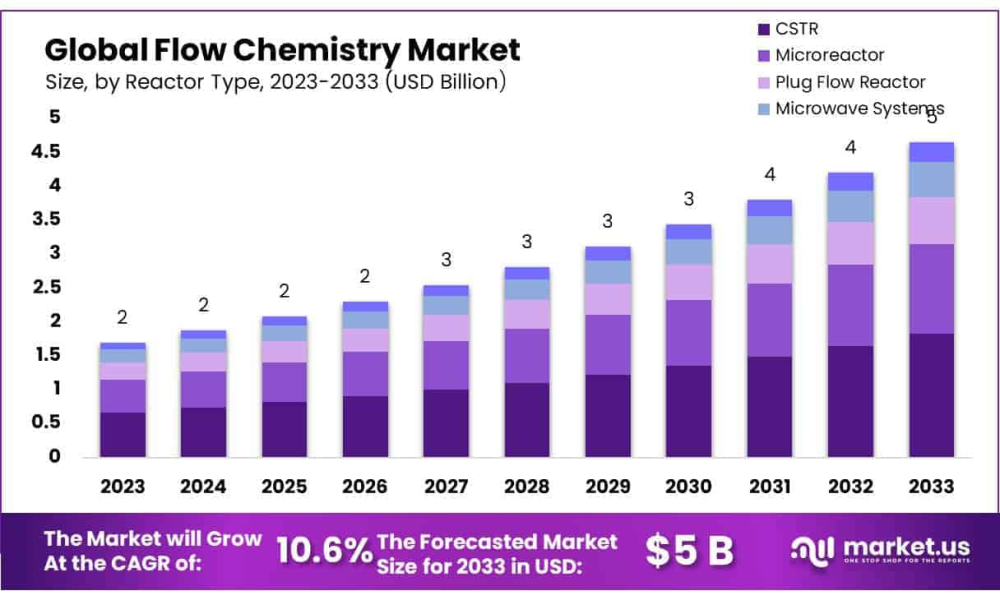
New York, NY – July 11, 2025 – The Global Flow Chemistry Market is gaining strong popularity due to its efficiency, safety, and scalability in chemical production. In 2024, the market was valued at USD 1.7 billion and is expected to reach USD 4.6 billion by 2034, growing at a steady CAGR of 10.6% from 2025 to 2034.
This growth is driven by increasing demand from industries like pharmaceuticals, agrochemicals, and specialty chemicals, where continuous flow processes offer faster reactions, reduced waste, and better control compared to traditional batch methods. Market demand is rising as companies seek cost-effective and sustainable manufacturing solutions.
Key growth factors include advancements in microreactor technology, government support for green chemistry, and the need for faster drug development. The market is also expanding due to opportunities in emerging regions, where industries are adopting modern production techniques. Additionally, the ability of flow chemistry market to handle hazardous reactions safely makes it a preferred choice, boosting its market expansion. With ongoing innovations and increasing investments, the flow chemistry market is set to play a crucial role in the future of chemical manufacturing.
Important Revelation
- Report Scope: The Flow Chemistry market is expected to grow to around USD 4.6 billion by 2033, from USD 1.7 billion in 2023, showcasing a CAGR of 10.6% during the forecast period from 2023 to 2033.
- Reactor Type Analysis: Continuous Stirred-Tank Reactors (CSTRs) dominated in 2023, holding over 39.2% market share due to their adaptability and consistency in conducting various chemical processes.
- Application Insights: Chemicals sector dominated the market (38.7%), followed by Pharmaceuticals (29.4%) and Petrochemicals (21.5%), showcasing diverse applications and acceptance of flow chemistry market techniques.
- Drivers: Global pharmaceutical industry progress, particularly in emerging economies like China and India, is a significant driver. Continuous flow technology also reduces manufacturing stages, cutting costs significantly.
- Challenges: A limited supply of reagents and catalysts poses challenges. Disruptions during events like the COVID-19 pandemic caused global shortages, impacting the flow of chemistry applications.
- Regional Analysis: North America held the largest market share (37.5%) in 2023, driven by pharmaceutical and chemical product demand, while APAC is expected to witness the highest CAGR of 11.9%.
➤ Download Exclusive Sample Of This Premium Report (Including Full TOC, Table & Figures): https://market.us/report/flow-chemistry-market/request-sample/
Report Segmentation
Reactor Type Analysis
- In 2023, Continuous Stirred-Tank Reactors (CSTRs) led the flow chemistry market, commanding over 39.2% of the market share. Known for their versatility, CSTRs feature a well-mixed tank where reactants are continuously introduced, blended, and withdrawn during reactions. Their adaptability ensures consistent and controlled conditions, making them ideal for a wide range of chemical processes.
- Beyond CSTRs, the market includes other reactor types such as Wet Chemical, Direct, Indirect, and specialized reactors, each tailored to specific applications. These reactors provide unique advantages, addressing niche requirements in flow chemistry and contributing to the Flow Chemistry market diversity.
- CSTRs’ dominance reflects their efficiency and reliability in continuous chemical reactions, while other reactor types enhance the market by catering to specialized processes, offering varied solutions for flow chemistry applications.
Purification Method Analysis
- In 2023, Powder purification led the flow chemistry market, securing a significant share due to its versatility and ease of use in various chemical processes. This method excels in delivering efficient and reliable purification, making it a preferred choice in flow chemistry. Pellets and Liquid purification methods held smaller market shares.
- Pellets are valued for their controlled-release properties and specific shapes suited for targeted applications, while Liquid purification is favored in cases requiring effective dispersion. Powder’s prominence highlights its broad applicability and effectiveness in purification processes, reinforcing its critical role across diverse chemical reactions and industries in the flow chemistry market.
Application Analysis
- In 2023, the Chemicals sector dominated the flow chemistry market, capturing over 38.7% of the market share. Flow chemistry techniques enhanced efficiency and streamlined production in synthesizing various chemical compounds. Pharmaceuticals followed with a 29.4% share, leveraging flow chemistry for precise synthesis and improved efficiency in drug development. Petrochemicals accounted for approximately 21.5% of the market, utilizing flow chemistry for refining and synthesizing petrochemical products.
- Academia, research, and other sectors contributed to the remaining share, with flow chemistry market gaining traction for driving scientific discoveries and innovations across multiple fields. The Chemicals sector’s lead underscores flow chemistry’s widespread adoption, while its applications in Pharmaceuticals, Petrochemicals, and other areas highlight the technology’s versatility, fostering advancements and efficiencies across diverse industries.
Market Key Segmentation
Reactor Type
- CSTR (Continuous stirred-tank reactor)
- Microreactor
- Plug Flow Reactor
- Microwave Systems
- Others
By Purification Method
- Crystallization
- Distillation
- Liquid-Liquid Extraction
- Membrane Filtration
- Others
Application
- Pharmaceuticals
- Academia & Research
- Chemicals
- Petrochemicals
- Others
Regional Analysis
In 2023, North America led the global flow chemistry market, capturing over 37.5% of the revenue. Growth in the region was driven by rising demand for pharmaceutical and chemical products, alongside increased investments in flow chemistry R&D, particularly for continuous processing.
The Asia-Pacific (APAC) region is projected to achieve the highest CAGR of 11.9% during the forecast period. This growth is fueled by increased government investment in pharmaceutical production to meet rising demand for generic drugs, coupled with a positive outlook for the chemical and petrochemical sectors.
In Europe, the pharmaceutical industry is focusing on medical R&D, supported by a robust regulatory and incentive framework that promotes innovation. The flow chemistry market enables cost-effective drug production, making it increasingly popular among European pharmaceutical manufacturers.
In Brazil, rising oil production and investments in the pharmaceutical sector are expected to drive industry growth. Additionally, a growing emphasis on biotechnology and the adoption of sustainable, green production processes will further support the expansion of the flow chemistry market.
Competitive Landscape
- Am Technology
- CEM Corporation
- Milestone Srl
- Biotage AB
- Syrris Ltd.
- Vapourtec Ltd.
- ThalesNano Inc.
- Hel Group
- Uniqsis Ltd.
- Chemtrix BV
- Ehrfeld Mikrotechnik BTS
- Future Chemistry Holding BV
- Corning Incorporated
- Cambridge Reactor Design Ltd.
- PDC Machines Inc.
- Parr Instrument Company
Get in Touch with Us:
Market.us (Powered By Prudour Pvt. Ltd.)
Address: 420 Lexington Avenue, Suite 300, New York City, NY 10170, United States
Send Email: [email protected]
Refer To More Related Reports:
Carbon Trading Market
Corrugated Bulk Bins Market
Nano-Fertilizers Market



