
Market Overview
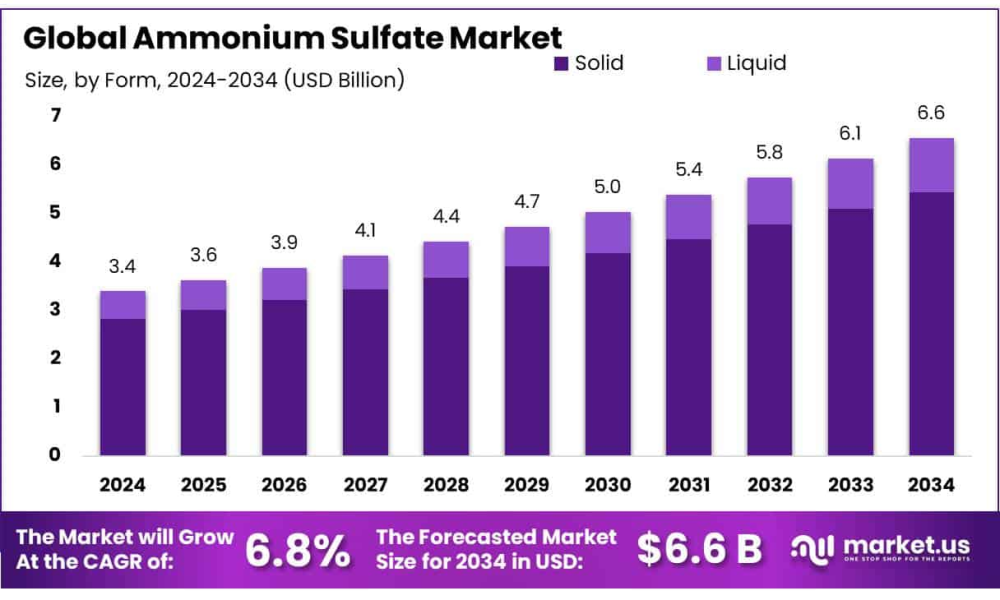
The global ammonium sulfate market is projected to grow from USD 3.4 billion in 2024 to approximately USD 6.6 billion by 2034, expanding at a steady CAGR of 6.8% during the forecast period from 2025 to 2034. Ammonium sulfate ((NH₄)₂SO), an inorganic salt, is widely used in agriculture for its ability to enhance soil nitrogen and sulfur levels—both essential nutrients for healthy plant growth. As global demand for high-yield crops rises, the use of ammonium sulfate has become increasingly important, solidifying its position as one of the most commonly used nitrogen-based fertilizers worldwide.
Approximately 70% of ammonium sulfate consumption is attributed to the fertilizer industry, with the remaining demand coming from sectors such as pharmaceuticals, textiles, and water treatment, where the compound is used in various chemical processes. Major production hubs include China, the United States, and Europe, with China alone accounting for over 35% of the global output, underscoring its dominant role in the market.
The market’s growth is being fueled by the increasing need to improve agricultural productivity in response to rising global food requirements. According to the United Nations, the world population is expected to reach 9.7 billion by 2050, creating significant pressure on food systems. In many regions, intensive farming practices have led to sulfur-deficient soils, making ammonium sulfate a key input for restoring soil fertility and ensuring consistent crop yields. This makes the compound vital not only for meeting present agricultural needs but also for supporting long-term food security and sustainable farming practices.
Important Revelation
- Market Growth Projection: The Ammonium Sulfate Market is expected to witness significant growth, reaching around USD 6.6 billion by 2034 from USD 3.4 billion in 2024, exhibiting a projected CAGR of 6.8%.
- Solid ammonium sulfate held a dominant market position, capturing more than an 83.40% share.
- Caprolactam held a dominant market position, capturing more than a 43.30% share of the ammonium sulfate market by production process.
- Fertilizers held a dominant market position, capturing more than a 67.30% share of the ammonium sulfate market.
- Asia Pacific (APAC) region, which will capture a dominant share of 39.40%, equating to a market value of approximately $1.3 billion.
Download Exclusive Sample Of This Premium Report (Including Full TOC, Table & Figures): https://market.us/report/ammonium-sulfate-market/free-sample/
Factors Affecting the Growth of Ammonium Sulfate Market
- Rising Global Food Demand and Agricultural Productivity: One of the primary drivers of the ammonium sulfate market is the increasing global population, projected by the United Nations to reach 9.7 billion by 2050. This growth is creating a sustained need for higher agricultural output, thereby increasing the demand for nitrogen- and sulfur-based fertilizers like ammonium sulfate. It plays a critical role in enhancing soil fertility and crop yield, particularly in sulfur-deficient regions.
- Sulfur-Deficient Soils Due to Intensive Farming: Modern intensive farming practices and the widespread use of high-analysis NPK fertilizers (which often lack sulfur) have led to sulfur depletion in soils, particularly in regions like Asia-Pacific and parts of Africa. Ammonium sulfate, containing 24% sulfur and 21% nitrogen, is widely used to correct this deficiency, further driving its adoption in agriculture.
- Growth in Industrial Applications: While agriculture remains the dominant application, the industrial segment is steadily expanding. Ammonium sulfate is used in water treatment, flame retardants, pharmaceuticals, food additives, and textiles. Its role as a protein precipitant in biotechnology and as a coagulant in wastewater treatment systems is contributing to non-agricultural demand growth.
- Expansion of Fertilizer Production in Emerging Economies: Countries like India, Brazil, and Indonesia are investing in fertilizer production and agricultural infrastructure to meet local demand and reduce dependency on imports. This expansion enhances the regional ammonium sulfate market and encourages international trade, particularly from major producers like China (which alone accounts for over 35% of global production).
- Price Volatility of Raw Materials and By-Product Dependency: A significant portion of global ammonium sulfate is produced as a by-product of caprolactam (used in nylon production), and to a lesser extent from coal combustion and steel manufacturing. Fluctuations in the production of these primary products can directly impact ammonium sulfate availability and pricing, introducing volatility to the market.
- Environmental Regulations and Shift Toward Sustainable Practices: Environmental regulations that limit sulfur dioxide emissions and promote sustainable farming are pushing the adoption of fertilizers that restore sulfur balance in soil. Ammonium sulfate fits well within this context. However, stricter controls on industrial waste and emissions can also increase operational costs for producers.
Report Segmentation
By Form Analysis – Solid Ammonium Sulfate Leads with 83.40% Share in 2024
In 2024, solid ammonium sulfate held a commanding position in the market, accounting for more than 83.40% of the total share. Its dominance is primarily driven by its widespread application in agriculture, where it serves as an effective nitrogen and sulfur-based fertilizer. Solid ammonium sulfate is especially favored for large-scale farming due to its ease of storage, handling, and controlled distribution. Its granulated or crystalline form allows for precise application in soil enhancement, making it the go-to choice for improving crop productivity and soil health in various agricultural settings.
By Production Process – Caprolactam Process Dominates with 43.30% Share in 2024
In 2024, the caprolactam-based production process accounted for more than 43.30% of the global ammonium sulfate market. Caprolactam, used in the production of nylon, generates ammonium sulfate as a byproduct, making it a significant contributor to overall supply. This linkage with the synthetic fiber industry has made caprolactam-based production a stable and large-scale source for ammonium sulfate, especially in regions with strong manufacturing infrastructure.
By Application Analysis – Fertilizers Dominate with 67.30% Market Share in 2024
Fertilizers continued to be the primary application for ammonium sulfate in 2024, commanding over 67.30% of total market demand. As a dual-source fertilizer offering both nitrogen and sulfur, ammonium sulfate plays a vital role in improving soil fertility and supporting crop yield. Its widespread use in global agriculture, particularly in sulfur-deficient soils, drives consistent and high-volume demand, making it an essential component of modern farming systems.
To Purchase this Premium Report@ https://market.us/purchase-report/?report_id=38253
Market Key Segmentation
By Form
- Solid
- Liquid
By Production Process
- Caprolactam
- Coke Oven Gas
- Gypsum
- Neutralization
- Others
By Application
- Fertilizers
- Water Treatment
- Pharmaceuticals
- Food & Feed Additives
- Other Applications
Regional Analysis
In 2024, the Asia Pacific (APAC) region is expected to lead the global ammonium sulfate market, capturing a dominant 39.40% share, which translates to a market value of approximately USD 1.3 billion. This regional dominance is largely attributed to the strong agricultural presence in countries such as China, India, and various Southeast Asian nations, where the rising need for food production continues to drive demand for nitrogen- and sulfur-based fertilizers like ammonium sulfate. The region’s expanding population and increasing pressure on agricultural yields further strengthen its position in the global market.
Meanwhile, Europe is projected to hold a significant 25% share of the ammonium sulfate market in 2024. The region’s demand is supported by both traditional farming practices and a growing shift toward sustainable agriculture. The European Union’s initiatives to reduce the use of synthetic chemical fertilizers are creating opportunities for more environmentally friendly options like ammonium sulfate. Furthermore, the EU’s regulatory framework promotes the use of nutrient-efficient fertilizers, reinforcing the compound’s relevance in the region’s evolving agricultural landscape.
Competitive Landscape
- Lanxess Corporation
- BASF SE
- Sumitomo Chemical Co., Ltd.
- Honeywell International Inc
- Evonik Industries AG
- Novus International, Inc.
- AdvanSix Inc.
- J.R. Simplot Company
- Domo Chemicals
- Arkema
- Aarti Industries Ltd
- Gujarat State Fertilizers & Chemicals Limited (GSFC)
- GAC Chemical Corporation
- UBE Corporation
- Other Key Players
View More reports
- Casein Protein Market
- Electric Submersible Pump Market
- PET Preforms Market
- Oregano Oil Market
- Acrylonitrile Butadiene Styrene Market
Get in Touch with Us:
Market.us (Powered By Prudour Pvt. Ltd.)
Address: 420 Lexington Avenue, Suite 300, New York City, NY 10170, United States.
Contact No: +1 718 874 1545 (International), +91 78878 22626 (Asia).
Email: [email protected]



