
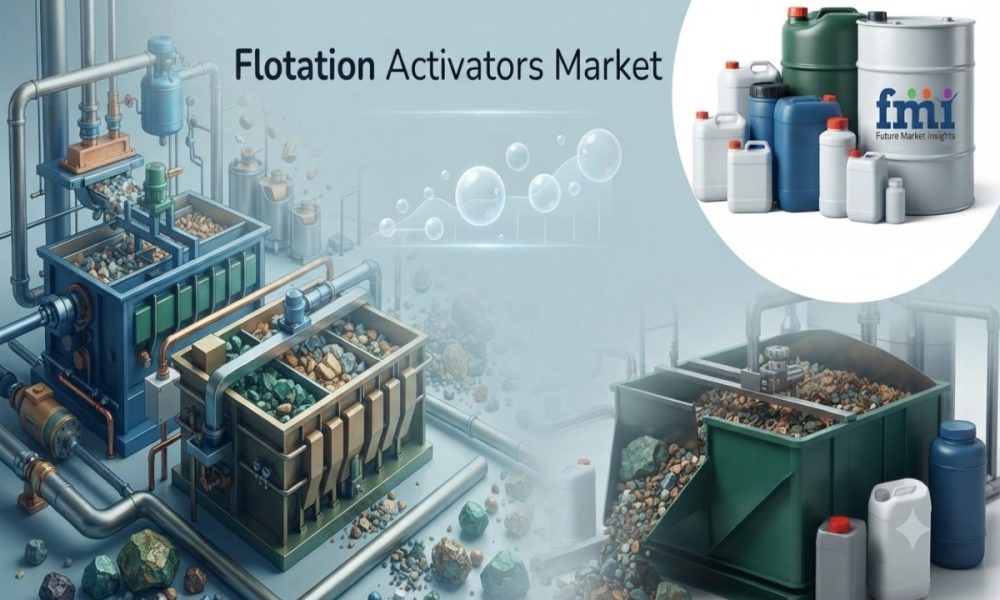
The global flotation activators market is projected to reach USD 1.8 billion by 2036, up from USD 1.1 billion in 2026, expanding at a 4.8% CAGR between 2026 and 2036, according to Future Market Insights (FMI). The market is expected to add approximately USD 0.7 billion in value over the forecast period as mining companies use activators to improve mineral surface response and support recovery in increasingly variable sulfide-ore processing circuits.
Flotation activators are becoming increasingly important in base-metal beneficiation as changes in sulfide mineralogy, ore grades, gangue composition, and pulp conditions affect collector performance. Plant metallurgists increasingly evaluate activation chemistry through site-specific laboratory and plant trials, where recovery, concentrate grade, dosage tolerance, and repeatability determine whether a reagent can move from qualification to routine procurement.
Base-Metal Processing Remains a Core Demand Driver
Base-metal concentrators are expected to account for 59.0% of the market in 2026, reflecting continued use of activators in copper, zinc, lead, and polymetallic flotation circuits. Copper sulfate is projected to hold 39.0% of the activator-type segment, supported by its established application in sphalerite activation.
Sphalerite ores are forecast to represent 29.0% of the ore-type segment in 2026. Activation of zinc sulfide surfaces allows collectors to attach more effectively, although operators must manage dosage, conditioning time, pH, water chemistry, and interactions with other flotation reagents.
Mineral surface activation is projected to lead the function segment with a 36.0% share in 2026. Direct mine contracts are expected to account for 44.0% of sales channels, reflecting the importance of technical support, site trials, delivery schedules, and reagent qualification.
Get detailed market forecasts, competitive benchmarking, and pricing trends: https://www.futuremarketinsights.com/reports/sample/rep-gb-35060
Ore-Specific Testing Shapes Purchasing Decisions
The market is increasingly influenced by the need to achieve recovery improvements without compromising concentrate quality. Variable gangue minerals, dissolved ions, changing ore feeds, and unintended activation of pyrite can narrow the operating window for flotation activators.
As a result, mining companies are placing greater emphasis on repeatable performance rather than reagent price alone. Commercial qualification often requires laboratory testing followed by controlled plant trials before a new activator becomes part of an approved reagent program.
The opportunity for suppliers lies in combining formulation expertise with metallurgical testing, field service, regional inventory, and technical support. These capabilities can help mining operators manage ore transitions while reducing the risk associated with switching established flotation chemistry.
Latin American Mining Activity Supports Regional Demand
Country-level growth varies according to mine development, concentrator capacity, ore characteristics, logistics, and project timing. Mexico is projected to record a 5.6% CAGR, followed by Peru at 5.3% and Chile at 5.2% through 2036. Australia, Canada, the United States, and Japan are forecast to grow at 4.7%, 4.5%, 4.3%, and 3.2%, respectively.
Chile’s large copper-processing base creates recurring opportunities for reagent trials focused on recovery and concentrate quality. Peru’s expanding mining project pipeline supports future qualification activity, while Mexico’s polymetallic mining districts create opportunities for regional chemical supply and technical services.
Australia and Canada present opportunities linked to established mineral-processing operations, although dispersed and remote mine locations make inventory planning and field support important. In the United States, brownfield operations must often ensure that new chemistry is compatible with existing equipment and approved reagent schemes.
Competitive Landscape
The flotation activators market includes global mining-chemistry companies, specialty chemical suppliers, and regional distributors. Orica, BASF, Clariant, Syensqo, Nouryon, Arkema, FUCHS, and Quadra are among the companies profiled in the market.
Recent corporate activity highlights continued investment in mining chemistry. In April 2026, Orica announced the acquisition of the Danafloat product range from FMC Corporation, expanding its Specialty Mining Chemicals portfolio into copper and other sulfide-ore processing applications.
BASF announced in May 2025 that it would strengthen its copper hydrometallurgy and flotation research and development activities, including relocating global R&D leaching activities to Houston and continuing development of formulations for sulfidic and non-sulfidic flotation.
Nouryon also opened a new innovation center in Shanghai in November 2025 to expand localized innovation and customer collaboration in China and the Asia Pacific region.
Analyst Perspective
“Plant metallurgists should compare flotation activators on recovery, concentrate grade, dosage tolerance, and repeatability on the site’s own ore. Unit price enters the decision after that evidence is stable. Commercial value comes from reproducing the result during ore changes and keeping the qualified chemistry available without disrupting the approved reagent scheme.”
— Nikhil Kaitwade, Principal Consultant, Future Market Insights
Access the Complete Report in PDF Format: https://www.futuremarketinsights.com/reports/brochure/rep-gb-35060
Flotation Activators Market — Report Scope
The FMI report analyzes the flotation activators market by activator type, ore type, function, end use, sales channel, and region.
Activator types covered include copper sulfate, sodium sulfide, lead nitrate, zinc sulfate activator blends, and specialty metal salts. Ore types include sphalerite, oxidized, gold sulfide, copper, and polymetallic ores. Functions include mineral surface activation, sulfidization support, collector response improvement, and selective flotation control.
End-use categories include base-metal concentrators, gold plants, industrial mineral plants, and toll-processing plants. Sales channels cover direct mine contracts, chemical distributors, reagent service providers, and regional blending.
The geographic assessment covers North America, Latin America, Western Europe, Eastern Europe, East Asia, South Asia and Pacific, and the Middle East and Africa, with country-level analysis for Mexico, Peru, Chile, Australia, Canada, the United States, Japan, and more than 30 countries included in the full report.
Business Impact
FMI helps organizations transform market complexity into strategic clarity, enabling leadership teams to identify growth opportunities faster, optimize resource allocation, strengthen competitive positioning, and make high-stakes business decisions with confidence.
To explore how FMI Custom Research can support your strategic priorities, please connect with our team at – [email protected]
About Future Market Insights (FMI)
Future Market Insights, Inc. (FMI) is an ESOMAR-certified, ISO 9001:2015 market research and consulting organization, trusted by Fortune 500 clients and global enterprises. With operations in the U.S., UK, India, and Dubai, FMI provides data-backed insights and strategic intelligence across 30+ industries and 1200 markets worldwide.



