
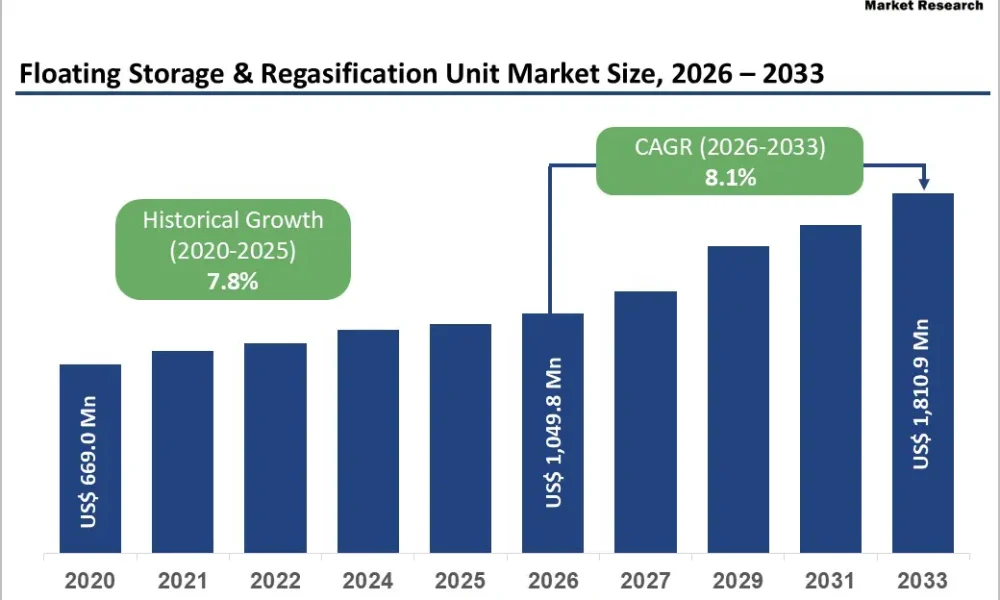
The Floating Storage & Regasification Unit Market is witnessing steady expansion as global energy systems transition toward cleaner fuels. According to Persistence Market Research, the global floating storage & regasification unit market is expected to reach US$ 1,049.8 million in 2026 and further expand to US$ 1,810.9 million by 2033, registering a CAGR of 8.1% over 2026 to 2033. Rising demand for liquefied natural gas LNG remains the central growth catalyst, particularly in countries facing delays in onshore regasification terminal development. FSRUs provide rapid deployment capabilities and lower capital expenditure compared to land based terminals. The market previously expanded at a CAGR of 7.8% from 2020 to 2025, highlighting sustained adoption momentum. Increasing LNG trade flows and infrastructure flexibility are reshaping global gas logistics. The growing need for floating LNG regasification solutions is strengthening project pipelines worldwide.
Market expansion is strongly influenced by decarbonization policies and rising energy security concerns. Emerging economies are accelerating LNG imports to diversify fuel sources and reduce coal dependence. FSRUs offer cost advantages, faster commissioning timelines, and adaptability in fluctuating demand environments. The leading segment within the market remains floating storage and regasification infrastructure deployed for import based LNG supply models due to its economic and operational benefits. Geographically, emerging LNG importing nations represent the leading regional growth contributors as they rely on floating units to bridge supply gaps quickly. Flexible marine based regasification systems are becoming strategic assets for countries expanding natural gas penetration. This structural shift in energy sourcing underpins long term market stability and growth.
Want Market Insights? Get Your Free Report Sample : https://www.persistencemarketresearch.com/samples/25984
Key Highlights from the Report
➤ The floating storage & regasification unit market is projected to grow from US$ 1,049.8 million in 2026 to US$ 1,810.9 million by 2033.
➤ The market is expected to register a CAGR of 8.1% during the forecast period from 2026 to 2033.
➤ Historical growth between 2020 and 2025 stood at a CAGR of 7.8%, indicating strong adoption momentum.
➤ Rising global LNG demand is the primary growth driver for floating regasification infrastructure.
➤ Cost advantages and faster deployment compared to onshore LNG terminals are accelerating investment decisions.
➤ Energy transition goals and energy security requirements are increasing reliance on FSRU based LNG import solutions.
Market Segmentation
The floating storage & regasification unit market can be segmented based on deployment type, storage capacity, and end use applications. In terms of deployment, floating LNG regasification units are favored for import terminals requiring rapid operationalization. Their ability to function as both storage and regasification facilities enhances supply chain efficiency. Capacity based segmentation reflects variations in LNG storage volumes tailored to national consumption needs. Smaller capacity units are often selected by emerging LNG importers seeking scalable infrastructure. Larger capacity units are deployed in markets with higher LNG throughput requirements. The flexibility in vessel conversion and redeployment supports dynamic market conditions. This segmentation highlights the adaptability of FSRUs across diverse energy environments.
From an end use perspective, the primary segment includes national gas utilities and power generation entities relying on LNG imports. These end users benefit from floating infrastructure that ensures reliable feed gas supply. Industrial consumers also contribute to demand where pipeline connectivity is limited. Floating storage and regasification systems support seasonal and peak demand management strategies. Their mobility allows relocation in response to shifting supply patterns. The dominance of LNG import dependent markets reinforces the importance of FSRUs in energy diversification strategies. Segmentation trends indicate sustained reliance on floating regasification solutions over fixed infrastructure alternatives.
Get a Customized Market View in One Click : https://www.persistencemarketresearch.com/request-customization/25984
Regional Insights
Emerging LNG importing regions are central to floating storage & regasification unit market expansion. These markets increasingly depend on floating regasification units to meet growing natural gas consumption. Delays in constructing permanent onshore terminals encourage the adoption of flexible marine based solutions. Rapid industrialization and urbanization further amplify LNG demand. FSRUs help governments secure diversified supply sources without long construction cycles. Their modular and relocatable nature strengthens regional energy resilience. This trend continues to shape investment priorities in developing economies.
In energy import reliant nations, floating regasification units serve as strategic infrastructure assets. They support decarbonization initiatives by enabling a shift from coal to natural gas. LNG imports facilitated through FSRUs enhance grid stability and fuel availability. The ability to deploy these units near demand centers reduces transportation bottlenecks. Market growth aligns with broader energy transition policies and security planning. As LNG trade volumes rise globally, regional adoption of floating storage solutions remains robust. This reinforces sustained market expansion through 2033.
Market Drivers
Rising global demand for liquefied natural gas LNG is the principal driver of the floating storage & regasification unit market. Countries seeking cleaner alternatives to coal and oil are increasing LNG imports. FSRUs provide immediate regasification capacity without requiring extensive onshore construction. Their faster commissioning timelines make them attractive for urgent supply needs. The historical CAGR of 7.8% from 2020 to 2025 reflects this sustained demand trajectory. Energy transition policies further amplify LNG adoption worldwide. Flexible infrastructure solutions are therefore gaining prominence.
Energy security considerations also drive market expansion. Governments prioritize diversified supply channels to reduce geopolitical risks. Floating storage and regasification units enable rapid diversification of gas sourcing strategies. Their cost efficiency compared to permanent terminals lowers investment barriers. Surging LNG imports in emerging economies directly support FSRU deployment. The projected 8.1% CAGR through 2033 underscores confidence in long term demand. Collectively, these drivers sustain steady market growth.
Market Restraints
Despite strong growth prospects, capital intensity remains a limiting factor for some stakeholders. Although cheaper than onshore terminals, FSRU projects still require significant upfront investment. Financing complexities can delay project approvals. Market participants must also navigate regulatory frameworks governing maritime and energy infrastructure. Compliance requirements may extend deployment timelines. These structural challenges can moderate short term expansion rates.
Operational risks associated with floating infrastructure present additional concerns. Weather conditions and port limitations may affect efficiency. Long term charter agreements require careful financial planning. Some markets may eventually transition toward permanent onshore terminals, influencing redeployment strategies. However, these restraints are balanced by cost and flexibility advantages. The market outlook remains positive despite these constraints.
Market Opportunities
The energy transition continues to create significant opportunities for floating storage & regasification unit deployment. Decarbonization policies encourage the replacement of high emission fuels with natural gas. FSRUs offer scalable infrastructure to support this transition. Emerging economies with growing power demand represent untapped potential. LNG import infrastructure gaps present expansion opportunities.
Long term growth prospects are supported by increasing LNG trade volumes. Floating regasification units can be relocated based on demand shifts, enhancing asset utilization. Governments prioritizing rapid energy diversification may increasingly adopt floating solutions. As the market approaches US$ 1,810.9 million by 2033, investment pipelines are expected to expand. Strategic collaborations and vessel conversions further strengthen opportunity landscapes.
Exclusive Data Awaits – Continue to Checkout : https://www.persistencemarketresearch.com/checkout/25984
Company Insights
Key players operating in the floating storage & regasification unit market include:
- Höegh LNG Holdings Ltd.
- Excelerate Energy Inc.
- Golar LNG Limited
- BW Gas Limited
- Exmar NV
- Samsung Heavy Industries Co., Ltd.
- Hyundai Heavy Industries Co., Ltd.
- Daewoo Shipbuilding & Marine Engineering Ocean
- Hudong-Zhonghua Shipbuilding
- Keppel Offshore & Marine
- Seatrium
- Mitsui O.S.K. Lines
- Kawasaki Heavy Industries, Ltd.
- Maran Gas Maritime
- New Fortress Energy
Recent Developments
January 2023 Expansion of floating LNG regasification deployment initiatives to support rising import demand.
September 2022 Increased investment focus on flexible floating LNG infrastructure to strengthen energy security strategies.
Future Opportunities and Growth Prospects
The floating storage & regasification unit market is positioned for sustained growth as LNG trade expands and energy security priorities intensify. With projected growth to US$ 1,810.9 million by 2033 at a CAGR of 8.1%, the sector reflects long term confidence in floating regasification infrastructure. Continued emphasis on decarbonization and flexible energy systems will reinforce FSRU deployment globally.




