
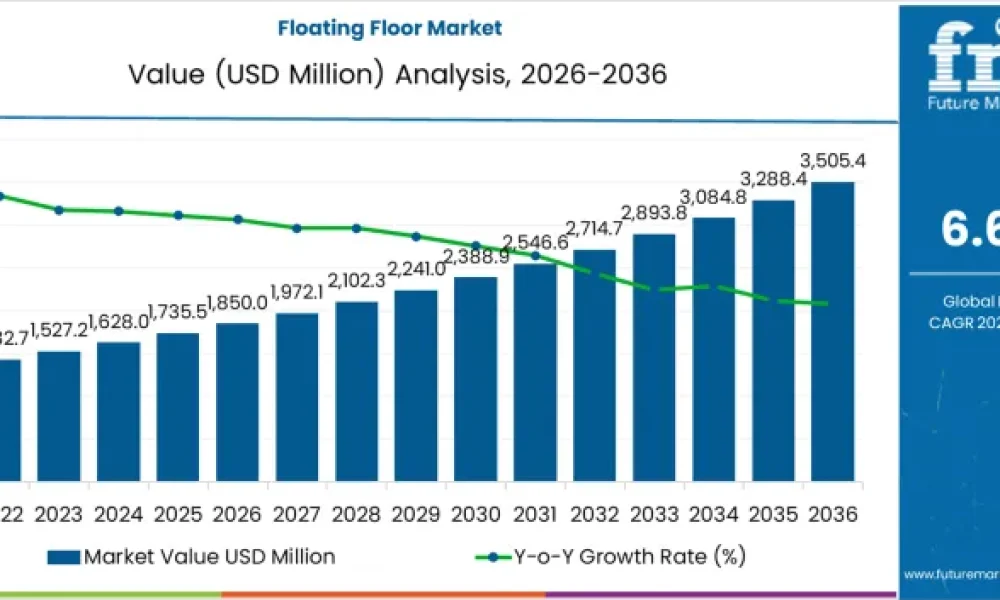
The global floating floor market is entering a decisive growth phase as building performance, acoustic comfort, and vibration control move to the forefront of construction and renovation priorities. According to the latest industry outlook, the floating floor market is valued at USD 1,850.0 million in 2026 and is projected to reach USD 3,505.4 million by 2036, expanding at a CAGR of 6.6% during the forecast period.
Unlike decorative flooring solutions, floating floors are increasingly viewed as technical infrastructure systems designed to manage impact noise, footfall vibration, and structure-borne sound. Their relevance continues to grow as building codes tighten impact insulation requirements and occupants demand quieter, more comfortable living and working environments.
Gain access to detailed segment-wise analysis and forecast statistics – Request the Sample Report Today
Market Growth Anchored in Performance, Not Aesthetics
Floating floor systems are gaining strong traction in multifamily residential buildings, hotels, offices, healthcare facilities, and institutional spaces where concrete slabs alone are insufficient to control impact noise. These systems work by decoupling the finished floor from the structural base using resilient underlayments, isolators, or engineered assemblies.
Key performance factors shaping specification decisions include:
- Dynamic stiffness and vibration damping
- Long-term compressive strength
- Resistance to creep under sustained loads
- Stability under moisture and humidity variations
As renovation and adaptive reuse projects increase globally, demand is rising for floating floor systems that can be installed over existing substrates without structural intervention, minimizing downtime and installation risk.
Quick Stats: Floating Floor Market at a Glance
- Market Value (2026): USD 1,850.0 million
- Forecast Value (2036): USD 3,505.4 million
- CAGR (2026–2036): 6.6%
- Leading System Type: Resilient underlayment floating floors
- Fastest-Growing Countries: India, Vietnam, Indonesia, Saudi Arabia, UAE
- Key Global Players: Getzner Werkstoffe, Kinetics Noise Control, REGUPOL, Mason Industries, GERB Schwingungsisolierung
Key Segments of the Floating Floor Market
- By System Type
- Resilient underlayment floating floors
- Raised floating floors (acoustic)
- Spring or isolator floating floors
- Other hybrid systems
Resilient underlayment systems dominate with a 46.0% share due to thin profiles, cost efficiency, and compatibility with standard finishes.
- By End Use
- Residential multifamily
- Commercial offices
- Hospitality
- Studios & specialty rooms
Residential multifamily leads with a 34.0% share, driven by inter-unit noise regulations and high installation volumes.
- By Material
- Rubber & elastomer
- Foam underlay
- Mineral wool systems
- Other materials
Rubber and elastomer systems hold 38.0% share due to durability, compression resistance, and consistent acoustic performance.
- By Sales Channel
- Flooring contractors
- Building distributors
- Direct manufacturer sales
- Other channels
Why Demand for Floating Floors Is Accelerating
The rise in urban density, mixed-use developments, and activity-based interior planning is reinforcing demand for floating floors that enable acoustic separation without increasing slab thickness. Architects and acoustic consultants increasingly specify systems that meet defined Impact Insulation Class (IIC) and Sound Transmission Class (STC) targets.
Floating floors are also favored in retrofit projects because they:
- Avoid disruptive demolition
- Install quickly without curing time
- Integrate with wood, laminate, vinyl, and tile finishes
Advances in resilient materials and moisture-control layers are further improving long-term reliability and performance predictability.
Regional Growth Highlights
- India (CAGR 7.9%): High-rise housing, hospitals, IT offices, and regulatory enforcement drive adoption.
- Vietnam (7.4%): Hospitality, mixed-use development, and office privacy needs fuel growth.
- Indonesia (7.1%): Institutional buildings, airports, and education facilities lead demand.
- Saudi Arabia (6.6%): Infrastructure megaprojects, healthcare, and hospitality investments sustain growth.
- UAE (6.3%): Premium commercial buildings and refurbishment projects support steady expansion.
Growth in these markets is driven by functional acoustic performance, not luxury positioning.
Competitive Landscape: Established Leaders and Emerging Innovators
The floating floor market features a mix of established global manufacturers and new technology-driven entrants seeking to expand regional presence and develop advanced isolation systems.
- Getzner Werkstoffe leads with precision-engineered elastomer systems for defined load ranges.
- Kinetics Noise Control specializes in spring and elastomer solutions for studios and theaters.
- REGUPOL supports demand with recycled elastomer products focused on sustainability.
- Mason Industries delivers spring-based systems for mechanical and structural vibration control.
- GERB Schwingungsisolierung targets ultra-low-frequency isolation for critical environments.
Additional players such as Trelleborg, Saint-Gobain, Knauf, and MAPEI are expanding portfolios through material innovation, acoustic testing, and contractor support, creating opportunities for both established brands and emerging manufacturers.
Outlook: Floating Floors as Core Building Infrastructure
Looking ahead, floating floors are increasingly positioned as essential building performance layers, not optional upgrades. Market expansion will remain tied to acoustic compliance, urban renovation activity, and demand for predictable, long-term vibration control.
For manufacturers—both established and new—the opportunity lies in engineering-driven differentiation, certified acoustic performance, and close collaboration with designers and installers. As buildings grow denser and expectations for comfort rise, floating floor systems are set to play a critical role in shaping quieter, more functional built environments worldwide.
Have a specific Requirements and Need Assistant on Report Pricing or Limited Budget please contact us – [email protected]
About Future Market Insights (FMI)
Future Market Insights, Inc. (FMI) is an ESOMAR-certified, ISO 9001:2015 market research and consulting organization, trusted by Fortune 500 clients and global enterprises. With operations in the U.S., UK, India, and Dubai, FMI provides data-backed insights and strategic intelligence across 30+ industries and 1200 markets worldwide
Why Choose FMI: https://www.futuremarketinsights.com/why-fmi



