
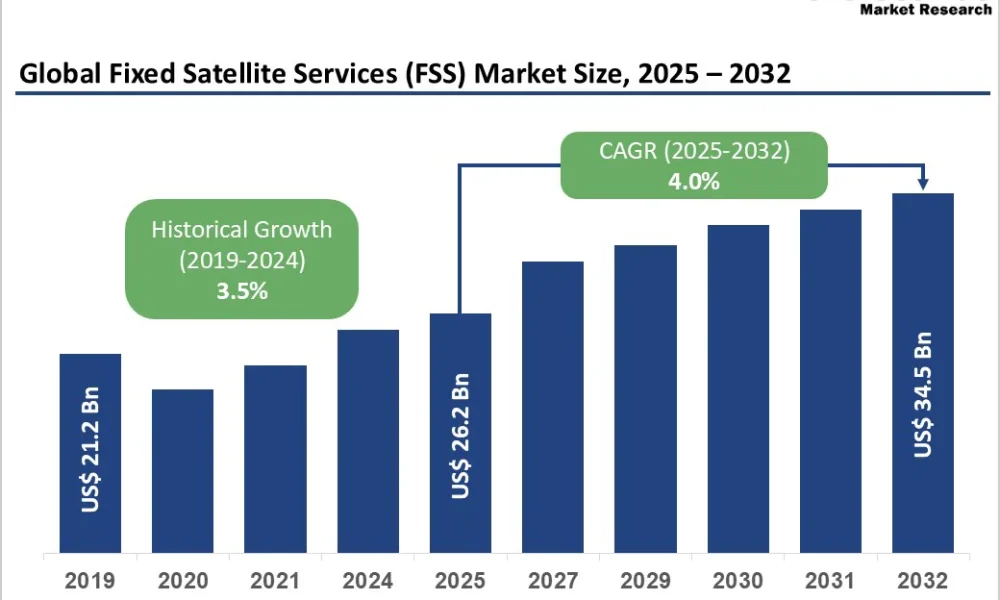
The global Fixed Satellite Services (FSS) market is entering a decisive growth phase as demand for reliable, high-bandwidth, and geographically unrestricted communication intensifies. In 2025, the market is estimated to be valued at US$26.2 billion and is projected to reach US$34.5 billion by 2032, expanding at a compound annual growth rate (CAGR) of 4.0% during the forecast period from 2025 to 2032.
This growth is underpinned by the rising need for remote connectivity, increasing reliance on satellite-enabled broadcasting, and the evolution of satellite technologies that enhance data throughput and network resilience. As industries and governments push for universal connectivity, Fixed Satellite Services continue to serve as a critical backbone for communication where terrestrial networks fall short.
Understanding Fixed Satellite Services (FSS)
Fixed Satellite Services refer to satellite communication systems designed to provide continuous, point-to-point or point-to-multipoint communication between fixed ground stations via satellites. Unlike mobile satellite services, FSS focuses on stationary terminals, making it ideal for broadcasting, telecom backhaul, broadband internet, and secure data transmission.
FSS solutions operate across multiple frequency bands, including C-band, Ku-band, and Ka-band, enabling a wide range of applications from television broadcasting to enterprise data networks. These services are particularly valuable in remote, rural, maritime, and aeronautical environments where fiber or cellular infrastructure is either unavailable or economically unviable.
Market Size and Growth Outlook
The FSS market has demonstrated steady historical growth, registering a CAGR of 3.5% between 2019 and 2024. This momentum is expected to strengthen moderately over the forecast period due to expanding digital infrastructure requirements and increasing satellite capacity.
Key Market Metrics
- Market Size (2025): US$26.2 Billion
- Forecast Value (2032): US$34.5 Billion
- Projected CAGR (2025–2032): 4.0%
While the growth rate may appear moderate compared to emerging satellite segments, the FSS market benefits from long-term contracts, mission-critical use cases, and consistent demand from broadcasting, defense, and enterprise customers.
Key Drivers Fueling Market Expansion
Rising Demand for Reliable Broadcasting and Media Distribution
One of the strongest drivers of the FSS market is the continued reliance on satellite broadcasting for television and radio distribution. Despite the rise of internet-based streaming platforms, satellite TV remains dominant in many regions due to its ability to deliver consistent, high-quality content over vast geographic areas.
TV channel broadcasting alone accounts for approximately 30% of the total FSS market share, reflecting the enduring importance of satellites in global media ecosystems. Broadcasters rely on FSS for live events, news transmission, and international content syndication.
Growing Need for Telecom Backhaul and High-Bandwidth Connectivity
Telecommunication operators increasingly depend on FSS to support network backhaul, especially in remote and hard-to-reach areas. Satellites play a crucial role in extending mobile and broadband networks where fiber deployment is impractical.
With the expansion of 4G and 5G networks, FSS enables seamless connectivity between base stations and core networks, ensuring uninterrupted service coverage. This capability is particularly valuable in emerging markets and geographically complex regions.
Technological Advancements in Satellite Systems
Advancements in satellite design, including high-throughput satellites (HTS) and improved ground segment technologies, are enhancing the efficiency and performance of FSS solutions. Modern satellites offer higher capacity, lower latency, and improved spectral efficiency compared to legacy systems.
The integration of space and ground systems allows for dynamic data routing, significantly reducing latency and improving service reliability. This convergence supports next-generation applications such as 5G, Internet of Things (IoT), and enterprise cloud connectivity.
Key Market Opportunity: Bridging the Digital Divide
One of the most compelling opportunities in the Fixed Satellite Services market lies in expanding digital connectivity in underserved and unconnected regions. By integrating FSS with 5G and IoT networks, service providers can enable advanced communication services in areas lacking terrestrial infrastructure.
Satellite-based broadband solutions can support education, healthcare, e-governance, and disaster management, creating new revenue streams while addressing social and economic development goals. Governments and international organizations are increasingly recognizing FSS as a strategic tool for achieving universal broadband access.
Regional Market Analysis
North America: Market Leader
North America leads the global FSS market, commanding approximately 35% of the total market share in 2025. The region’s dominance is driven by advanced telecommunications infrastructure, high broadcasting penetration, and robust research and development activities, particularly in the United States.
The presence of major satellite operators, defense agencies, and media conglomerates further strengthens demand. Additionally, continuous investments in satellite modernization and secure communication systems support long-term market stability in the region.
Elevate your business strategy with comprehensive market data. Request a sample report now: https://www.persistencemarketresearch.com/samples/14653
Asia Pacific: Fastest-Growing Region
Asia Pacific is expected to register the fastest growth rate during the forecast period. Rapid digitalization, rising awareness of satellite connectivity, and growing broadband investments in countries such as China and India are key growth catalysts.
Governments across the region are promoting satellite-based connectivity to support rural development, smart cities, and national security initiatives. The expanding media and telecommunications sectors further contribute to rising FSS adoption.
Europe and Rest of the World
Europe maintains a steady share of the FSS market, driven by public broadcasting networks, aerospace applications, and cross-border communication needs. Meanwhile, regions such as the Middle East, Africa, and Latin America present significant long-term growth potential due to increasing demand for connectivity in remote and developing areas.
Segment Analysis
By Service Type: TV Channel Broadcasting Dominates
TV channel broadcasting remains the dominant service type in the FSS market, accounting for nearly 30% of total revenue. Satellite broadcasting offers unmatched coverage, making it indispensable for national and international content distribution.
Despite the growth of digital streaming, satellite broadcasting continues to serve as a primary distribution channel, particularly in regions with limited broadband infrastructure.
By Enterprise Size: Large Enterprises Lead
Large enterprises account for over 45% of market revenue, driven by their global operations and need for secure, high-capacity communication networks. Industries such as media, aerospace, defense, and telecommunications rely heavily on FSS for mission-critical connectivity.
These organizations often enter long-term service agreements, providing stable revenue streams for satellite service providers.
By End User: Media and Entertainment at the Forefront
The media and entertainment sector contributes nearly 35% of total FSS market revenue, making it the leading end-user segment. Satellites are essential for live broadcasts, sports events, news coverage, and content syndication across borders.
As content consumption continues to globalize, the need for reliable satellite-based distribution is expected to remain strong.
Role of FSS in Aerospace and Defense
Beyond commercial applications, Fixed Satellite Services play a vital role in aerospace and defense operations. Secure and resilient communication links are critical for military missions, surveillance, and emergency response.
FSS provides global coverage, encryption capabilities, and redundancy, making it indispensable for national security agencies. Ongoing modernization of defense communication infrastructure continues to support market growth in this segment.
Competitive Landscape and Industry Dynamics
The FSS market is characterized by a mix of established satellite operators, regional service providers, and technology innovators. Companies focus on expanding satellite capacity, improving service reliability, and forming strategic partnerships with telecom operators and governments.
Investments in next-generation satellites and ground infrastructure are reshaping competitive dynamics, enabling providers to offer more flexible and scalable services tailored to evolving customer needs.
Future Trends Shaping the FSS Market
Several trends are expected to influence the evolution of the Fixed Satellite Services market over the coming years:
- Integration with 5G Networks: Enhancing hybrid connectivity solutions
- Growth of IoT Applications: Supporting large-scale device connectivity
- Improved Satellite Efficiency: Higher throughput and lower operational costs
- Focus on Sustainability: Energy-efficient satellites and longer mission lifecycles
These trends will help FSS remain relevant and competitive alongside emerging satellite communication models.
Conclusion
The Fixed Satellite Services market continues to be a foundational pillar of global communication infrastructure. With a projected value of US$34.5 billion by 2032, the market demonstrates steady and sustainable growth driven by broadcasting demand, telecom backhaul needs, and technological advancements.
As digital connectivity becomes a universal necessity, FSS will play an increasingly important role in bridging coverage gaps, supporting next-generation networks, and enabling secure, high-bandwidth communication across industries. The integration of FSS with 5G and IoT ecosystems presents significant opportunities for innovation and expansion, positioning the market for long-term relevance in an interconnected world.
Related Reports:




