
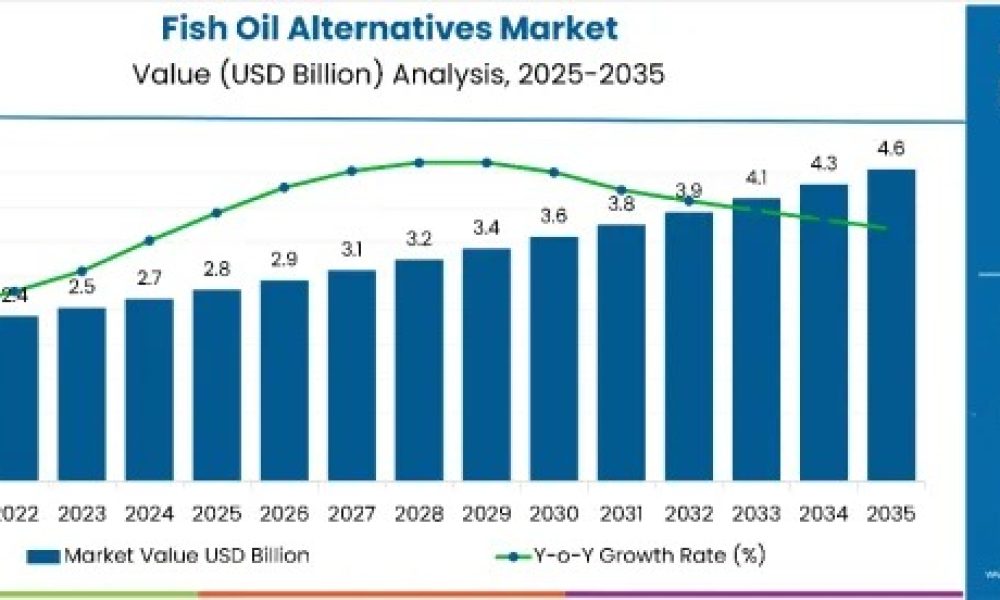
The global fish oil alternatives market is set for steady expansion, projected to grow from USD 2.8 billion in 2025 to USD 4.6 billion by 2035, registering a consistent CAGR of 5.0%. Rising demand for sustainable omega-3 sources, cleaner-label ingredients, and plant-based nutrition is reshaping the competitive landscape and accelerating adoption across food, nutraceutical, cosmetic, and pharmaceutical sectors.
Updated as of 10 September 2025, fresh data indicates strong momentum driven by scaling innovation, regulatory shifts, and expanding consumer awareness. By 2030, the market is expected to reach USD 3.6 billion, with USD 0.8 billion in incremental growth between 2025 and 2030—reflecting a back-loaded adoption pattern due to rapid advancements in extraction, purification, and bioavailability technologies.
Explore trends before investing – request a sample report today! https://www.futuremarketinsights.com/reports/sample/rep-gb-16914
Market Overview
Key markets, including China, India, Japan, Germany, and the USA, continue to strengthen global demand, with China leading at a CAGR of 6.0%, followed by India at 5.8%. Product innovation, sustainability benchmarks, and shifting dietary preferences are ensuring steady penetration across both developed and emerging economies.
In 2025, chia seed oil remains the dominant segment, accounting for 35% of the total market. Other notable plant-derived alternatives—soybean oil, canola oil, flaxseed oil, hemp seed oil, walnut oil, and algae oil—are gaining traction due to improved extraction efficiencies and broader application compatibility.
Growth Drivers
The shift toward plant-forward diets and environmental responsibility continues to propel the market. Manufacturers prioritize cleaner, sustainable omega-3 sources as consumers demand transparency, efficacy, and ethical sourcing. Expansion in functional foods, fortified beverages, premium cosmetics, and nutraceuticals remains central to market growth.
Advances in extraction and processing—including solvent-free extraction, cold-pressing, microencapsulation, and enhanced stabilization methods—have improved product quality, purity, and bioactivity. These innovations enable superior absorption in supplements and support broader use in pharmaceutical formulations.
Country-Level Insights (2025–2035)
China (CAGR: 6.0%)
China’s expanding chia and algae cultivation base supports strong production growth. Government sustainability programs and rising functional food consumption reinforce its leading position.
India (CAGR: 5.8%)
A high vegetarian population and expanding nutraceutical sector accelerate adoption. Organic farming incentives and modern processing facilities enhance supply-side capability.
Japan (CAGR: 5.5%)
Japan prioritizes pharmaceutical-grade omega-3 oils, driven by its aging population and emphasis on preventive healthcare. Strict quality and safety standards fuel investments in advanced extraction.
Germany (CAGR: 5.2%)
Europe’s sustainability leader benefits from strong demand for organic and allergen-free oils. Eco-friendly cultivation and stringent environmental certifications boost premium product uptake.
USA (CAGR: 5.0%)
A vast health-conscious consumer base, strong supplement demand, and advanced retail ecosystems support steady market growth, supplemented by innovative formulation technologies enhancing stability and bioavailability.
Industry Challenges
While demand strengthens, higher production costs and regulatory complexities remain pressing challenges. Consumer awareness about plant-based omega-3 efficacy still trails behind traditional fish oil, underscoring the need for targeted education and clearer labeling. Maintaining product purity and securing sustainable raw materials also pose ongoing hurdles.
Competitive Landscape
The market is moderately consolidated, with established players expanding through R&D investments and diversified applications. Key companies include Cargill Incorporated, Wilmar International, Archer Daniels Midland Company, Marico Limited, The Nisshin OilliO Group, Nutiva Inc., Connolis LLC, Bio-gen Extracts, Ming Chyi Biotechnology Ltd., and Bunge Limited.
Leading companies focus on scalable extraction systems, premium-quality plant oils, and compliance with global purity standards. Regional players capitalize on localized cultivation and niche formulations, capturing market share through agility and cost-effective sourcing.
Market Segmentation Analysis
By Product (2025)
- Chia Seeds Oil – 35% (largest and fastest-growing segment)
- Soybean Oil
- Canola Oil
- Algae Oil
- Flaxseed Oil
- Walnut Oil
- Hemp Seed Oil
- Others (specialty seed blends)
By Application (2025)
- Food & Beverage Industry – 40% (largest segment)
- Nutraceuticals
- Pharmaceuticals
- Cosmetics & Personal Care
- Pet Food Additives
- Animal Feed
- Biofuels
- Others
By Distribution Channel
- B2B
- B2C (Hypermarkets/Supermarkets, Convenience Stores, Specialty Stores, Online Retail)
By Region
- North America
- Latin America
- Europe
- Asia Pacific
- Middle East & Africa (MEA)
Outlook
With sustainability, health, and technological innovation at its core, the fish oil alternatives market is positioned for sustained global expansion. Growing consumer preference for vegan omega-3s, combined with rapid improvements in extraction science and broadening product applications, ensures strong long-term prospects.
About Future Market Insights (FMI)
Future Market Insights, Inc. (FMI) is an ESOMAR-certified, ISO 9001:2015 market research and consulting organization, trusted by Fortune 500 clients and global enterprises. With operations in the U.S., UK, India, and Dubai, FMI provides data-backed insights and strategic intelligence across 30+ industries and 1200 markets worldwide.



