
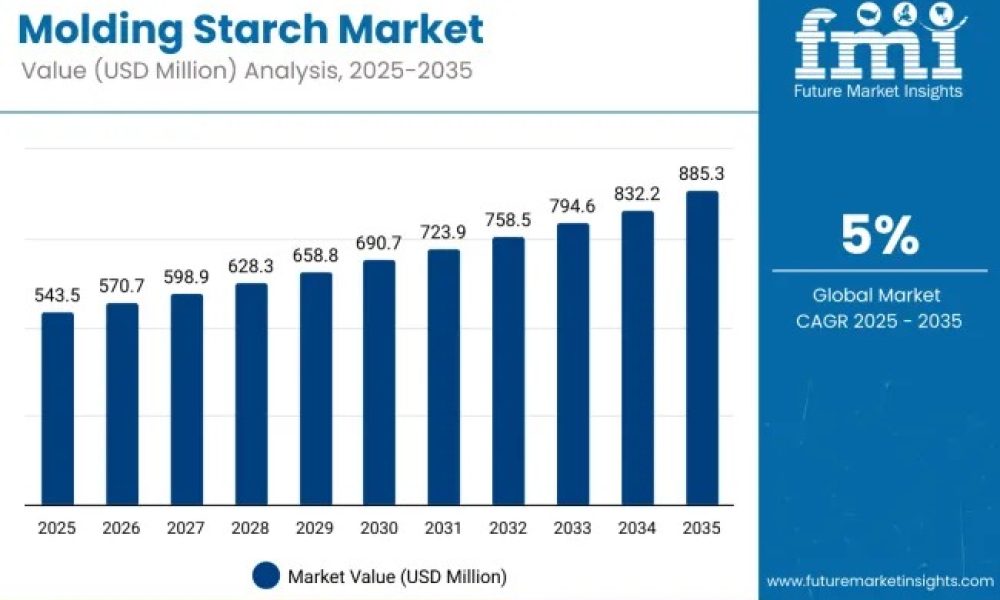
The global molding starch market is set for steady expansion, with valuation expected to rise from USD 543.5 million in 2025 to USD 885.3 million by 2035, reflecting a 5.0% CAGR. By 2030, the market is projected to reach USD 693.5 million, adding USD 150 million in value during the first half of the period and USD 191.8 million in the latter half. This upward trajectory is shaped by innovation in modified starch technologies, strong adoption across confectionery processing, and the growing demand for natural, biodegradable molding agents.
Explore trends before investing – request a sample report today! https://www.futuremarketinsights.com/reports/sample/rep-gb-9073
Consistent Growth Fueled by Sustainable Manufacturing
Molding starch continues to gain momentum as manufacturers shift toward bio-based, food-safe, and sustainable processing aids. Enhanced functional attributes—such as moisture absorption, improved demolding efficiency, and intrinsic biodegradability—position it as a preferred alternative to synthetic molding agents. By 2025, molding starch secures:
- 18% share of the global confectionery starch applications market
- 45% share of the molding processing agents market
- 23% share of the mold release agents market
- 2.4% share of the broader food starch market
- 40% share of confectionery ingredients market (candies segment)
Companies like Cargill, ADM, Ingredion, and Tate & Lyle are scaling up investments in starch modification technologies and sustainable sourcing frameworks, strengthening their competitive edge in food processing and eco-friendly packaging segments.
Market Drivers: Clean Label, Confectionery Innovation & Functional Performance
The molding starch market benefits from rising consumer preference for clean-label foods and natural processing ingredients. Functional advantages—including moisture control, heat stability, and efficient mold release—are increasing its use in:
- High-speed confectionery molding
- Gummy and jelly production
- Functional and nutraceutical gummies
- Emerging biodegradable packaging solutions
Advanced enzymatic modification and controlled amylopectin–amylose ratios further enhance process efficiency and product quality.
In 2024 alone, global molding starch consumption surged 14% year-over-year, with Europe contributing 42% due to its established confectionery manufacturing base.
Segment Analysis: Type & Application Outlook
By Type
Rapidly Digestible Starch (RDS) leads the market with 45% share in 2025, supported by its fast hydrolysis rate, superior mold-release behavior, and compatibility with automated confectionery systems. Technological milestones—such as ultra-fine milling and advanced enzyme treatments—continue to elevate RDS performance in modern molding environments.
By Application
The candies segment dominates with 40% of global share, attributed to its demand for precise shapes, moisture balance, and premium texture finishes. Rising novelty candy trends and social-media-driven product innovation amplify demand for high-performance molding starch formulations.
Key Restraints: Supply Volatility & Processing Complexity
Despite strong demand, challenges persist:
- Raw starch price fluctuations (USD 450–620 per metric ton)
- Specialized molding room requirements
- Starch recycling processes adding 18–22% to operational costs
- Limited global suppliers of high-performance blends
These constraints complicate scaling efforts, particularly in emerging markets.
Country-Wise Growth Analysis (2025–2035)
The market shows diverse regional growth:
- India: 20.3% CAGR — rapid confectionery expansion and investment in modification facilities
- China: 7.3% CAGR — strong production capacity and modernization of starch clusters
- Saudi Arabia: 6.0% CAGR — economic diversification and plant commissioning
- United States: 5.0% CAGR — biorefinery integration and clean-label regulations
- Japan: 4.0% CAGR — premium confectionery demand and precision processing technologies
India leads in production capacity expansion, projecting an increase from 250 kilotons in 2025 to 410 kilotons by 2035. China continues to strengthen its global supply role through advanced drying and enzymatic modification units.
Competitive Landscape
The molding starch industry is moderately consolidated. Key players include:
- ADM & Cargill — leaders in high-performance RDS with proprietary enzyme technologies
- Ingredion — specialized clean-label blends and tailored starch ratios
- Tate & Lyle — sustainable, low-residue starch grades for premium applications
- Roquette SA & GPC — regional strengths in flexible supply and rapid technical support
High capital requirements, food safety regulations, and technical expertise in starch chemistry create substantial entry barriers, reinforcing the competitive advantage of established players.
Recent developments include Roquette’s April 2024 expansion of its LYCAGEL® pea starch range, supporting vegan and nutraceutical softgel applications.
About Future Market Insights (FMI)
Future Market Insights, Inc. (FMI) is an ESOMAR-certified, ISO 9001:2015 market research and consulting organization, trusted by Fortune 500 clients and global enterprises. With operations in the U.S., UK, India, and Dubai, FMI provides data-backed insights and strategic intelligence across 30+ industries and 1200 markets worldwide.



