
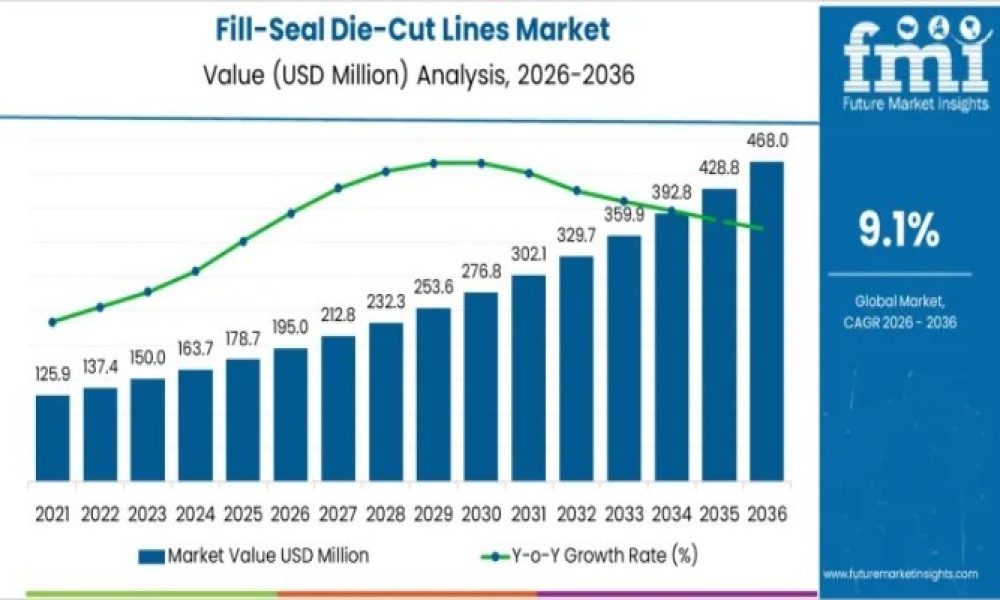
The global Fill-Seal Die-Cut Lines Market is entering a decade of structurally strong growth, driven by rising automation in packaging operations and the increasing need for efficiency, flexibility, and precision across food, pharmaceutical, and consumer goods manufacturing. Valued at USD 195 million in 2026, the market is projected to reach USD 468 million by 2036, expanding at a healthy compound annual growth rate (CAGR) of 9.1% over the forecast period.
This growth trajectory reflects not only rising demand for integrated packaging solutions but also evolving production strategies. Manufacturers are moving away from fragmented forming, filling, and sealing processes toward unified, high-speed systems that reduce waste, improve quality consistency, and optimize labor utilization. Fill-seal die-cut lines have emerged as a critical enabler of these objectives.
Explore Opportunities – Get Your Sample of Our Industry Overview Now!
Market Dynamics Highlight Seasonal and Cyclical Growth Patterns
Analysis of annual market data reveals recurring cyclical patterns in fill-seal die-cut line deployment. Moderate growth typically appears in the early quarters of each year, followed by accelerated uptake in the latter half. These cycles align closely with peak production schedules, festive demand surges, promotional campaigns, and new product launches in food, pharmaceuticals, and personal care sectors.
Over the longer term, from 2031 to 2036, the market demonstrates a sustained cyclical rhythm. While absolute gains fluctuate year to year, the overall upward trend remains firmly intact. High-demand periods correspond with inventory replenishment and batch production cycles, while slower periods reflect planned maintenance shutdowns and capital budgeting phases. This pattern highlights that although year-over-year growth is robust, operational deployment is inherently seasonal, an important consideration for strategic investment and resource planning.
Growth Outlook: From Selective Adoption to Structural Scaling
From 2026 to 2031, the market is expected to grow from USD 195 million to approximately USD 289 million. This phase represents a recovery from an early adoption trough toward an initial peak, with demand concentrated among food, beverage, and pharmaceutical manufacturers upgrading packaging efficiency. During this period, companies typically integrate die-cut capabilities into selected lines, validating performance, output quality, and return on investment before broader rollout.
Between 2031 and 2036, growth accelerates markedly as the market expands from roughly USD 289 million to USD 468 million. This phase reflects portfolio-wide deployment, higher throughput utilization, and expansion across multiple production sites and SKUs. Adoption becomes standardized, repeat procurement increases, and fill-seal die-cut lines are embedded as core components of high-speed packaging operations.
Quick Stats: Fill-Seal Die-Cut Lines Market
- Market Value (2026): USD 195.0 million
- Forecast Value (2036): USD 468.0 million
- Forecast CAGR (2026–2036): 9.1%
- Leading Packaging Format: Die-cut fill-seal lines for cartons (40% share)
- Key Growth Regions: North America, Asia Pacific, Europe
- Major Players: Bobst / BOBST converters, WestRock Machinery, BOBST China
What Is Driving Demand?
Historically, demand for fill-seal die-cut lines grew out of the need to reduce material waste, minimize manual handling, and improve packaging consistency. Traditional packaging setups relied on separate machines for forming, filling, and sealing, leading to longer cycle times and higher error rates. Early adopters—particularly in snack foods, pet treats, and small-volume liquid products—recognized the value of integrated die-cut systems that streamlined these processes into a single line.
Looking ahead, future demand will be shaped less by pure throughput gains and more by flexibility and agility. Manufacturers are prioritizing systems that can handle shorter production runs, rapid format changes, and frequent product launches. Advances in adaptive tooling, real-time quality monitoring, and digital control integration are further enhancing the appeal of modern fill-seal die-cut lines.
End-Use and Packaging Format Insights
Demand varies by application and packaging format:
- Bakery and confectionery account for roughly 35% of total demand, driven by consistent volumes and standardized carton formats.
- Ready meals and snacks rely on die-cut lines for portion control and shelf-ready packaging.
- Consumer electronics inserts use these systems for precise component protection within cartons.
- Personal care small runs favor flexible lines suited for limited batch production.
From a packaging perspective, die-cut fill-seal carton lines dominate with a 40% share, reflecting their compatibility with high-speed secondary packaging workflows. Pre-formed die-cut boxes, insert-based systems, and small-batch lines serve more specialized or low-volume needs, but adoption remains anchored in proven, operationally practical configurations.
Regional Growth Highlights
- India (CAGR 11.8%) leads global growth, supported by organized food manufacturing, expanding retail networks, and cost-aligned automation solutions.
- China (10.5%) follows closely, driven by e-commerce fulfillment, export-oriented manufacturing, and rapid modernization of packaging facilities.
- United States (8.2%) sees strong adoption in snacks, bakery, and processed foods, emphasizing throughput and labor reduction.
- Brazil (7.0%) benefits from rising packaged food shipments and expanding retail distribution.
- Germany (6.8%) maintains steady demand through structured production standards and recurring packaging operations.
- Japan (4.5%) reflects a mature market, where precision, reliability, and replacement-driven purchasing dominate.
Competitive Landscape: Precision and Reliability as Differentiators
Competition in the fill-seal die-cut lines market is shaped by precision engineering, high-speed repeatability, and system compatibility. Bobst plays a central role through its integrated die-cut and forming solutions, supported by a global network of BOBST-aligned converters.
WestRock Machinery contributes with systems designed to integrate seamlessly into fill-seal operations for brand owners and contract packers. Meanwhile, BOBST China strengthens regional competitiveness through localized manufacturing, customization, and faster service support.
High capital requirements, tooling complexity, and reliance on proven line stability continue to create strong entry barriers, reinforcing the position of established players.
Why FMI: https://www.futuremarketinsights.com/why-fmi
About Future Market Insights (FMI)
Future Market Insights, Inc. (FMI) is an ESOMAR-certified, ISO 9001:2015 market research and consulting organization, trusted by Fortune 500 clients and global enterprises. With operations in the U.S., UK, India, and Dubai, FMI provides data-backed insights and strategic intelligence across 30+ industries and 1200 markets worldwide.



