
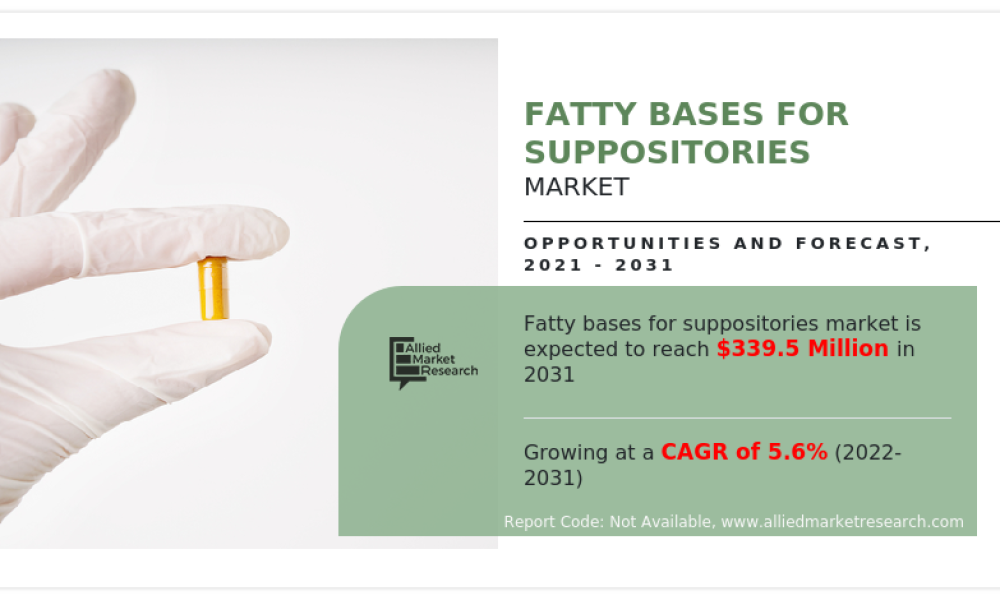
The global fatty bases for suppositories market was valued at $197.9 million in 2021 and is projected to reach $339.5 million by 2031, growing at a CAGR of 5.6% from 2022 to 2031. Fatty bases serve as critical excipients in suppository formulations, enabling effective drug delivery through rectal, vaginal, and urethral routes. These bases melt or dissolve at body temperature, ensuring optimal drug release and absorption.
Key Market Drivers
1. Advantages of Fatty Bases in Drug Delivery
Rapid absorption of low molecular-weight drugs.
Lymphatic system absorption bypasses first-pass metabolism.
Ideal for pediatric and geriatric patients who struggle with oral medications.
2. Rising Prevalence of Gynecological & Gastrointestinal Disorders
Bacterial vaginosis (BV) affects ~30% of European women of reproductive age.
Increasing cases of hemorrhoids, constipation, and inflammatory bowel disease (IBD) drive demand for rectal suppositories.
3. Growing Research on Antiretroviral & Antiviral Suppositories
Development of vaginal/rectal microbicides for HIV prevention and other viral infections.
Ongoing studies on topical antiviral drug delivery boost market potential.
4. Expanding Applications in Specialty Medicine
Used for pain management, nausea, hormonal therapy, and fever control.
Preferred for patients with swallowing difficulties (e.g., post-surgery, neurological disorders).
Market Segmentation
1. By Base Type
| Base Type | Market Share (2021) | Key Characteristics |
|---|---|---|
| Hard Fat | Largest segment | Derived from cocoa butter, melts at body temperature (~35°C). |
| Water-Miscible Base | Steady growth | Compatible with hydrophilic drugs, enhances dissolution. |
| Emulsifying Bases | Fastest-growing | Improves drug stability & absorption, preferred for hormonal & antiviral therapies. |
2. By Region
| Region | Market Share (2021) | Growth Factors |
|---|---|---|
| Europe | Dominant (~35%) | High gynecological disorder prevalence, strong pharmaceutical R&D. |
| North America | Significant | Rising geriatric population, demand for alternative drug delivery. |
| Asia-Pacific | Fastest-growing (CAGR ~6.5%) | Improving healthcare access, increasing GI disorder cases. |
| LAMEA | Emerging | Limited adoption due to cultural hesitancy, but growing awareness. |
Challenges & Restraints
❌ Low Patient Acceptance – Cultural reluctance toward rectal/vaginal drug delivery.
❌ Manufacturing Complexity – Requires precise temperature control to avoid polymorphic instability.
❌ Competition from Oral & Injectable Drugs – Suppositories remain a niche segment.
Future Opportunities
✅ Development of Bioadhesive Suppositories – Enhances retention & sustained release.
✅ Expansion in Emerging Markets – Rising healthcare expenditure in India, China, Brazil.
✅ Personalized Medicine – 3D-printed suppositories for customized dosing.
Key Market Players
Unither
Bliss GVS Pharma Ltd.
Delpharm
ATRAL
Aenova Holding GmbH
FAMAR
LGV (Laboratoires Mayoly Spindler)
Priyans Drugs
These companies focus on innovative formulations, strategic collaborations, and regulatory approvals to strengthen market presence.
Conclusion
The fatty bases for suppositories market is poised for steady growth, driven by rising demand for alternative drug delivery systems, increasing gynecological disorders, and advancements in suppository technology. While patient hesitancy and manufacturing challenges persist, innovations in emulsifying bases and antiviral applications present lucrative opportunities.
Europe leads the market, but Asia-Pacific is the fastest-growing region, fueled by improving healthcare infrastructure. With ongoing R&D in suppository-based therapies, the market is set to expand, offering effective solutions for patients with specific medical needs.
Key Takeaways (Bullet Points Summary)
✔ Market Size: $197.9M (2021) → $339.5M (2031) | CAGR: 5.6%
✔ Top Drivers: Pediatric/geriatric drug delivery, gynecological disorders, antiviral research
✔ Dominant Segments: Hard Fat (base type), Europe (region)
✔ Fastest-Growing Segment: Emulsifying Bases (due to better drug stability)
✔ Challenges: Patient reluctance, manufacturing complexities
✔ Future Trends: Bioadhesive suppositories, 3D printing, emerging market expansion




