
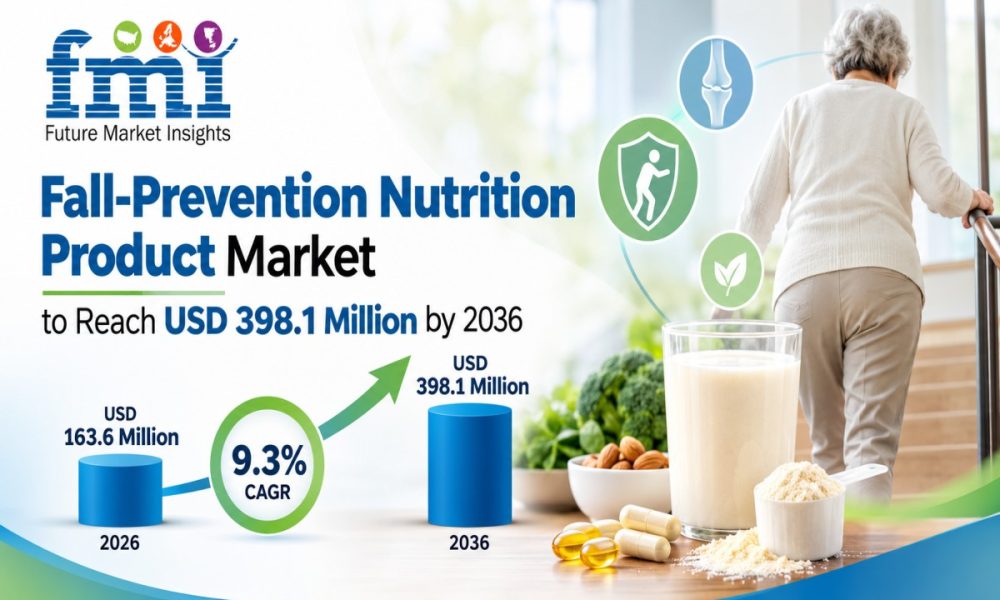
The global Fall-Prevention Nutrition Product Market is projected to reach USD 398.1 million by 2036, up from USD 163.6 million in 2026, expanding at a 9.3% CAGR during the forecast period, according to the latest analysis by Future Market Insights (FMI).
The market is being supported by increasing attention to nutrition among older adults undergoing fall assessment, rehabilitation and frailty management.
Get Detailed Market Forecasts, Competitive Benchmarking, and Pricing Trends:
https://www.futuremarketinsights.com/reports/sample/rep-gb-34838
Vitamin D + Calcium Products Lead Product Demand
Vitamin D + calcium products are estimated to account for 41.7% of product type demand in 2026, making them the leading category.
Their position is supported by familiar daily dosing, established pharmacy availability and their role in addressing identified bone-health and nutrient-adequacy needs. Vitamin D supports calcium absorption and bone mineralization, giving the category a defined nutritional role.
However, evidence limitations influence market positioning. Products are increasingly promoted around nutrient adequacy, bone health and identified deficiency rather than as stand-alone solutions for preventing falls.
Post-Fall Rehabilitation Drives Program Demand
Post-fall rehabilitation is projected to represent 48.5% of program-context demand in 2026.
A fall creates a defined period for reassessing nutritional status, mobility and muscle function. Healthcare teams can incorporate targeted nutrition products alongside rehabilitation activities when poor intake, frailty or specific nutrient needs are identified.
The rehabilitation setting also creates opportunities for products that can continue to be used after discharge, particularly when adherence and ease of administration are considered during product selection.
Tablets and Capsules Hold a Significant Share
Tablets and capsules are forecast to account for 40.9% of product-form demand in 2026.
These formats provide concentrated dosing, low storage requirements and convenient repeat purchasing. They are particularly suited to targeted supplementation where a complete oral nutrition serving is not required.
Alternative formats remain important because swallowing difficulties, pill burden and taste preferences can affect adherence among older adults. Ready-to-drink products and powders therefore provide additional routes for patients who may find tablets or capsules less convenient.
Long-Term Care Represents a Major End-User Segment
Long-term care is estimated to account for 41.6% of end-user demand in 2026.
Long-term care environments concentrate older adults with frailty, limited mobility and nutrition risks. Staff-led nutrition monitoring allows products to be introduced when a specific need is identified and enables continued observation of intake and adherence.
The setting can also support repeat purchasing because nutrition products can become part of scheduled nutrition routines when they are appropriate for individual care plans.
Evidence Limits Stand-Alone Prevention Claims
Evidence requirements remain an important market restraint.
Guidance does not support positioning vitamin D supplementation alone as a universal intervention for reducing fall risk. This limits broad prevention claims and encourages manufacturers to focus on documented nutrient needs, bone health, frailty and recovery.
Products must therefore balance commercial messaging with evidence-based nutritional applications.
Adherence-Focused Nutrition Creates Opportunities
Product formats designed around adherence can create additional growth opportunities.
Ready-to-drink oral nutrition supplements, powders, smaller serving formats and alternative flavors can help address poor appetite, taste fatigue and difficulties with conventional supplementation. Products that combine protein, vitamin D and other relevant nutrients can also support nutrition programs during rehabilitation when clinically appropriate.
South Korea Leads Growth Among Highlighted Markets
Among the highlighted country markets, South Korea is projected to record a 9.6% CAGR through 2036, followed by the USA at 9.0%, the UK at 8.7%, Germany at 8.4% and Japan at 7.2%.
South Korea’s growth is associated with expanding community-integrated care services that create additional opportunities to identify frailty and nutrition risks. The USA benefits from a large older-adult population, established healthcare infrastructure and mature pharmacy and supplement channels.
Competitive Landscape
The Fall-Prevention Nutrition Product Market includes clinical nutrition companies, consumer supplement manufacturers and senior-focused nutrition providers.
Key companies profiled by FMI include Abbott, Pharmavite (Nature Made), Nestle Health Science, Danone Nutricia, Haleon (Caltrate), Thorne, Meiji Holdings and Medtrition.
Competitive positioning is influenced by product breadth, clinical nutrition capabilities, protein and recovery formulations, bone-health portfolios, distribution access and the ability to provide formats suitable for older adults.
Key Industry Developments
The market continues to see product launches, manufacturing investments and formulation innovation.
In October 2025, Medtrition launched NutriConnect as a portfolio brand focused on personalized modular nutrition for healthcare settings.
In May 2025, Pharmavite opened a new production and research facility in New Albany, Ohio, following a reported USD 250 million investment.
In March 2025, Meiji Holdings introduced a savory soup-flavored version of its Meiji MeiBalance Mini Cup product in Japan, expanding compact balanced-nutrition options for older consumers.
Analyst Perspective
“Commercial value rises when a fall or frailty assessment identifies a specific nutrition gap and the product addresses that need without overstating prevention. Strong portfolios separate bone-health supplementation from protein-led recovery nutrition and choose formats that patients can keep using after discharge.” — Nandini Roy Choudhury, Principal Consultant, Future Market Insights
Exclusive Discounts on Full Report
Fall-Prevention Nutrition Product Market – https://www.futuremarketinsights.com/reports/fall-prevention-nutrition-product-market
Report Scope
The FMI study covers the Fall-Prevention Nutrition Product Market by product type, program context, product form, end user, sales channel and region. Product categories include vitamin D + calcium products, protein-vitamin D combo ONS, balance & neuro-muscular blends and others. Program contexts include post-fall rehabilitation, high-risk prevention programs and general 70+ prevention. Product forms include tablets-capsules, RTD ONS, powders and others.
End users include long-term care, home/self-care, community fall programs and others, while sales channels include online/DTC, retail pharmacy, supermarkets & hypermarkets, specialty & health stores and others.
The research covers North America, Latin America, Western Europe, Eastern Europe, East Asia, South Asia and Pacific, and the Middle East and Africa.
Key Executive Benefits
- Decision-Ready Insights
- Reduced Strategic Risk
- Market Entry Confidence
- Competitive Advantage
- Faster Growth Decisions
- Primary Market Validation
To explore how FMI Custom Research can support your strategic priorities, connect with our team at [email protected].
About Future Market Insights (FMI)
Future Market Insights, Inc. is an ESOMAR-certified, ISO 9001:2015 market research and consulting organization trusted by Fortune 500 companies. With a global presence across the U.S., UK, India and Dubai, FMI delivers data-driven insights across 30+ industries and 1,200 markets worldwide.



