
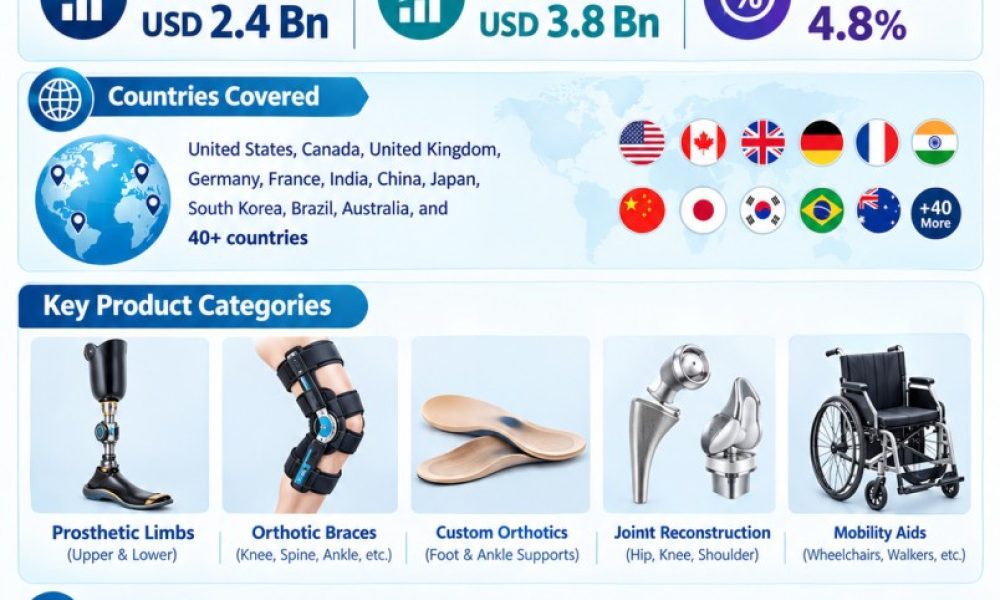
NEWARK, Del. — According to Future Market Insights (FMI), the global orthopedic prosthetic device market is estimated at USD 2.4 billion in 2025 and is projected to reach USD 3.8 billion by 2035, expanding at a 4.8% CAGR during the forecast period. The market is expected to add an absolute dollar opportunity of approximately USD 1.4 billion between 2025 and 2035.
Growth is being supported by rising limb loss associated with diabetes, vascular diseases, trauma, road accidents, sports injuries, and an aging population. At the same time, advances in electric-powered prosthetics, microprocessor-controlled joints, smart sensors, IoT integration, and 3D-printed components are improving mobility, comfort, customization, and rehabilitation outcomes.
👉 Get Detailed Market Forecasts, Competitive Benchmarking, and Pricing Trends:
https://www.futuremarketinsights.com/reports/sample/rep-gb-741
Key Market Highlights
- Market Size (2025): USD 2.4 billion
- Forecast Value (2035): USD 3.8 billion
- CAGR (2025–2035):8%
- Absolute Dollar Opportunity: USD 1.4 billion
- Leading Product: Lower Extremity Prosthetics, with 50% share
- Leading Technology: Electric-Powered Prosthetics, with 47% share
- Fastest-Growing Country: India, at 6.5% CAGR
- Slowest-Growing Profiled Country: United States, at 3.7% CAGR
- Key Growth Regions: North America, Europe, and Asia Pacific
Global Segment Leaders
Lower Extremity Prosthetics: Lower extremity prosthetics hold 50% of the market in 2025, making them the leading product category. Demand is linked to the prevalence of lower-limb amputations caused by diabetes, peripheral arterial disease, trauma, and vascular disorders. Microprocessor-controlled knees, energy-storing feet, and lightweight materials are improving mobility and reducing fatigue.
Electric-Powered Prosthetics: Electric-powered systems account for approximately 47% share in 2025, supported by microprocessor-controlled joints, smart sensors, and IoT capabilities. These technologies enable more adaptive movement, real-time gait adjustments, and improved user control compared with conventional systems.
Country-Level Market Performance
- India – 6.5% CAGR (2025–2035): Diabetes-related amputations, road injuries, government healthcare programs, rural access, and affordable local manufacturing.
- Spain – 5.9% CAGR (2025–2035): Aging population, sports injuries, 3D-printed customized prosthetics, and supportive reimbursement.
- Germany – 5.7% CAGR (2025–2035): Sustainable materials, digital fitting technologies, reimbursement, and high R&D investment.
- Italy – 5.3% CAGR (2025–2035): Aging population, clinical research, 3D printing, and healthcare infrastructure investment.
- Canada – 5.2% CAGR (2025–2035): Tele-orthotics, AI-enabled devices, sensor technologies, and government-backed access programs.
- United Kingdom – 4.2% CAGR (2025–2035): NHS digital orthopedics programs, rehabilitation services, chronic disease prevalence, and 3D printing.
- United States – 3.7% CAGR (2025–2035): Myoelectric and robotic prosthetics, insurance coverage, R&D investment, and rehabilitation infrastructure.
FMI’s country analysis covers 40+ countries, with seven top-performing OECD markets highlighted in the report.
India
India is forecast to record the strongest growth among the profiled countries, with a 6.5% CAGR. Rising diabetes-related lower-limb amputations and road accident injuries are expanding the patient base. Government healthcare programs and outreach initiatives are improving access to prosthetic care, particularly in rural and underserved areas. Local manufacturers are also developing cost-effective and modular systems.
Spain
Spain is projected to expand at 5.9% CAGR. Its aging population and sports-related injuries are supporting demand, while 3D printing is enabling more customized prosthetic components. Supportive reimbursement policies, improved distribution, and research activity are also contributing to adoption.
Germany
Germany is expected to register a 5.7% CAGR, supported by advanced digital fitting technologies and a focus on sustainable prosthetic materials. Carbon fiber and recyclable materials are being incorporated into durable prosthetic designs, while established reimbursement systems and strong R&D investment support technology adoption.
Italy
Italy is projected to grow at 5.3% CAGR. An aging population, increasing clinical research, personalized prosthetics enabled by 3D printing, and public and private investment in healthcare infrastructure are supporting market development.
Canada
Canada is forecast to expand at 5.2% CAGR, with tele-orthotics extending prosthetic services to remote populations. AI-enabled and sensor-integrated devices are improving functionality, while government programs and insurance coverage are helping reduce cost barriers to next-generation prosthetics.
United Kingdom
The UK market is expected to grow at 4.2% CAGR. NHS-backed digital orthopedics and rehabilitation programs, increasing chronic disease-related amputations, and the use of 3D printing for prosthetic manufacturing are supporting demand.
United States
The United States is projected to grow at 3.7% CAGR. Although growth is comparatively slower because of market maturity, the country remains a major technology market, supported by insurance coverage, myoelectric and robotic prosthetics, high R&D investment, and a strong rehabilitation ecosystem.
👉 Access the Complete Report in PDF Format:
https://www.futuremarketinsights.com/reports/brochure/rep-gb-741
Limb Loss and Rehabilitation Needs Drive Market Growth
The rising incidence of limb loss is a central growth factor for orthopedic prosthetic devices. Diabetes, vascular disease, trauma, road accidents, and sports injuries contribute to demand across both developed and emerging markets. An aging population further increases the need for mobility restoration and long-term rehabilitation.
Improving awareness of rehabilitation and mobility restoration is also encouraging patients and healthcare providers to consider advanced prosthetic solutions. Expanding healthcare infrastructure and specialized prosthetic clinics are improving access to fitting, rehabilitation, and follow-up services.
Smart Prosthetics and 3D Printing Expand Technology Opportunities
The market is moving beyond conventional prosthetic designs toward electric-powered systems, adaptive sensors, microprocessor-controlled joints, and connected devices. These technologies can adjust gait and movement in response to user activity, helping improve comfort and reduce fatigue.
3D printing is creating additional opportunities for patient-specific components. Manufacturers and clinics can use digital design and additive manufacturing to develop customized devices, while AI-enabled sensors and remote diagnostics are supporting more personalized care. Sustainable materials and energy-efficient designs are also emerging as areas of product development.
Cost and Accessibility Remain Key Challenges
Despite advances in prosthetic technology, access to sophisticated systems can remain constrained by cost and availability of specialized services. Advanced electric-powered and sensor-integrated devices require higher investment than conventional prosthetics, while fitting and rehabilitation require trained professionals.
The report also highlights differences in healthcare infrastructure and prosthetic access across regions. Expanding specialized clinics, government programs, reimbursement mechanisms, and tele-orthotics can help address these gaps.
Competitive Landscape
The orthopedic prosthetic device market includes established medical-device manufacturers as well as specialized and emerging companies. Zimmer Biomet, Össur hf., Stryker Corporation, and Blatchford Group are identified among the major players, with companies competing through product innovation, technology development, and broader healthcare-provider relationships.
Competitive activity is centered on electric-powered prosthetics, microprocessor-controlled joints, IoT-enabled systems, customized components, and improved patient support. Strategic collaborations with healthcare providers and prosthetic clinics are helping companies strengthen distribution and customer support, while emerging firms are developing niche products such as 3D-printed limbs and hybrid prosthetics.
Other companies profiled by FMI include Hanger Inc., Otto Bock HealthCare GmbH, Boston Orthotics & Prosthetics, Arm Dynamics, Inc., Steeper Group, and Trulife.
Report Scope
The orthopedic prosthetic device market is segmented as follows:
- By Product: Upper Extremity Prosthetics, Hand Prosthetics, Elbow Prosthetics, Shoulder Prosthetics, Lower Extremity Prosthetics, Foot & Ankle Prosthetics, Knee Prosthetics, Hip Prosthetics, Liners, Sockets, and Modular Components
- By Technology: Conventional, Electric-Powered, and Hybrid Orthopedic Prosthetics
- By End User: Hospitals, Prosthetic Clinics, Rehabilitation Centers, and Others
- By Region: North America, Latin America, Europe, South Asia, East Asia, Oceania, and Middle East & Africa
- Countries Covered: United States, Canada, United Kingdom, Germany, France, India, China, Japan, South Korea, Brazil, Australia, and 40+ countries
- Forecast Period: 2025–2035
Access Full Report: https://www.futuremarketinsights.com/reports/orthopedic-prosthetic-devices-market
About Future Market Insights (FMI)
Future Market Insights (FMI) is a global market intelligence and consulting firm providing comprehensive market research, competitive intelligence, and strategic business insights across industries. The firm delivers detailed forecasts, technology analysis, and data-driven recommendations that support informed decision-making for manufacturers, investors, distributors, and policymakers worldwide.
For Press & Corporate Inquiries
Rahul Singh
AVP – Marketing and Growth Strategy
Future Market Insights, Inc.
+91 8600020075



