
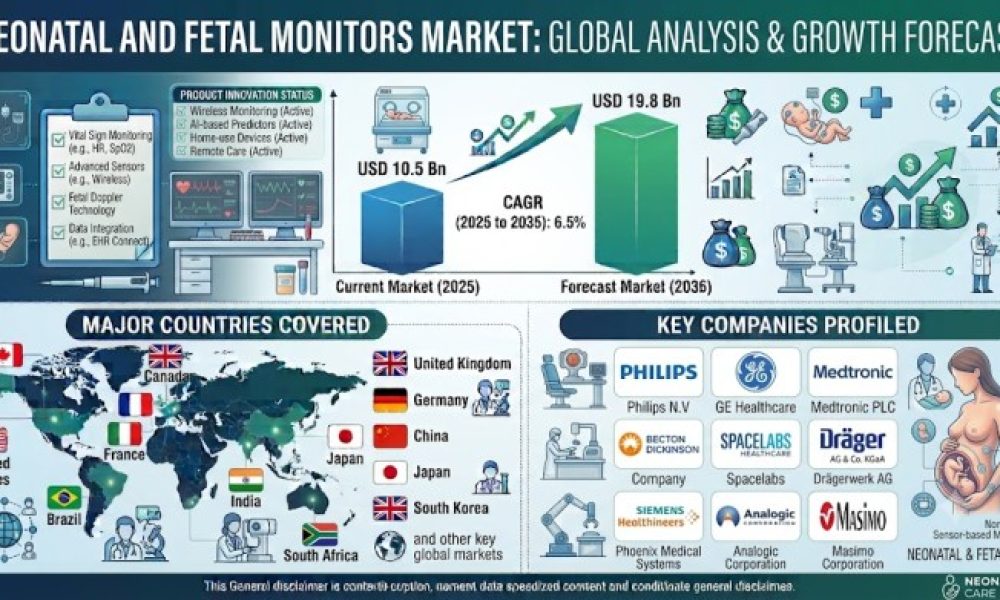
NEWARK, Del — According to Future Market Insights (FMI), the global neonatal and fetal monitors market is estimated at USD 10.5 billion in 2025 and is projected to reach USD 19.8 billion by 2035, expanding at a 6.5% CAGR during the forecast period. Increasing focus on maternal and infant safety, rising preterm birth risks, healthcare infrastructure investments, and advances in connected monitoring technologies are supporting demand for neonatal and fetal monitoring systems.
Fetal monitoring devices remain the leading product category, accounting for 56.7% of market revenue share in 2025. Hospitals represent the largest end-user segment, with 61.4% share, reflecting their role in high-risk pregnancies, deliveries, and neonatal intensive care.
👉 Get Detailed Market Forecasts, Competitive Benchmarking, and Pricing Trends:
https://www.futuremarketinsights.com/reports/sample/rep-gb-786
Key Market Highlights
- Market Size (2025): USD 10.5 billion
- Forecast Value (2035): USD 19.8 billion
- CAGR (2025–2035):5%
- Leading Product: Fetal Monitoring Devices, with 56.7% share
- Leading End User: Hospitals, with 61.4% share
- Fastest-Growing Country: China, at 8.8% CAGR
- Second-Fastest Country: India, at 8.1% CAGR
- Slowest-Growing Profiled Country: Brazil, at 4.9% CAGR
Global Segment Leaders
Fetal Monitoring Devices: Fetal monitoring devices are projected to account for 56.7% of market revenue in 2025, retaining their position as the leading product category. Their use in monitoring fetal heart rate, uterine activity, and vital signs throughout pregnancy and labor supports continued demand, particularly in high-risk pregnancies.
Hospitals: Hospitals are projected to hold 61.4% of market revenue share in 2025. High-risk pregnancy management, delivery volumes, neonatal intensive care, specialist staff availability, and investments in advanced diagnostic technologies make hospitals the primary setting for neonatal and fetal monitoring equipment.
Country-Level Market Performance
- China – 8.8% CAGR (2025–2035): Healthcare infrastructure expansion, rising awareness, and increasing demand for advanced maternal and neonatal care.
- India – 8.1% CAGR (2025–2035): Growing healthcare access, rising hospital capacity, and increased focus on maternal and newborn health.
- Germany – 7.5% CAGR (2025–2035): Strong healthcare infrastructure and continued demand for advanced monitoring systems.
- France – 6.8% CAGR (2025–2035): Maternal and neonatal healthcare programs and adoption of connected monitoring technologies.
- United Kingdom – 6.2% CAGR (2025–2035): Institutional maternity care and investment in monitoring technologies.
- United States – 5.5% CAGR (2025–2035): Advanced healthcare infrastructure, high healthcare expenditure, and continued device development.
- Brazil – 4.9% CAGR (2025–2035): Expanding healthcare awareness and gradual development of maternity and neonatal care infrastructure.
China leads the country comparison at 8.8% CAGR, followed by India at 8.1% and Germany at 7.5%. France is projected to grow at 6.8%, while the UK and USA are expected to register CAGRs of 6.2% and 5.5%, respectively. Brazil records the lowest CAGR among the countries highlighted by FMI at 4.9%.
Germany is expected to remain an important Western European market, with a 7.5% CAGR. The USA market is estimated at USD 4.0 billion in 2025 and is projected to reach USD 6.8 billion by 2035, also reflecting a 5.5% CAGR. FMI additionally identifies 2025 market values of USD 520.0 million for Japan and USD 295.3 million for South Korea.
👉 Access the Complete Report in PDF Format:
https://www.futuremarketinsights.com/reports/brochure/rep-gb-786
Maternal and Infant Safety Strengthen Monitoring Demand
The growing focus on maternal and infant health is supporting demand for continuous monitoring technologies. Rising preterm birth risks and complications during pregnancy increase the need for systems capable of tracking fetal and neonatal conditions and helping healthcare professionals identify abnormalities early.
Government healthcare programs aimed at promoting safe childbirth and reducing newborn mortality are also supporting adoption. Increasing awareness of maternal health in emerging economies, combined with investments in healthcare infrastructure, is broadening access to monitoring technologies.
Wireless Connectivity Creates New Opportunities
Technological development is changing how neonatal and fetal monitoring systems are deployed in maternity and neonatal care settings. Wireless connectivity and real-time data transmission can improve patient mobility and comfort during labor while allowing clinical teams to maintain visibility of vital information.
Integration with hospital information systems and electronic medical records is also supporting adoption. Connected monitoring platforms can improve workflow and enable more timely clinical decisions, particularly in high-acuity maternity and neonatal environments.
Multiple Pregnancies and Preterm Birth Risk Support Adoption
The increasing frequency of multiple pregnancies associated with reproductive treatments is identified by FMI as another factor supporting demand. Twin and triplet pregnancies can carry greater risks of premature birth, increasing the need for fetal and neonatal monitoring before and after delivery.
Healthcare authorities in developing countries are also increasing awareness initiatives aimed at lowering newborn mortality. These efforts, alongside improving hospital and clinic infrastructure, are creating additional opportunities for monitoring equipment manufacturers.
Competitive Landscape
The neonatal and fetal monitors market includes global medical technology companies with established portfolios in maternal, fetal, and neonatal monitoring. Koninklijke Philips N.V., GE Healthcare, Medtronic PLC, Becton, Dickinson and Company, Spacelabs Healthcare, Drägerwerk AG & Co. KGaA, Siemens Healthineers, Phoenix Medical Systems, Analogic Corporation, and Masimo Corporation are among the key companies profiled by FMI.
Competition is shaped by sensor reliability, connected monitoring capabilities, hospital integration, service support, and training. Companies offering systems that improve clinical visibility across maternity wards and neonatal care units can strengthen their position as healthcare providers modernize monitoring infrastructure.
Access Full Report: https://www.futuremarketinsights.com/reports/neonatal-and-fetal-monitors-market
Analyst Perspective
“Neonatal and fetal monitor demand reflects stronger focus on maternal and infant safety. Fetal monitoring devices remain central in labor and pregnancy assessment. Hospitals lead due to delivery volume and specialist care teams. Connectivity improves clinical visibility across maternity units. Manufacturers with reliable sensors and training support can improve provider confidence.”
— Anurag Sharma, Principal Consultant at Future Market Insights
Report Scope
The neonatal and fetal monitors market is segmented as follows:
- By Product: Fetal Monitoring Devices and Neonatal Monitoring Devices
- Fetal Monitoring Devices: Heart Rate Monitors, Uterine Contraction Monitors, Pulse Oximeters, and Others
- Neonatal Monitoring Devices: Cardiac Monitors, Capnography, Blood Pressure Monitors, Pulse Oximeters, and Others
- By End User: Hospitals and Neonatal Care Centers
- Regions: North America, Latin America, Western Europe, Eastern Europe, East Asia, South Asia & Pacific, and Middle East & Africa
- Countries Covered: United States, Canada, Germany, France, United Kingdom, China, Japan, India, Brazil, South Africa, and other markets
- Key Companies: Koninklijke Philips N.V., GE Healthcare, Medtronic PLC, Becton, Dickinson and Company, Spacelabs Healthcare, Drägerwerk AG & Co. KGaA, Siemens Healthineers, Phoenix Medical Systems, Analogic Corporation, and Masimo Corporation
About Future Market Insights (FMI)
Future Market Insights (FMI) is a global market intelligence and consulting firm providing comprehensive market research, competitive intelligence, and strategic business insights across industries. The firm delivers detailed forecasts, technology analysis, and data-driven recommendations that support informed decision-making for manufacturers, investors, distributors, and policymakers worldwide.
For Press & Corporate Inquiries
Rahul Singh
AVP – Marketing and Growth Strategy
Future Market Insights, Inc.
+91 8600020075



