
NEWARK, Del — According to Future Market Insights, the global dialysis equipment market is projected to grow from USD 11.66 billion in 2025 to USD 18.63 billion by 2035, expanding at a 4.8% CAGR during the forecast period. Rising chronic kidney disease and end-stage renal disease prevalence, increasing diabetes and hypertension burden, and expanding access to home-based dialysis are supporting demand for dialysis machines, consumables, and related equipment.
Haemodialysis devices remain the dominant product category, accounting for 60.3% of market value share in 2025. Chronic kidney disease represents 70.5% of value share, reflecting the recurring treatment requirements of patients with progressive renal impairment. At the end-use level, home care settings are the fastest-growing segment, projected to expand at a 6.5% CAGR from 2025 to 2035.
👉 Get Detailed Market Forecasts, Competitive Benchmarking, and Pricing Trends:
https://www.futuremarketinsights.com/reports/sample/rep-gb-711
Key Market Highlights
- Market Size (2025): USD 11.66 billion
- Forecast Value (2035): USD 18.63 billion
- CAGR (2025–2035):8%
- Leading Product: Haemodialysis devices, with 60.3% share
- Leading Disease Condition: Chronic kidney disease, with 70.5% share
- Fastest-Growing End Use: Home care settings, at 6.5% CAGR
- Leading Country: United States, at 5.3% CAGR
- Other Key Countries: Japan 5.2%, Germany 5.1%, United Kingdom 5.0%, France 5.0%
Global Segment Leaders
Haemodialysis Devices: Haemodialysis devices account for 60.3% of the market in 2025, supported by their established use in treating chronic kidney disease and end-stage renal disease. Demand is also being supported by improvements in membrane design, biocompatible materials, automated monitoring, and home-friendly equipment.
Chronic Kidney Disease: CKD represents 70.5% of market value share in 2025. Unlike acute renal conditions that may require short-term intervention, CKD creates sustained demand for regular dialysis treatment, supporting recurring equipment and consumable requirements.
Home Care Settings: Home care is projected to record the fastest growth among end-use segments at 6.5% CAGR through 2035. Device miniaturization, automation, remote monitoring, and patient demand for greater treatment flexibility are encouraging the shift toward home-based dialysis.
Country-Level Market Performance
- United States – 5.3% CAGR (2025–2035): Rising CKD and ESRD prevalence, advanced healthcare infrastructure, reimbursement support, and adoption of portable and home-based systems.
- Japan – 5.2% CAGR (2025–2035): High dialysis-patient population, state-supported healthcare coverage, and adoption of compact and advanced blood-purification systems.
- Germany – 5.1% CAGR (2025–2035): Established healthcare infrastructure, aging population, renal-health awareness, and increasing acceptance of home dialysis.
- United Kingdom – 5.0% CAGR (2025–2035): NHS support for home dialysis, aging population, and development of compact and patient-friendly systems.
- France – 5.0% CAGR (2025–2035): Rising CKD incidence, home-based dialysis adoption, reimbursement schemes, and automated peritoneal dialysis technologies.
The United States is projected to expand at 5.3% CAGR, with obesity, diabetes, hypertension, CKD, and ESRD contributing to dialysis demand. Advanced healthcare infrastructure and favorable reimbursement policies are also supporting adoption of portable and home-based dialysis systems.
Japan follows at 5.2% CAGR. Its large dialysis-patient population, aging society, state-sponsored healthcare coverage, and strong local manufacturing capabilities support continued equipment demand. Compact and wearable dialysis units are among the technologies shaping the market.
Germany is forecast to grow at 5.1% CAGR, supported by its established healthcare system, aging population, and rising acceptance of peritoneal and home dialysis. The United Kingdom and France are each projected to grow at 5.0% CAGR, with home-based care, reimbursement support, and improvements in automated dialysis technologies contributing to market development.
Smart Technology Reshapes Dialysis Equipment
Dialysis equipment manufacturers are incorporating remote monitoring, AI-driven analytics, cloud connectivity, and automated controls into treatment systems. These technologies are designed to support treatment personalization, predictive maintenance, clinician oversight, and home-based care.
Fresenius Medical Care offers smart home haemodialysis and peritoneal dialysis systems with remote monitoring capabilities. Baxter’s HomeChoice Claria APD system is integrated with the Sharesource platform, while Outset Medical’s Tablo system combines automated processes, touchscreen operation, and data connectivity for clinical and home use. Quanta Dialysis Technologies and Renalyx Health Systems are also developing compact and connected dialysis platforms.
Aging Population and ESRD Prevalence Drive Demand
Population aging is a significant demand driver for dialysis equipment because the risk of chronic kidney disease and end-stage renal disease increases with age. Longer life expectancy is also contributing to a larger population requiring long-term renal care.
The rising prevalence of ESRD is another major factor. The report cites American Kidney Fund data indicating that up to 37 million Americans have kidney disease, with nearly 808,000 people living with kidney failure and more than 557,000 people on dialysis.
Growing awareness of kidney health is also encouraging screening, chronic disease management, and earlier intervention. These initiatives can help identify CKD before it progresses and increase the need for ongoing renal-care infrastructure.
High Manufacturing and Maintenance Costs Remain a Constraint
Dialysis equipment requires sophisticated engineering, high-precision components, pumps, filtration systems, sensors, and durable materials. Stringent safety and quality requirements further increase manufacturing and validation costs.
Ongoing maintenance also adds to the cost of ownership. Dialysis machines require routine servicing, replacement of finite-life components, and skilled technical support. These costs can restrict access to advanced dialysis equipment in low- and middle-income markets where healthcare budgets are constrained.
👉 Access the Complete Report in PDF Format:
https://www.futuremarketinsights.com/reports/brochure/rep-gb-711
Competitive Landscape
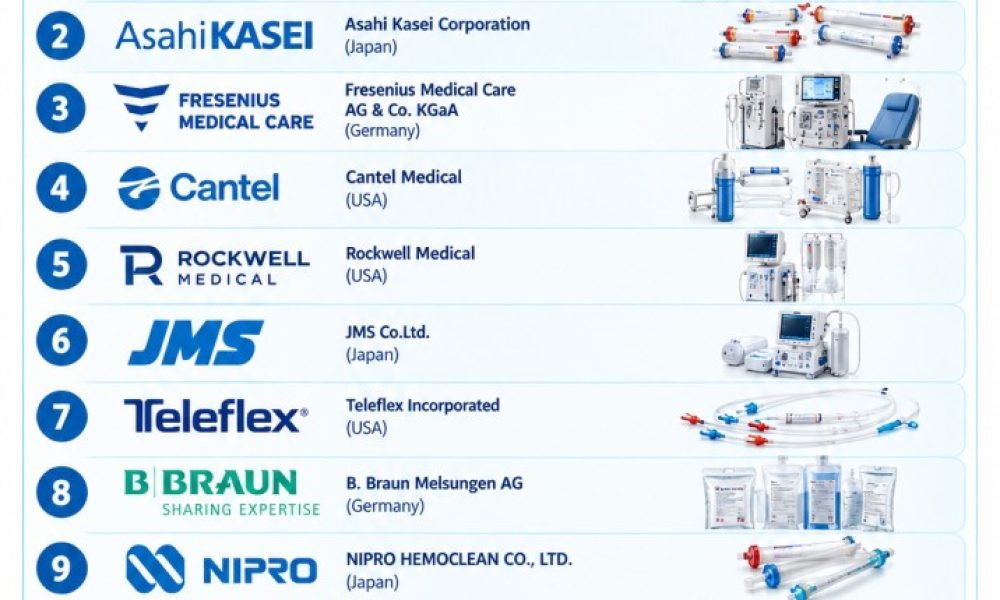
The dialysis equipment market remains competitive, with Tier 1 companies accounting for 54.4% of global market share. Major participants include Baxter, Asahi Kasei Corporation, Fresenius Medical Care AG & Co. KGaA, and Cantel Medical. Tier 2 participants include Rockwell Medical, JMS, Teleflex, B. Braun Melsungen, and NIPRO, while companies such as HEMOCLEAN, Quanta, and Outset Medical participate in specialized areas.
Manufacturers are focusing on R&D, strategic partnerships, product differentiation, service networks, and expanded distribution. Smart connectivity and home-use capabilities are becoming increasingly important as providers and patients seek more flexible dialysis models.
Recent Industry Developments
- May 2024: Asahi Kasei acquired Calliditas Therapeutics AB as part of its strategy to strengthen growth as a global healthcare company.
- July 2023: Baxter announced Vantive as the name for its proposed spinoff of its Renal Care and Acute Therapies businesses.
- November 2021: Braun Avitum strengthened its extracorporeal blood-treatment portfolio through the takeover of the business operations of Nephtec GmbH.
Analyst Perspective
“Dialysis equipment demand remains linked to chronic kidney disease and long-term renal care. Haemodialysis devices dominate because center-based treatment remains the main care model. Home care settings are expanding as patients seek flexibility and lower travel burden. Consumables strengthen recurring revenue across treatment cycles. Suppliers with service support and reliable consumable supply can improve provider confidence.”
— Anurag Sharma, Principal Consultant at Future Market Insights
Report Scope
The dialysis equipment market is segmented as follows:
- By Product: Haemodialysis Devices, Peritoneal Dialysis Devices, and Continuous Renal Replacement Therapy
- Haemodialysis Devices: Haemodialysis Machines, Dialyzers and Filters, and Vascular Access Devices
- Peritoneal Dialysis Devices: Dialyzers and Filters and Vascular Access Devices
- By Disease Condition: Chronic and Acute
- By End Use: Hospitals, Clinics, Ambulatory Surgical Centres, and Home Care Settings
- By Region: North America, Latin America, Europe, South Asia, East Asia, Oceania, and Middle East & Africa
- Key Companies: Baxter, Asahi Kasei Corporation, Fresenius Medical Care AG & Co. KGaA, Cantel Medical, Rockwell Medical, JMS Co. Ltd., Teleflex Incorporated, B. Braun Melsungen AG, NIPRO, HEMOCLEAN Co., Ltd., Quanta, and Outset Medical, Inc.
Access Full Report: https://www.futuremarketinsights.com/reports/dialysis-equipment-market
About Future Market Insights (FMI)
Future Market Insights (FMI) is a global market intelligence and consulting firm providing comprehensive market research, competitive intelligence, and strategic business insights across industries. The firm delivers detailed forecasts, technology analysis, and data-driven recommendations that support informed decision-making for manufacturers, investors, distributors, and policymakers worldwide.
For Press & Corporate Inquiries
Rahul Singh
AVP – Marketing and Growth Strategy
Future Market Insights, Inc.
+91 8600020075



