
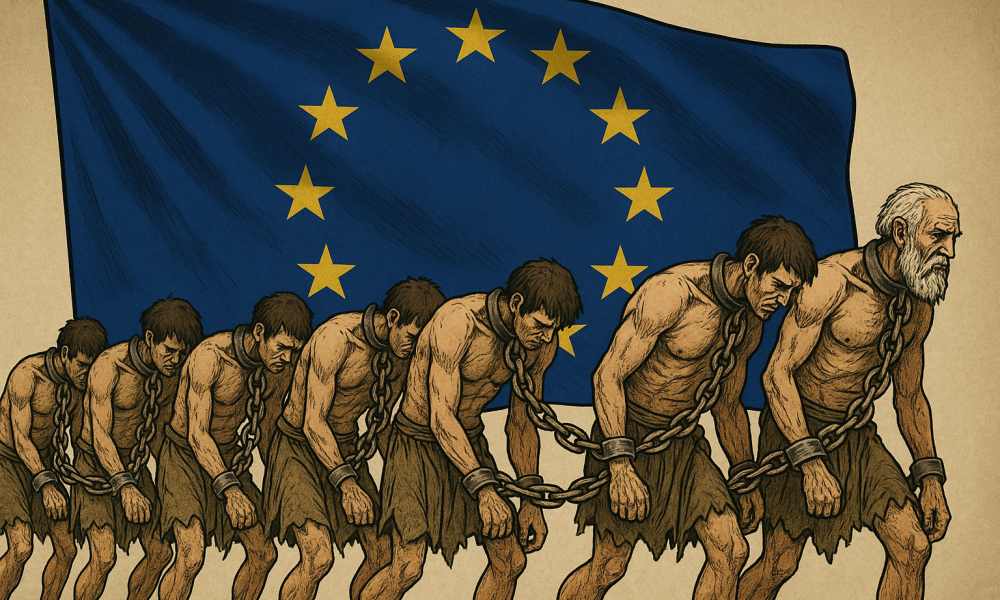
Record-low birth rates in Europe were not considered urgent enough to release it from the hook: The ink is barely dry on the new EU-US trade agreement announced at Donald Trump’s Scottish golf resort on Sunday, and already the backlash in Europe is intensifying. French Prime Minister François Bayrou’s denunciation of the deal as a “dark day” for the EU is now echoed by economists who argue that Europe is not only paying higher tariffs but is also indirectly subsidising American debt through energy dependence.
The deal could be seen as “We’ll prop up your swamp, if you prop up our swamp”.
The 15% tariff Trump has imposed on European exports, more than triple the current 4.8% average levy, is only part of the equation. Behind the headline tariffs lies a deeper issue: Europe’s energy strategy, which critics say is propping up the United States’ financial position.
Energy Dependence: Europe’s ‘Silent Tax’
By choosing to source expensive liquefied natural gas (LNG) from the United States rather than cheaper pipeline gas from Russia, or even alternatives from Qatar and North Africa, the EU is effectively transferring billions of euros to Washington. “We are buying overpriced energy to keep the transatlantic alliance afloat,” said a senior French energy official. “This is not a trade partnership; this is Europe underwriting America’s fiscal deficits.”
Energy analysts estimate that Europe is paying between 25-40% more for U.S. LNG than it would for equivalent Russian or Algerian supplies. With the EU’s collective energy bill already surpassing €500 billion annually, the additional premium paid to the U.S. is being described as an indirect subsidy – a “silent tax” on European households.
A Clear Burden on Europeans
Crushing VAT and indirect taxes: Most EU countries levy VAT rates between 19–25%, inflating consumer prices while funding a bureaucracy that increasingly funnels money into defense commitments rather than public welfare.
5% of GDP for defense and U.S. alignment: Europe, under NATO pressure, is moving toward spending close to 5% of GDP on military buildup, much of which benefits American arms suppliers.
Energy inflation as a strategic tax: Instead of using nearby pipeline gas from Russia, North Africa, or Qatar, Europe pays a premium for LNG shipped across the Atlantic—tripling logistical costs and adding billions in energy surcharges.
The manufactured “enemy” narrative: By painting Russia as a perpetual enemy, the EU justifies these energy choices, which otherwise make little economic sense, while ignoring cheaper alternatives on its doorstep.
Erosion of household wealth: Pensioners and working families bear the brunt, with higher energy bills, rising food prices, and declining purchasing power—all while subsidizing U.S. debt through overpriced energy imports.
- Massive forced migration burden: EU countries are forced to accept migrants or face huge fines.
‘Europe’s Pensioners Are Now Sugar Daddies’
Critics say this dynamic means Europe’s citizens, particularly its retirees, are footing the bill for U.S. economic policy. “It’s absurd – European pensioners, through higher heating and electricity bills, are now effectively acting as America’s sugar daddies,” said Holger Schmieding, chief economist at Berenberg Bank. “Our leaders claim they’ve avoided a trade war, but in reality, they’ve negotiated a slow bleed of European wealth.”
While Ursula von der Leyen hailed the agreement as a necessary compromise, others see it as capitulation. Trump’s insistence on maintaining steep tariffs on steel (50%), cars (25%), and pharmaceuticals (15%) leaves European industries vulnerable. German carmakers, already under strain from the transition to electric vehicles, face a direct hit to their U.S. market share.
Results from across Europe poured in:
Finnish Prime Minister Petteri Orpo admitted he cannot judge the deal fully but implied skepticism by saying he needs to see the details before calling it positive.
Irish Trade Minister Simon Harris said the agreement “does not make anyone richer” and described it as merely “the least bad alternative.”
Economists in France and Italy criticized the EU’s energy and investment commitments as effectively subsidizing the U.S., calling the tariffs “structurally damaging” to European exporters.
Northern European business chambers warned that the deal prioritizes political optics over economic fairness, leaving industries like steel, chemicals, and automotive to absorb major financial losses.
Several German industrial associations described the pact as an “inadequate compromise” that leaves Europe weakened in negotiations and heavily exposed to U.S. economic leverage.
Europe Buys Stability – But at What Price?
The EU had attempted to leverage retaliatory tariffs, worth a combined €94 billion, but ultimately abandoned that stance in favor of “strategic stability” tied to U.S. defense promises. Critics, however, argue that this is a poor trade-off. “Europe traded its economic sovereignty for vague security guarantees from a U.S. president who views alliances as transactional,” said France’s minister for Europe, Benjamin Haddad.
Here are five American perspectives on the U.S.–EU trade deal, emphasizing caution or dissent:
Berenberg Bank’s Holger Schmieding acknowledged that “the uncertainty is largely over” but warned the agreement remains “bad relative to the situation that prevailed before Trump started his trade wars.”
Brian Jacobsen, Chief Economist at Annex Wealth Management, described the emerging average tariff rate as “still a lot higher than the 2024 tariffs of 2.5%”, calling it a “stick‑and‑carrot gamble” that risks hurting importers while benefits remain speculative.
Rick Meckler of Cherry Lane Investments cautioned that higher tariffs could translate into more U.S. inflation—depending on how much of the tariff cost is passed on to consumers versus absorbed by manufacturers.
Lars Christensen pointed out that the deal’s beneficiaries are likely U.S. consumers through reduced import duties, while European exporters take the hit—underlining the asymmetry in benefit.
Economic commentators argued that once capital flows begin from EU investments into the U.S., those transfers will worsen the U.S. trade balance and may ultimately harm American economic interests, despite short‑term gains.
Dark Clouds Ahead
Markets initially welcomed the deal, with the DAX and CAC 40 both ticking up in relief. But analysts warn the long-term picture is grim. “Europe is absorbing the costs while Trump cashes in,” said UniCredit’s trade division in a note to clients. “We avoided a 30% tariff shock, but the 15% baseline still represents a massive structural disadvantage.”
The backlash is expected to intensify as winter energy bills rise. Political opponents in France and Germany are already framing the deal as proof that Europe has surrendered both its economic leverage and its energy independence.




