
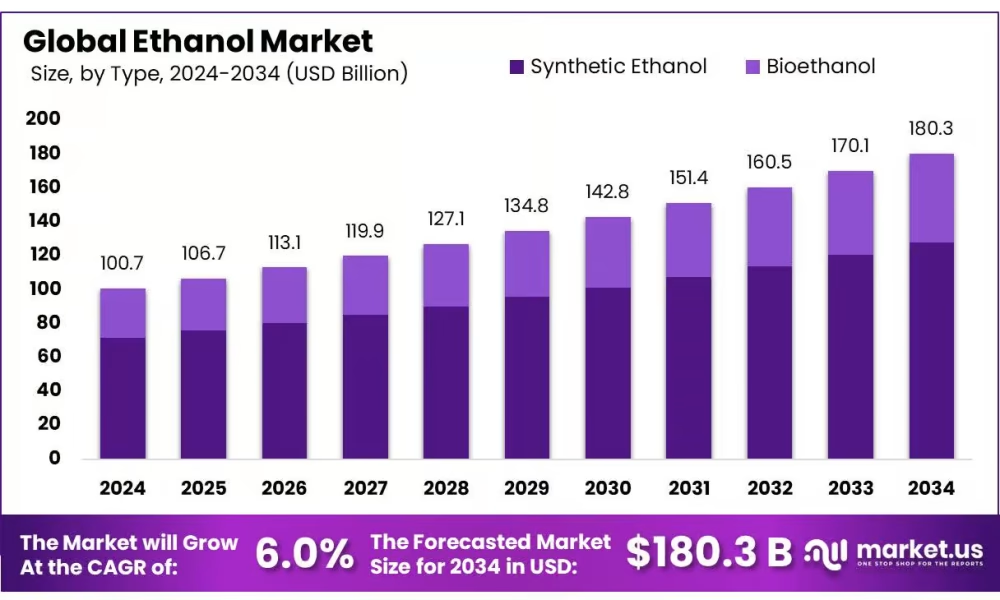
According to market.us, the global ethanol market is projected to reach approximately USD 180.3 billion by 2034, growing from USD 100.7 billion in 2024, at a compound annual growth rate (CAGR) of 6.0% during the forecast period from 2025 to 2034. Ethanol, a bio-based fuel, is primarily derived from biomass materials such as corn and other plant sources.
In the United States, nearly 94% of ethanol is produced from corn starch, and more than 98% of the gasoline sold contains ethanol to help oxygenate the fuel and reduce emissions. Commonly blended as E10 (10% ethanol, 90% gasoline), ethanol contributes to lower air pollution levels, while E85 (up to 83% ethanol) is used in flex-fuel vehicles.
Ethanol can be produced through fermentation or chemical synthesis and is typically obtained as a dilute aqueous solution. Fractional distillation yields a 95.6% ethanol mixture, which is further dehydrated to produce absolute alcohol. Industrial ethanol is usually denatured with substances like methanol or kerosene.
In biological preservation, ethanol remains the preferred solution, with concentrations of 70% for general use and 90% or more for genetic studies. Ethanol’s renewable nature, energy efficiency, and wide industrial applications are key factors propelling its global demand and long-term market growth.
Key Takeaways
- The Global Ethanol Market is projected to grow from USD 100.7 billion in 2024 to USD 180.3 billion by 2034, at a 6.0% CAGR.
- Synthetic ethanol dominates the market by type, holding over 71.2% share due to cost-effective production and industrial use.
- Denatured ethanol leads in purity, capturing 59.2% share, driven by its use in industrial and fuel applications.
- Corn is the top source for ethanol, holding a 48.2% share, supported by strong biofuel demand and agricultural infrastructure.
- Fuel is the largest application segment, with a 41.1% share, as ethanol is widely used as a renewable fuel additive.
- North America leads the ethanol market with a 48.2% share, generating USD 48.5 billion, driven by the U.S. as the top producer and consumer.
Access a Complimentary Sample of This Premium Report: https://market.us/report/ethanol-market/request-sample/
Factors Affecting the Growth of the Ethanol Market
Government Policies and Mandates: The growth of the ethanol market is significantly influenced by national and regional biofuel blending mandates. Many countries have introduced renewable fuel standards requiring a certain percentage of ethanol to be blended with gasoline. These policies are aimed at reducing greenhouse gas emissions and promoting energy independence, thereby directly supporting ethanol demand.
Availability of Feedstock: Ethanol production largely depends on the availability of raw materials such as corn, sugarcane, and other biomass. Seasonal variations, crop yields, and weather conditions can impact feedstock supply and pricing, which in turn affect ethanol production capacity and market stability.
Fluctuations in Crude Oil Prices: Ethanol competes with gasoline and other fossil fuels. When crude oil prices rise, ethanol becomes a more attractive alternative fuel, leading to increased demand. Conversely, falling oil prices may reduce the economic incentive for ethanol usage, especially in markets without strict blending regulations.
Technological Advancements in Production: Improvements in fermentation processes, enzyme efficiency, and cellulosic ethanol technologies are enabling more cost-effective and higher-yield ethanol production. Technological progress also plays a key role in expanding the use of non-food biomass sources, enhancing sustainability.
Environmental and Climate Considerations: Growing global awareness regarding climate change and environmental sustainability is driving a shift toward cleaner energy sources. Ethanol, as a renewable and lower-emission fuel, is benefiting from this trend. Its role in reducing vehicle emissions and reliance on fossil fuels makes it a favorable option in the transition to a low-carbon economy.
Key Market Segmentation
By Type Analysis
In 2024, synthetic ethanol accounted for over 71.2% of the global ethanol market by type, establishing a dominant position. This dominance is attributed to its widespread use in industrial applications and its cost-effective production, especially in regions with easy access to petrochemical feedstocks.
Derived mainly from ethylene, synthetic ethanol is favored in non-food-grade applications such as solvents, chemical intermediates, and personal care products. Its consistent quality and reliable supply continue to support demand in industries like cosmetics, paints, and pharmaceuticals.
While bioethanol is gaining traction in the fuel sector due to policy support, synthetic ethanol remains the preferred option in sectors requiring purity and affordability outside of transportation use.
By Purity Analysis
In 2024, denatured ethanol captured a leading 59.2% share of the global ethanol market by purity. Its dominance is driven by widespread use in industrial and fuel applications, where it is chemically altered to prevent human consumption. Supported by government mandates, particularly in countries like India and Brazil, denatured ethanol is favored for biofuel blending to reduce emissions.
Its cost-effectiveness compared to undenatured ethanol further boosts its adoption in manufacturing and energy sectors. As renewable energy initiatives grow, the demand for denatured ethanol is expected to remain strong due to its storage, distribution, and blending advantages.
By Source Analysis
In 2024, corn accounted for 48.2% of the global ethanol market by source, maintaining its position as the primary feedstock, especially in the United States. Its dominance is supported by a well-established agricultural system and strong demand for biofuels driven by government blending mandates.
Corn-based ethanol continues to benefit from reliable supply chains and mature fermentation technology, making it a preferred option for large-scale fuel production. Despite concerns over feedstock costs and land use, corn is expected to retain its lead, with producers focusing on yield improvements and sustainable practices to address long-term challenges.
By Application Analysis
In 2024, fuel applications accounted for 41.1% of the global ethanol market, making it the leading segment by application. This growth is driven by ethanol’s role as a renewable fuel additive, particularly in efforts to lower emissions and reduce dependence on fossil fuels. Government blending mandates such as E10 and E20 have significantly boosted demand for fuel-grade ethanol, especially in Asia-Pacific and Latin America.
Ethanol’s clean-burning properties, affordability, and compatibility with existing engines support its continued use, even as electric vehicles gain market share. Its role remains vital in the ongoing transition toward cleaner energy in transportation.
Key Market Segments
By Type
- Synthetic Ethanol
- Bioethanol
By Purity
- Denatured
- Undenatured
By Source
- Corn
- Sugarcane
- Wheat
- Cellulose
- Petrochemical
- Others
By Application
- Pharmaceuticals
- API
- Disinfectants
- Herbal Medicinal Products
- Syrups
- Others
- Fuel
- E5
- E10
- E15 to E70
- E75 and E85
- Others
- Personal Care and Cosmetics
- Perfumes and Fragrances
- Hair Care
- Hygiene Products
- Skin Care
- Others
- Beverages
- Chemicals
- Others
Regional Analysis
In 2024, North America led the global ethanol market with a dominant 48.2% share, generating approximately USD 48.5 billion in revenue. This leadership is largely driven by the United States, the world’s top ethanol producer and consumer. The U.S. Renewable Fuel Standard (RFS) has played a key role by mandating renewable fuel blending, encouraging large-scale investments in corn-based ethanol production, particularly in the Midwest.
In the same year, the U.S. exported a record 1.9 billion gallons of ethanol, valued at USD 4.3 billion. Technological advancements in enzyme and fermentation processes have further improved efficiency and reduced production costs. With strong policy backing and ongoing innovation, North America is expected to maintain its dominant market position.
Top Key Players in the Market
- The Archer Daniels Midland Company
- POET, LLC
- Valero Energy Corporation
- Green Plains
- Advanced BioEnergy LLC
- Cargill, Incorporated
- INEOS
- HBL
- LyondellBasell Industries
- Sasol
- Marquis Energy LLC
- Pannonia Bio
- BIOAGRA SA
- Balrampur Chini Mills Ltd
- Shree Renuka Sugars Ltd
- The Andersons Inc.
- Bajaj Hindusthan Limited
- Triveni Group
- Raízen
Get in Touch with Us:
Market.us (Powered By Prudour Pvt. Ltd.)
Address: 420 Lexington Avenue, Suite 300 New York City, NY 10170, United States
Send Email: [email protected]
Refer to More Related Reports:



