
The enterprise VSAT market has emerged as a vital pillar of global business connectivity, enabling reliable communication across remote, offshore, and infrastructure-poor regions. Enterprises operating in sectors such as BFSI, energy, mining, maritime, and government increasingly rely on VSAT (Very Small Aperture Terminal) networks to ensure uninterrupted data, voice, and video transmission. Unlike terrestrial networks, enterprise VSAT solutions offer resilience, redundancy, and wide coverage, making them indispensable for mission-critical operations.
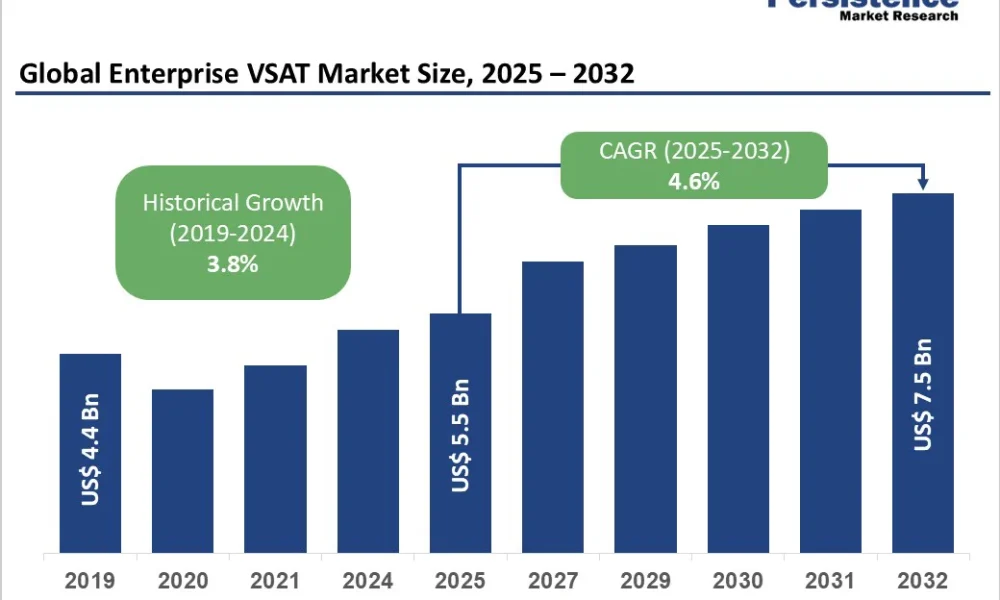
In terms of market statistics, the global enterprise VSAT market size is likely to be valued at US$ 5.5 billion in 2025 and is estimated to reach US$ 7.5 billion by 2032, expanding at a CAGR of 4.6% during 2025–2032. Growth is primarily driven by rising demand for high-speed and secure communication networks in remote and underserved areas, alongside the steady expansion of energy, mining, and BFSI industries. Hardware systems dominate the component landscape, while North America leads the market due to mature satellite infrastructure and early adoption of hybrid and multi-orbit VSAT solutions.
Key Highlights from the Enterprise VSAT Market Report
- The enterprise VSAT market is projected to grow steadily, reaching US$ 7.5 billion by 2032.
- Enterprise VSAT hardware systems account for over 60% market share due to performance control and upgrade flexibility.
- Shared bandwidth VSAT systems dominate product demand, favored by enterprises with geographically dispersed operations.
- BFSI remains the leading end-use industry, driven by secure connectivity needs for ATMs and branch networks.
- North America holds the largest regional share, supported by advanced satellite infrastructure.
- Asia Pacific is the fastest-growing region, fueled by maritime demand and LEO constellation adoption.
Market Segmentation Analysis
The enterprise VSAT market is segmented by component type, product type, and end-use industry, each playing a critical role in shaping demand patterns. By component, the market includes hardware systems, software solutions, and services. Hardware systems dominate the landscape, holding nearly 60.2% share in 2025, as enterprises prefer owning and controlling performance, upgrades, and compatibility across GEO, MEO, and LEO satellite orbits. This dominance is further reinforced by increasing investments in multi-orbit VSAT terminals.
Based on product type, the market is segmented into shared bandwidth VSAT and dedicated bandwidth VSAT systems. Shared bandwidth systems account for approximately 61.7% of the enterprise VSAT market in 2025, owing to their cost-effectiveness and scalability. Enterprises with distributed branch offices, such as retail chains and BFSI institutions, increasingly favor shared bandwidth solutions to balance performance with operational efficiency. Dedicated bandwidth systems, meanwhile, continue to find traction in defense, government, and high-data-demand applications.
Enterprise VSAT End-User Landscape
From an end-user perspective, the enterprise VSAT market caters to BFSI, energy and utilities, mining, maritime, government, healthcare, and retail sectors. BFSI leads the market with nearly 39.3% share in 2025, as banks and financial institutions require secure, redundant, and always-on connectivity for ATMs, branch offices, and digital transaction platforms. VSAT networks play a critical role in ensuring uptime in rural and semi-urban locations where fiber and cellular networks remain unreliable.
The energy and mining sectors represent another major demand driver, particularly in offshore oil rigs, pipelines, and remote mining sites. These industries rely heavily on enterprise VSAT solutions for real-time monitoring, operational safety, and workforce communication. As exploration activities expand into deeper and more remote geographies, VSAT adoption is expected to accelerate further.
Regional Insights: Global Enterprise VSAT Market
North America continues to dominate the enterprise VSAT market, accounting for around 32.8% share in 2025. The region benefits from well-established satellite infrastructure, strong presence of leading VSAT providers, and early adoption of hybrid satellite-terrestrial communication models. Enterprises in the U.S. and Canada increasingly deploy VSAT solutions for disaster recovery, defense, BFSI, and remote industrial operations.
The Asia Pacific region is witnessing the fastest growth, driven by expanding maritime trade, offshore energy projects, and rapid adoption of LEO satellite constellations. Countries such as India, China, and Indonesia are investing heavily in satellite broadband to bridge connectivity gaps, particularly in island nations and remote industrial zones. Government-backed digital inclusion initiatives further support enterprise VSAT market expansion across the region.
Market Drivers Shaping Enterprise VSAT Adoption
One of the primary market drivers is the growing demand for reliable and high-speed connectivity in areas where terrestrial networks are either unavailable or unreliable. Enterprises operating in remote locations require uninterrupted communication to support operational efficiency, safety, and regulatory compliance. VSAT solutions offer high availability and resilience, making them a preferred choice for mission-critical applications.
Another significant driver is the rapid digital transformation across industries. Cloud computing, IoT deployment, real-time data analytics, and remote monitoring systems have increased bandwidth requirements for enterprises. Enterprise VSAT networks enable seamless connectivity for these digital tools, especially in industries such as energy, mining, and maritime, where real-time data transmission is essential.
Elevate your business strategy with comprehensive market data. Request a sample report now: https://www.persistencemarketresearch.com/samples/14524
Market Restraints Limiting Growth Potential
Despite steady growth, the enterprise VSAT market faces certain restraints that may limit adoption. High initial installation costs, including satellite terminals and infrastructure setup, can be a barrier for small and medium-sized enterprises. While operational costs have declined over time, upfront capital expenditure remains a concern in price-sensitive markets.
Latency challenges associated with traditional GEO satellites also pose limitations for latency-sensitive applications. Although advancements in MEO and LEO constellations are addressing this issue, integration complexities and regulatory approvals can slow deployment timelines. Additionally, competition from expanding 5G and fiber networks in urban areas may restrain VSAT demand in developed regions.
Market Opportunities and Future Growth Areas
The integration of LEO satellite constellations presents significant growth opportunities for the enterprise VSAT market. LEO-based VSAT solutions offer lower latency, higher throughput, and improved performance, making them suitable for real-time enterprise applications. As commercial agreements between global satellite operators and regional VSAT providers increase, adoption is expected to accelerate.
Emerging markets represent another major opportunity. Governments and enterprises in Asia Pacific, Africa, and Latin America are investing in satellite broadband to support digital inclusion and industrial expansion. The growing use of VSAT in smart mining, offshore wind farms, and connected maritime fleets further expands the addressable market for enterprise VSAT solutions.
Reasons to Buy the Enterprise VSAT Market Report
✔ Gain in-depth insights into current and future enterprise VSAT market trends through 2032
✔ Understand key growth drivers, restraints, and opportunities shaping the industry
✔ Analyze detailed market segmentation by component, product type, and end-user
✔ Identify high-growth regions and investment hotspots across global markets
✔ Benchmark leading companies and track recent strategic developments
Frequently Asked Questions (FAQs)
How Big is the Enterprise VSAT Market in 2025 and beyond?
Who are the Key Players in the Global Market for Enterprise VSAT?
What is the Projected Growth Rate of the Enterprise VSAT Market during the forecast period?
What is the Market Forecast for the Enterprise VSAT Market for 2032?
Which Region is Estimated to Dominate the Enterprise VSAT Industry through the Forecast Period?
Company Insights: Key Players in the Enterprise VSAT Market
- Viasat, Inc.
- Hughes Network Systems
- SES S.A.
- Intelsat S.A.
- Eutelsat Communications
- Inmarsat Global Limited
- Gilat Satellite Networks
- Telesat
- Speedcast International
- Singtel Satellite
Recent Developments:
Starlink and Amazon Kuiper recently signed their first commercial agreements with Indian VSAT providers, marking a major step toward launching enterprise and government satellite broadband services in India. Additionally, leading VSAT operators are increasingly investing in multi-orbit compatible terminals to support seamless switching between GEO, MEO, and LEO satellites, enhancing service reliability for enterprise customers.
The enterprise VSAT market is poised for sustained growth as businesses prioritize resilient, secure, and high-performance connectivity beyond the reach of traditional networks. With advancing satellite technologies and expanding use cases, VSAT will remain a cornerstone of global enterprise communication strategies through 2032 and beyond.
Related Reports:




