
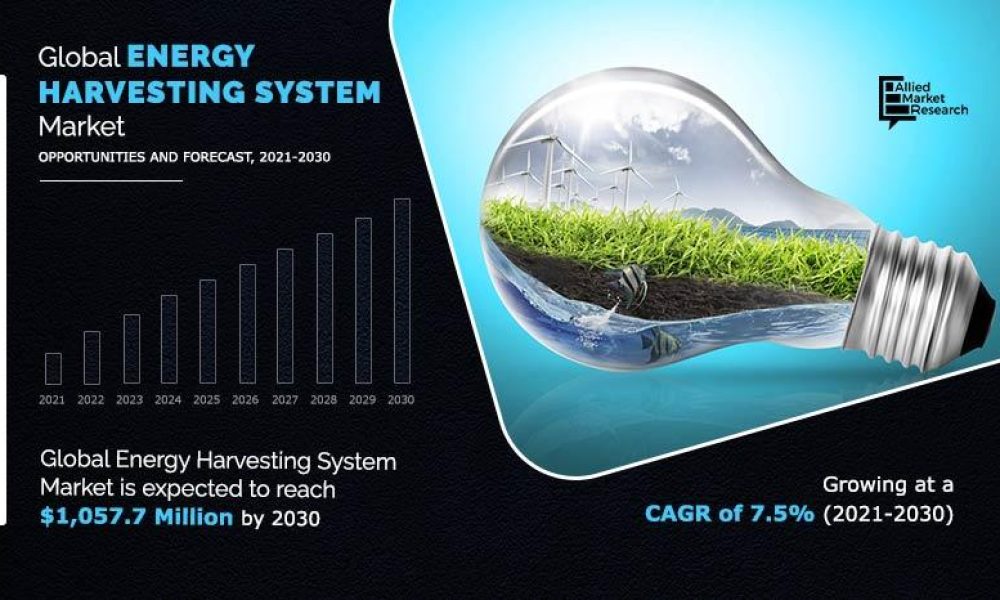
According to a new report published by Allied Market Research, titled, “Energy harvesting system market by technology, component, and application: global opportunity analysis and industry forecast, 2021–2030,”the global energy harvesting system market size was valued at USD 511.6 million in 2020, and is projected to reach USD 1,057.7 million by 2030, growing at a CAGR of 7.5% from 2021 to 2030.
The energy harvesting system market refers to the industry focused on technologies and solutions that capture and convert ambient energy from external sources—such as light, heat, vibration, and electromagnetic waves—into usable electrical energy. These systems are designed to power small, low-energy devices like sensors, wearables, and wireless electronics without the need for traditional batteries or direct electrical connections. Key technologies used in energy harvesting include solar (photovoltaic), thermoelectric, piezoelectric, and electromagnetic harvesting methods, all of which enable self-sustaining and maintenance-free energy solutions.
With the growing demand for sustainable and renewable energy sources, energy harvesting systems are gaining traction across industries such as automotive, consumer electronics, industrial automation, building infrastructure, and healthcare. These systems support the advancement of the Internet of Things (IoT) by enabling wireless sensor networks and remote devices to function efficiently without frequent battery replacements. As energy efficiency and miniaturization of electronic devices become more critical, the energy harvesting system market is poised for significant growth, driven by innovation and increasing adoption in smart and connected applications.
Download PDF Brochure: https://www.alliedmarketresearch.com/request-sample/A13686
The rising global demand for energy has significantly increased reliance on fossil fuels, which in turn has led to elevated carbon dioxide emissions and environmental degradation. To address these issues, energy harvesting technologies are being developed to capture and convert otherwise wasted energy from urban infrastructure—particularly roads—into usable power. Roads experience considerable kinetic energy losses due to constant vehicle movement. Innovations such as solar panels, piezoelectric devices, and thermoelectric and electromagnetic harvesters are being integrated into roadways to harness this lost energy, driving growth in the global energy harvesting market.
Despite the promise of these technologies, certain limitations hinder their widespread adoption. For example, while solar energy can be harnessed from road surfaces, it cannot directly power sensors without additional components like overcharge protection systems, which increase production costs. Moreover, solar energy’s unpredictability—due to changing weather and daylight conditions—adds another layer of complexity, potentially slowing market expansion.
The transportation sector remains the highest consumer of energy. In the UK alone, it consumed approximately 56.5 million tons of oil, with over 97% derived from petroleum sources. A significant portion of this energy is lost as heat and vibration during transportation. For instance, a single-lane road carrying truck traffic at an average of 600 vehicles per hour could generate up to 150 kWh of energy per kilometer. This lost energy has great potential to be captured through surface deformation, vibration, and heating—providing a valuable source for harvesting and reuse.
Therefore, the implementation of efficient energy harvesting systems on roads presents a promising opportunity to enhance energy sustainability. By converting traffic-induced mechanical stress into usable electricity, these technologies could significantly contribute to clean energy goals and reduce dependence on conventional fossil fuels, offering lucrative opportunities for future market growth.
For Purchase Inquiry: https://www.alliedmarketresearch.com/purchase-enquiry/A13686
The energy harvesting system market forecast is segmented on the basis of technology, component, application, and region. By technology, the market is segregated into light energy harvesting, vibration energy harvesting, radio frequency energy harvesting, and thermal energy harvesting. By component, the global energy harvesting system market is classified into energy harvesting transducer, power management integrated circuit (PMIC), and storage system. By application, the global market is divided into building & home automation, consumer electronics, industrial, transportation, and others. Region wise, the energy harvesting system market is analyzed across North America, Europe, Asia-Pacific, and LAMEA.
The energy harvesting system market exhibits diverse growth patterns across global regions, with Europe leading in technological adoption and sustainability initiatives. Countries like Germany, the UK, and France are investing heavily in renewable energy technologies and smart infrastructure, driving demand for advanced energy harvesting systems. The region benefits from strong regulatory support and funding for green technologies, making it a key player in implementing energy harvesting solutions, particularly in building automation, transportation, and industrial applications.
In contrast, Asia-Pacific is emerging as the fastest-growing region in the energy harvesting system market. Rapid urbanization, growing energy demand, and a surge in infrastructure development in countries like China, India, Japan, and South Korea are fueling the need for alternative energy sources. The region’s focus on reducing dependency on fossil fuels and increasing adoption of smart city initiatives further supports the integration of energy harvesting technologies in consumer electronics, transportation networks, and industrial equipment. This growth is bolstered by increasing R&D investments and government incentives for clean energy solutions.
Key players operating in the global energy harvesting system industry include Cymbet Corporation, Cedrat Technologies SA, Tekceleo, ZF Friedrichshafen AG, Physik Instrumente (PI) GmbH & Co. KG, Advanced Linear Devices Inc., Mide Technology Corporation, Powercast, Xidas, and Analog Devices.
The energy harvesting system market is analyzed in accordance with the impacts of the drivers, restraints, and opportunities. The period studied in this report is 2024–2033. The report includes the study of the energy harvesting system market with respect to the growth prospects and restraints based on the regional analysis. The study includes Porter’s five forces analysis of the industry to determine the impact of suppliers, competitors, new entrants, substitutes, and buyers on the market growth.




