
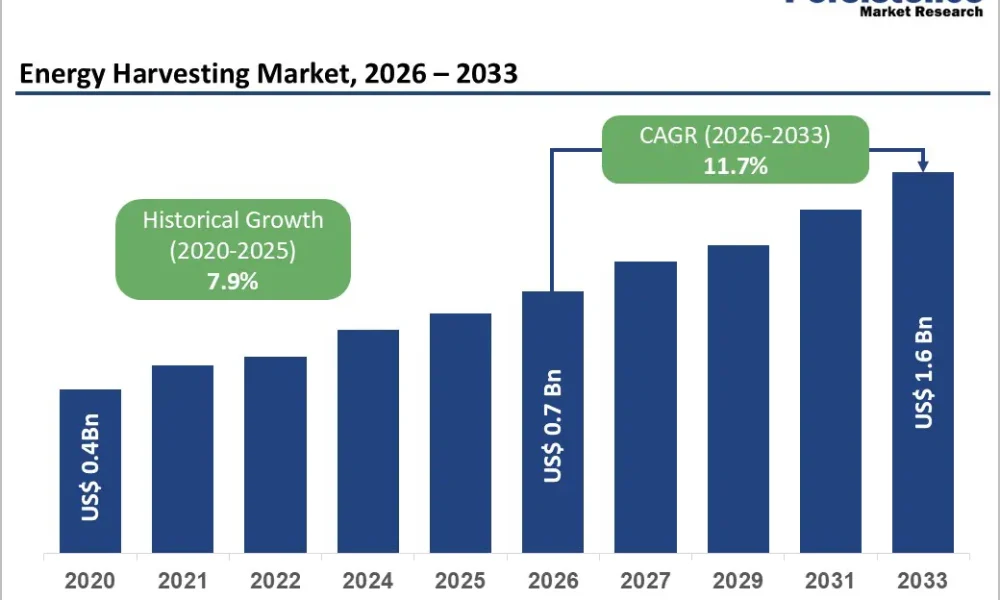
The global Energy Harvesting Market is entering a transformative phase as industries accelerate the deployment of self powered electronic systems. According to Persistence Market Research, the global energy harvesting market size was valued at US$ 0.7 Bn in 2026 and is projected to reach US$ 1.6 Bn by 2033, growing at a CAGR of 11.7% between 2026 and 2033. This steady expansion reflects the rising need for battery free IoT sensor networks across industrial automation and smart building applications. As enterprises seek long term reliability and lower maintenance costs, ambient energy conversion technologies are becoming increasingly attractive for powering distributed devices.
Market growth is further supported by technological advancements in ultra low power management circuits that enable efficient capture and storage of ambient energy sources such as light, vibration, and thermal gradients. Regulatory pressures promoting sustainable electronics, particularly under EU battery regulations, are also encouraging manufacturers to reduce reliance on disposable batteries. The leading segment within the market is expected to be light energy harvesting solutions, owing to their widespread deployment in smart buildings and commercial infrastructure. Geographically, Europe is emerging as a leading region due to strict sustainability mandates and strong adoption of industrial IoT frameworks that align with environmental compliance goals.
Get Your FREE Sample Report Instantly – Click Now : https://www.persistencemarketresearch.com/samples/10813
Key Highlights from the Report
➤ The Energy Harvesting Market is projected to expand from US$ 0.7 Bn in 2026 to US$ 1.6 Bn by 2033 at a CAGR of 11.7%.
➤ Rapid adoption of battery free IoT sensors in industrial automation is a primary growth accelerator.
➤ Technological innovation in ultra low power management circuits is improving ambient energy conversion efficiency.
➤ EU battery regulations are influencing sustainable electronics design and product innovation.
➤ Light energy harvesting solutions are gaining traction in smart building infrastructure.
➤ Europe stands out as a key regional market driven by regulatory and industrial digitization trends.
Market Segmentation
The Energy Harvesting Market can be segmented based on product type into light energy harvesting, vibration energy harvesting, thermal energy harvesting, and radio frequency energy harvesting solutions. Light based systems are widely adopted in commercial facilities and smart buildings due to reliable indoor lighting conditions. Vibration based harvesting solutions are increasingly used in industrial machinery monitoring, where mechanical motion is abundant. Thermal harvesting systems leverage temperature gradients in industrial environments to power sensors without wiring or batteries.
From an end user perspective, the market spans industrial automation, smart buildings, consumer electronics, transportation, and healthcare sectors. Industrial automation remains a dominant segment because of its high demand for predictive maintenance and real time monitoring. Smart building applications are rapidly integrating self powered sensors for lighting control, occupancy tracking, and HVAC optimization. Healthcare and wearable electronics are also emerging segments as manufacturers explore compact, maintenance free power sources for remote monitoring devices.
Customize This Report for Your Exact Requirements : https://www.persistencemarketresearch.com/request-customization/10813
Regional Insights
Europe is a significant market for energy harvesting technologies due to regulatory pressure aimed at reducing battery waste and promoting sustainable electronics. Strict compliance requirements under EU battery regulations are pushing manufacturers to integrate battery free solutions into IoT systems. The region’s strong industrial base and focus on digital transformation further contribute to widespread adoption across factories and commercial buildings.
North America is witnessing steady growth driven by industrial automation and smart infrastructure development. Enterprises in the region are actively deploying IoT sensor networks to enhance operational efficiency and minimize downtime. Meanwhile, Asia Pacific is gradually expanding its footprint as manufacturing hubs adopt cost effective and maintenance free energy harvesting systems to support large scale industrial operations.
Market Drivers
One of the most significant drivers in the Energy Harvesting Market is the proliferation of battery free IoT sensor deployments in industrial automation. Industries are increasingly investing in wireless sensor networks to monitor equipment health, optimize production lines, and reduce downtime. Battery free solutions eliminate the need for regular battery replacement, thereby lowering maintenance costs and enhancing operational continuity. This advantage is particularly critical in large scale manufacturing environments where thousands of sensors may be deployed simultaneously.
Another key driver is the advancement of ultra low power management circuits that enable efficient ambient energy conversion. These circuits allow devices to operate with minimal power input, making it feasible to harvest energy from light, vibration, or thermal sources. As component efficiency improves, the viability of energy harvesting in smart buildings and industrial systems continues to rise. Regulatory initiatives promoting sustainable electronics are also accelerating adoption by encouraging reduced battery dependency and environmentally responsible design practices.
Market Restraints
Despite promising growth prospects, the Energy Harvesting Market faces certain restraints. One major challenge is the variability of ambient energy sources, which can limit consistent power output. For instance, light intensity or vibration frequency may fluctuate depending on environmental conditions. Such variability can affect the reliability of self powered systems, particularly in mission critical applications requiring stable energy supply.
Another constraint is the relatively high initial integration cost associated with advanced energy harvesting modules and power management circuits. While long term maintenance savings are substantial, upfront investment can deter small and medium enterprises. Additionally, technical complexity in designing optimized harvesting systems tailored to specific industrial environments may slow widespread adoption in certain sectors.
Market Opportunities
The ongoing shift toward smart infrastructure presents significant opportunities for the Energy Harvesting Market. As smart buildings and industrial IoT ecosystems expand, demand for maintenance free power sources will continue to grow. Integration of energy harvesting modules into wireless sensor networks enables scalable deployment without complex wiring or battery management systems. This capability aligns with global sustainability goals and digital transformation strategies.
Emerging applications in healthcare, wearable electronics, and transportation also open new revenue streams. Compact and lightweight harvesting solutions can support remote patient monitoring and asset tracking systems without frequent battery replacement. Furthermore, advancements in miniaturization and improved conversion efficiency create opportunities for product innovation. Companies that invest in research and development of next generation energy harvesting technologies are likely to gain competitive advantage in this evolving market landscape.
Get Instant Access – Complete Your Purchase : https://www.persistencemarketresearch.com/checkout/10813
Company Insights
Key players operating in the Energy Harvesting Market include
- ABB
- Analog Devices, Inc.
- Bionic Power, Inc.
- Cymbet
- EnOcean GmbH
- Mahle GmbH
- Powercast Corp.
- Schneider Electric
- STMicroelectronics
- Texas Instruments, Inc.
Recent Developments
In March 2024, STMicroelectronics introduced enhanced ultra low power management solutions aimed at improving ambient energy conversion efficiency in industrial IoT applications.
In October 2023, EnOcean GmbH expanded its portfolio of battery free wireless switches to support broader smart building deployments across Europe.
Future Opportunities and Growth Prospects
The future of the Energy Harvesting Market lies in continuous technological refinement and broader integration into digital ecosystems. As industries prioritize sustainability and cost efficiency, battery free solutions are expected to gain stronger acceptance. Growth will be supported by innovation in power management circuits, expansion of smart infrastructure, and alignment with environmental regulations. With steady CAGR of 11.7% through 2033, the market is positioned to play a crucial role in advancing self powered electronic systems worldwide.




