
The global electric commercial vehicle thermal management systems market is projected to expand at a 9.1% CAGR between 2026 and 2036, increasing from USD 539.0 million in 2026 to USD 1,290.0 million by 2036. Commercial fleets require coordinated battery cooling, cabin heating, and temperature-control systems to maintain vehicle performance across long operating cycles and frequent charging requirements.
The growing range of electric commercial vehicle platforms is increasing the need for adaptable thermal management designs. In August 2025, the European Automobile Manufacturers’ Association listed at least 45 zero-emission truck models, demonstrating the expanding variety of electric commercial vehicle configurations available to fleet operators. Different vehicle applications and operating schedules require thermal systems capable of maintaining stable temperatures across batteries, cabins, power electronics, and other heat-sensitive components.
Regional fleet priorities are also influencing thermal system procurement. Fleet programs in the United States and Germany prioritize dependable cold-weather performance and reliable ongoing service, while operators in China and India emphasize locally supported parts and faster installation schedules. In January 2026, the European Automobile Manufacturers’ Association reported that electrically chargeable trucks accounted for 4.2% of European Union registrations during 2025, reflecting the different pace of commercial vehicle electrification across established fleet markets.
What Are the Key Segments in the Electric Commercial Vehicle Thermal Management Systems Market?
The electric commercial vehicle thermal management systems market is being shaped by component requirements, propulsion technologies, vehicle architectures, fleet operating conditions, and regional service capabilities.
- Sensors – 23.0%: Sensors are forecast to account for 23.0% of the component type segment in 2026, supported by continuous temperature measurement, monitoring, and fault detection across integrated coolant circuits.
- Battery Electric – 17.0%: Battery electric propulsion is estimated to lead with 17.0% share in 2026, reflecting the need for battery conditioning, cabin heating, cooling, and heat-pump functionality across commercial platforms.
- Sensors, Modules, Connectors, Software, and Thermal Systems: These component categories support temperature measurement, coolant management, thermal control, system coordination, and integration across electric commercial vehicle architectures.
- Passenger Cars, Light Commercial Vehicles, Heavy Trucks, Two-wheelers, and Buses: Different vehicle types present varying thermal loads and operating schedules, requiring systems adapted to vehicle size, duty cycle, and energy requirements.
- OEM and Aftermarket Channels: Commercial vehicle thermal management systems reach fleets through OEM supply arrangements as well as aftermarket, fleet operator, distributor, and direct sales channels.
Get detailed market forecasts, competitive benchmarking, and pricing trends:
https://www.futuremarketinsights.com/reports/sample/rep-gb-34096
Which Countries Are Showing the Strongest Growth in Electric Commercial Vehicle Thermal Management Systems?
South Korea: South Korea is projected to grow at a 12.3% CAGR between 2026 and 2036, representing the fastest growth among the countries in the supplied market comparison. The country’s commercial vehicle electrification environment is increasing the requirement for thermal systems capable of supporting battery conditioning and stable vehicle operation.
Thermal system suppliers serving the market must address changing vehicle architectures while maintaining compatibility with battery, cabin, and powertrain requirements. Engineering responsiveness and system integration capabilities can influence adoption as electric commercial platforms expand.
India: India is projected to expand at an 11.4% CAGR through 2036. Commercial fleet operators are placing greater emphasis on locally supported components and faster installation schedules as electrification expands across different vehicle applications.
Local service availability is particularly relevant for commercial fleets where vehicle downtime can affect operating schedules. Suppliers that combine adaptable thermal components with responsive technical support can address these fleet requirements.
China: China is projected to grow at a 10.5% CAGR through 2036. Fleet operators emphasize locally supported parts and faster installation, creating demand for thermal management systems that can be integrated efficiently across commercial electric vehicle platforms.
The growing diversity of electric commercial vehicles also increases the importance of adaptable thermal architectures that can accommodate different battery configurations, vehicle sizes, and operating requirements.
United States: The United States is projected to grow at a 9.6% CAGR between 2026 and 2036. Fleet programs prioritize dependable cold-weather performance and reliable ongoing service, making thermal stability an important consideration for commercial vehicle operators.
Thermal management suppliers serving US fleets therefore need to demonstrate consistent system performance across changing operating conditions while maintaining service availability throughout the vehicle lifecycle.
Japan: Japan is projected to expand at an 8.6% CAGR through 2036. Commercial electrification is creating requirements for thermal systems capable of maintaining stable operating conditions across different vehicle applications and duty cycles.
Germany: Germany is projected to grow at a 7.7% CAGR through 2036. Fleet programs prioritize cold-weather performance and dependable ongoing service, placing emphasis on thermal reliability and long-term system support.
How Is Regional Demand Shaping the Electric Commercial Vehicle Thermal Management Systems Market?
Regional procurement priorities differ according to fleet electrification rates, climate conditions, vehicle architectures, local parts availability, and service requirements. South Korea, India, and China are projected to record growth above the global market rate, while the United States remains closely aligned with the overall market trajectory.
European fleet electrification is also creating additional requirements for thermal management systems. The European Automobile Manufacturers’ Association’s report that electrically chargeable trucks represented 4.2% of European Union registrations in 2025 illustrates the expanding role of electric trucks within established commercial vehicle fleets.
Across these markets, suppliers must balance thermal performance with installation efficiency, component availability, and ongoing service. Country-specific engineering and local support can become important differentiators as fleet operators evaluate systems for different climates and operating schedules.
What Is Changing the Competitive Landscape?
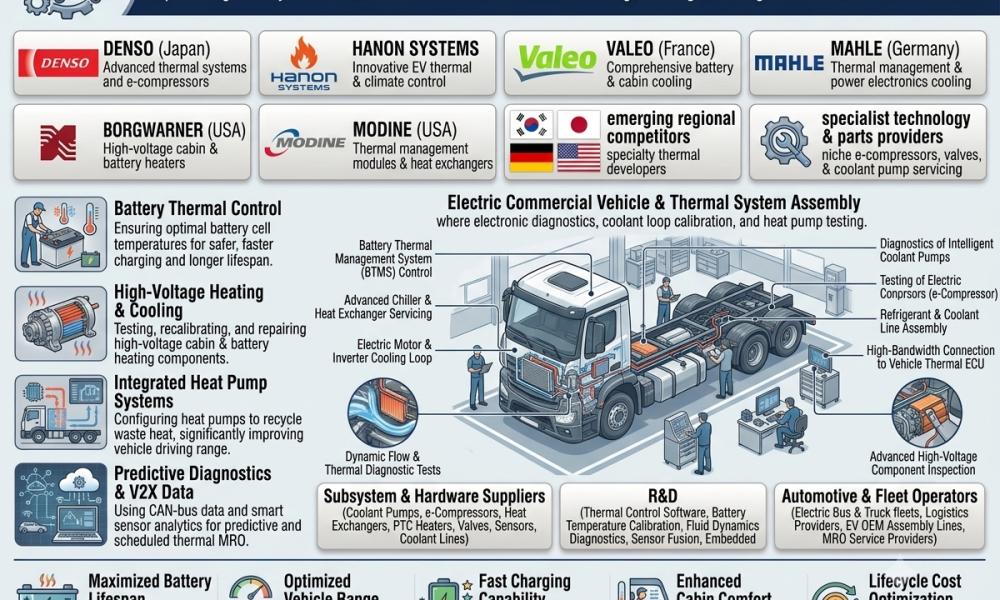
The competitive landscape includes automotive thermal management specialists, component manufacturers, cooling-system suppliers, and diversified automotive technology companies. Suppliers are differentiating through integrated thermal capabilities, component reliability, intelligent controls, commercial vehicle engineering, and service support.
DENSO Corporation and Valeo compete through broad automotive thermal management capabilities and systems designed to support increasingly electrified vehicle architectures. Their participation reflects the growing importance of integrated cooling and heating technologies across commercial platforms.
MAHLE GmbH and Hanon Systems participate through thermal management technologies addressing battery, cabin, and vehicle-level temperature requirements. Their capabilities position them within a market increasingly focused on coordinated thermal control rather than individual components.
Modine Manufacturing Company and BorgWarner Inc. contribute thermal and electrification technologies supporting commercial vehicle applications. Their competitive positioning reflects demand for systems capable of handling higher thermal loads and changing electric vehicle architectures.
Webasto Group and Robert Bosch GmbH further strengthen competition through thermal management, electrification, controls, and vehicle technology capabilities. Suppliers with broad engineering portfolios can address multiple integration requirements as commercial fleets transition toward electric propulsion.
Competition is increasingly influenced by the ability to combine hardware with intelligent controls, responsive service, and commercial vehicle-specific engineering. Fleet operators are evaluating thermal systems not only on component performance but also on installation schedules, parts availability, reliability, and lifecycle support.
What Does the Analyst Say About the Electric Commercial Vehicle Thermal Management Systems Market?
According to Nikhil Kaitwade, Principal Analyst for Automotive at Future Market Insights, thermal management is becoming a core measure of electric commercial vehicle performance as fleet operators evaluate battery and cabin temperature control across demanding routes.
“Thermal management is moving beyond a supporting engineering function and becoming a core measure of electric commercial vehicle performance. Fleet operators increasingly assess how effectively each system controls cabin conditions and limits energy loss across demanding routes. Suppliers combining responsive hardware with intelligent controls are able to extend component life and improve ownership economics. Long-term leadership are likely to come from solutions delivering consistent thermal stability across vehicle loads and operating schedules.”
Fleet operators therefore increasingly assess thermal systems in relation to total vehicle performance. Battery conditioning, cabin comfort, energy efficiency, component life, and service response all contribute to the commercial value of thermal management solutions.
What Is Driving Demand for Electric Commercial Vehicle Thermal Management Systems?
Fleet Electrification Increases Thermal Control Requirements
The transition toward electric commercial vehicles is creating new thermal requirements across batteries, cabins, power electronics, and propulsion systems. Unlike conventional platforms, battery-electric vehicles require precise temperature control to maintain battery performance and charging efficiency.
The expanding number of zero-emission commercial vehicle models is also creating demand for thermal architectures that can accommodate different vehicle designs and operating cycles.
Battery Conditioning Supports Thermal System Adoption
Battery conditioning is becoming an important requirement for electric commercial fleets. Maintaining appropriate battery temperatures can support consistent vehicle operation across long duty cycles and frequent charging events.
Thermal management systems therefore need to coordinate cooling and heating functions while minimizing unnecessary energy consumption. This creates opportunities for suppliers combining thermal hardware with intelligent control technologies.
Cabin Heating and Cooling Influence Fleet Economics
Commercial vehicles operate for extended periods, making cabin temperature control important for both driver conditions and energy consumption. Thermal systems must provide heating and cooling without placing unnecessary demands on the battery.
Suppliers that can coordinate cabin comfort with battery efficiency can address a broader portion of fleet operators’ thermal requirements.
Local Service Supports Commercial Fleet Uptime
Commercial fleet operators place strong emphasis on vehicle availability. A thermal system fault can affect vehicle operation, charging performance, or cabin conditions, creating potential downtime for fleet operators.
Local parts availability, installation speed, technical assistance, and ongoing maintenance therefore influence purchasing decisions alongside system specifications.
What Are the Key Market Restraints?
Capital intensity and country-specific qualification processes can restrain deployment, particularly among smaller fleets and regional operators. Thermal management systems require integration with vehicle architectures, battery packs, cooling circuits, and electronic controls, increasing development and qualification requirements.
Different commercial vehicle platforms can also require different thermal configurations. Suppliers may need to adapt components and control strategies according to vehicle size, battery architecture, duty cycle, climate, and charging requirements.
Service infrastructure represents another consideration. Commercial operators require dependable parts and technical support to minimize downtime, making market entry more challenging for suppliers without established regional service networks.
What Opportunities Exist for Electric Commercial Vehicle Thermal Management System Manufacturers?
The expansion of electric commercial vehicle fleets creates opportunities for suppliers offering integrated thermal solutions. Systems combining sensors, cooling modules, heating functions, controls, and software can address more of the vehicle’s temperature-management requirements through a coordinated architecture.
There is also an opportunity to develop adaptable systems for different commercial vehicle platforms. As the number of zero-emission truck models increases, suppliers capable of supporting multiple battery configurations and vehicle architectures can address a broader fleet customer base.
Regional service networks represent another opportunity. Suppliers that provide local parts availability, faster installation, diagnostic support, and lifecycle maintenance can respond to the operational requirements of commercial fleets in markets such as India, China, the United States, and Europe.
Drive Your Business Growth Strategy: Checkout the Report for Key Insights!
https://www.futuremarketinsights.com/checkout/34096
How Is the Electric Commercial Vehicle Thermal Management Systems Market Segmented?
The electric commercial vehicle thermal management systems industry is segmented by component type, vehicle type, propulsion, sales channel, and region.
By Component Type: Sensors, modules, connectors, software, and thermal systems.
By Vehicle Type: Passenger cars, light commercial vehicles, heavy trucks, two-wheelers, and buses.
By Propulsion: Battery electric, plug-in hybrid, fuel cell, hybrid, and ICE retrofit platforms.
By Sales Channel: OEM supply, aftermarket, fleet operators, distributors, and direct sales.
By Region: North America, Latin America, Western Europe, Eastern Europe, East Asia, South Asia and Pacific, and the Middle East and Africa.
The segmentation enables automotive manufacturers, fleet operators, and component suppliers to compare thermal management requirements according to vehicle architecture, propulsion type, component configuration, sales channel, and regional operating conditions.
What Are the Drivers, Restraints and Opportunities in the Electric Commercial Vehicle Thermal Management Systems Market?
The commercial case for electric vehicle thermal management increasingly depends on stable battery temperatures, efficient cabin control, adaptable architectures, and dependable service support across demanding fleet operating schedules.
- Battery electric commercial vehicles require coordinated thermal control across batteries, cabins, power electronics, and charging systems.
- Sensors, intelligent controls, and integrated thermal hardware can improve temperature monitoring and system coordination.
- Suppliers combining adaptable thermal architectures with local parts availability and technical support can address diverse commercial fleet requirements.
What Is the Electric Commercial Vehicle Thermal Management Systems Market Demand Outlook?
Demand for electric commercial vehicle thermal management systems is expected to remain connected to commercial fleet electrification, battery conditioning, cabin comfort, charging requirements, and the increasing diversity of electric vehicle platforms.
The market is projected to increase from USD 539.0 million in 2026 to USD 1,290.0 million by 2036, expanding at a 9.1% CAGR. As fleet operators adopt more electric commercial vehicles, procurement decisions are expected to increasingly consider thermal stability, energy efficiency, installation requirements, component reliability, and long-term service support.
Why Are Sensors the Leading Component Type?
Sensors are forecast to account for 23.0% of the component type segment in 2026. Continuous temperature measurement and fault detection are important to integrated coolant circuits and other thermal management functions.
Accurate sensing allows thermal systems to monitor changing operating conditions and coordinate cooling or heating responses across different vehicle components.
Why Is Battery Electric the Leading Propulsion Type?
Battery electric propulsion is estimated to account for 17.0% of the propulsion segment in 2026. Battery-electric commercial vehicles require thermal conditioning to support battery performance, charging, cabin heating, and cooling.
The growing availability of zero-emission truck models is increasing the number of commercial platforms requiring dedicated thermal management architectures.
How Fast Are Key Countries Growing in the Electric Commercial Vehicle Thermal Management Systems Market?
South Korea is projected to grow at 12.3% CAGR, followed by India at 11.4%, China at 10.5%, the United States at 9.6%, Japan at 8.6%, and Germany at 7.7% between 2026 and 2036. Differences in fleet electrification, climate requirements, local parts support, installation schedules, vehicle architectures, and service infrastructure are shaping the pace of thermal management system adoption across these markets.
About Future Market Insights
Future Market Insights (FMI) is an ESOMAR-certified business consulting and market research firm and a member of the Greater New York Chamber of Commerce. FMI provides market intelligence, syndicated research, consulting, and industry analysis across multiple sectors. Its research combines primary research, secondary research, and proprietary forecasting models to support strategic business decisions



