
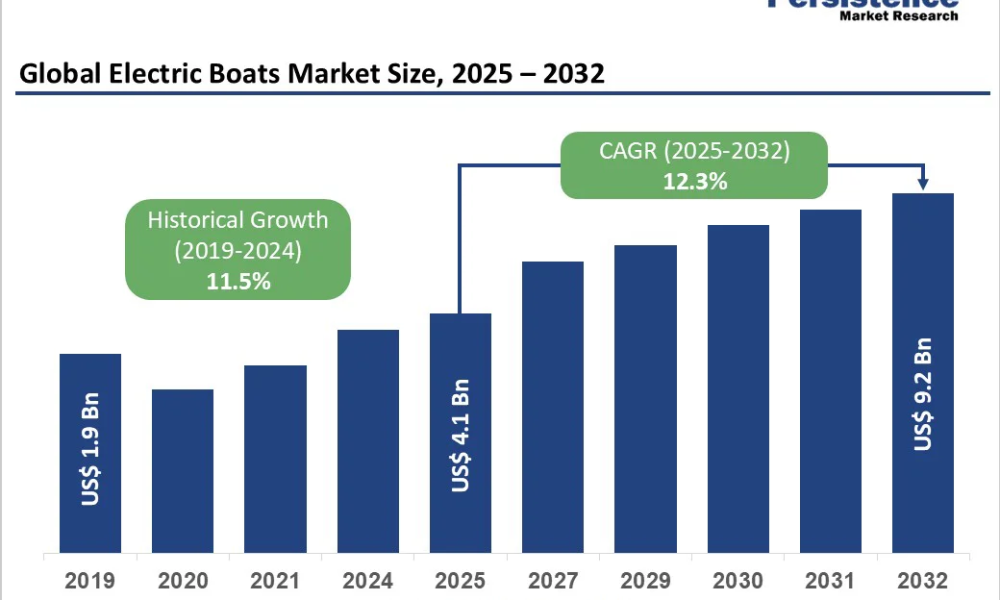
The global Electric Boats Market is entering a decisive growth phase, driven by intensifying environmental regulations, rapid advancements in electric propulsion technologies, and rising demand for sustainable maritime transport solutions. According to consolidated insights from leading market research firms, the global electric boats market size is expected to be valued at US$ 4.1 billion in 2025 and is projected to reach approximately US$ 9.2 billion by 2032, registering a robust compound annual growth rate (CAGR) of 12.3% during the forecast period from 2025 to 2032.
Electric boats, which include fully electric and hybrid-electric watercraft, are gaining traction across recreational, commercial, and defense applications. Their ability to significantly reduce greenhouse gas emissions, noise pollution, and fuel dependency positions them as a critical solution within the broader global decarbonization agenda. Governments, port authorities, tourism operators, and private consumers are increasingly transitioning toward electric propulsion to comply with emission norms and meet sustainability targets.
Market growth is primarily driven by stricter marine emission regulations, increasing fuel costs, and the growing popularity of electric recreational boating. Advancements in lithium-ion battery energy density, power management systems, and fast-charging infrastructure are improving operational efficiency and range, thereby addressing historical adoption barriers. Additionally, rising investments in electric marine infrastructure and increasing awareness of eco-friendly marine transportation are reinforcing long-term market expansion.
Get Your FREE Sample Report Instantly Click Now: https://www.persistencemarketresearch.com/samples/22972
Market Segmentation
By Boat Power
- < 5kW
- 5-30kW
- >30kW
By Boat Size
- < 20ft
- 20-50ft
- >50ft
By Power Source
- Battery
- Solar
- Hybrid
By End-users
- Recreational Boats
- Commercial Boats
- Military & Law Enforcements Boats
By Region
- North America
- Europe
- Asia Pacific
- Latin America
- Middle East & Africa
Regional Insights
Regionally, Europe currently leads the global electric boats market, supported by stringent emission regulations, strong government incentives, and a well-established marine manufacturing ecosystem. Countries such as Norway, Germany, the Netherlands, and France are at the forefront of electric ferry deployment and recreational electric boating. Norway, in particular, has implemented ambitious zero-emission mandates for fjords and public ferries, significantly accelerating adoption.
North America represents a significant share of the market, driven by technological innovation, rising consumer interest in sustainable recreational boating, and expanding electric marine startups. The United States is witnessing growing investments in electric boat manufacturing, charging infrastructure development, and public-private partnerships for electric water transport.
The Asia-Pacific region is projected to be the fastest-growing market over the forecast period. Rapid urbanization, increasing inland waterway transportation, and government initiatives promoting electric mobility are fueling demand. Countries such as China, Japan, South Korea, and India are investing heavily in electric propulsion technologies and smart port infrastructure. The region’s expanding tourism sector and rising environmental awareness further support market growth.
Customize This Report for Your Exact Requirements: https://www.persistencemarketresearch.com/request-customization/22972
Unique Features and Innovations in the Market
Modern electric boats are distinguished by advanced propulsion architectures, modular battery systems, and digital intelligence. Innovations in high-capacity lithium-ion and solid-state batteries are extending vessel range while reducing charging times and lifecycle costs. Lightweight composite hull designs are improving energy efficiency and performance without compromising durability.
Technologies such as artificial intelligence (AI) and Internet of Things (IoT) are transforming vessel operation and maintenance. AI-driven energy optimization systems dynamically manage power consumption based on route, weather, and load conditions. IoT-enabled sensors continuously monitor battery health, motor performance, and system diagnostics, enabling predictive maintenance and minimizing downtime.
The integration of 5G connectivity is enhancing real-time communication between vessels, ports, and fleet management platforms. This connectivity supports advanced navigation systems, autonomous docking, and remote monitoring capabilities. Together, these technological advancements are positioning electric boats as intelligent, connected assets rather than standalone vessels.
Market Highlights
The adoption of electric boats is being driven by multiple strategic and operational advantages. Businesses and public transport authorities are increasingly embracing electric propulsion to achieve long-term cost savings through reduced fuel consumption and lower maintenance requirements. Electric motors have fewer moving parts compared to internal combustion engines, resulting in improved reliability and reduced service intervals.
Sustainability remains a central adoption driver, as electric boats produce zero direct emissions and significantly reduce underwater noise pollution, protecting marine ecosystems. Regulatory frameworks at national and regional levels are reinforcing this transition by imposing emission limits, offering subsidies, and supporting infrastructure development. Declining battery costs and improving economies of scale are further enhancing the commercial viability of electric boats across diverse applications.
Key Players and Competitive Landscape
The electric boats market is moderately fragmented, with a mix of established marine manufacturers and innovative electric propulsion specialists competing globally. Leading companies are focusing on product innovation, strategic partnerships, and regional expansion to strengthen their market positions.
- Torqeedo GmbH: A pioneer in electric marine propulsion, Torqeedo focuses on high-efficiency electric outboards and integrated systems, supported by continuous R&D investments and global distribution.
- ABB Ltd.: ABB leverages its expertise in electrification and automation to deliver advanced electric propulsion and power management solutions for commercial vessels and ferries.
- Yamaha Motor Co., Ltd.: Yamaha is expanding its electric and hybrid marine portfolio, combining established marine engineering capabilities with next-generation electric technologies.
- Brunswick Corporation: Through strategic acquisitions and product launches, Brunswick is integrating electric propulsion into its recreational boat brands to address evolving consumer preferences.
- General Dynamics Electric Boat: The company applies advanced electric propulsion expertise to specialized defense and commercial marine applications.
Competitive strategies across the market include collaborations with battery manufacturers, investments in software platforms, and the development of modular propulsion systems that can be adapted across vessel types and regions.
Recent Developments
- A leading European ferry operator recently commissioned a fleet of fully electric passenger ferries equipped with fast-charging systems, significantly reducing operational emissions across urban waterways.
- Several major marine manufacturers announced partnerships with battery technology providers to accelerate the commercialization of next-generation high-density battery systems for long-range electric vessels.
Ready to Dive Deep? Buy Full Report Today: https://www.persistencemarketresearch.com/checkout/22972
Future Opportunities and Growth Prospects
The future of the electric boats market is shaped by expanding application areas, technological convergence, and supportive policy frameworks. Growing investments in smart ports, charging infrastructure, and autonomous marine systems are expected to unlock new growth opportunities. Commercial shipping segments such as short-sea transport, harbor operations, and inland logistics present significant untapped potential for electric propulsion.
Evolving technologies, including solid-state batteries, advanced power electronics, and autonomous navigation, are expected to further enhance performance, safety, and cost efficiency. Regulatory support for zero-emission vessels and continued advancements in renewable energy integration will play a decisive role in shaping the industry’s trajectory.
As sustainability transitions accelerate across the global transportation sector, the electric boats market is positioned to become a cornerstone of clean marine mobility, delivering long-term environmental, economic, and operational benefits across recreational, commercial, and public maritime applications.




