
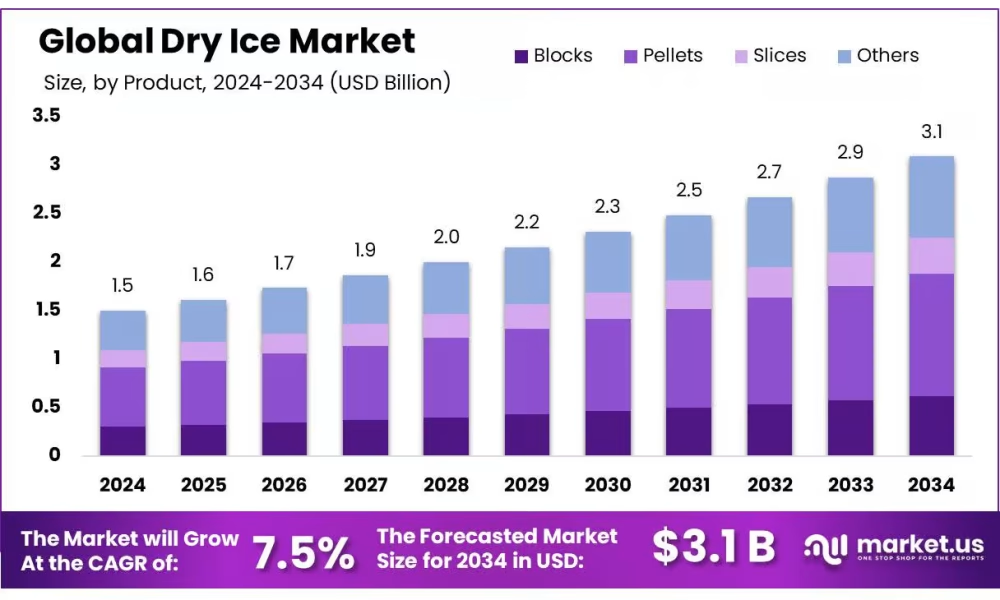
According to market.us, the global dry ice market is anticipated to expand from USD 1.5 billion in 2024 to nearly USD 3.1 billion by 2034, reflecting a compound annual growth rate (CAGR) of 7.5% during the forecast period from 2025 to 2034. Dry ice, which is the solidified form of carbon dioxide (CO2), is widely utilized for cooling and refrigeration purposes due to its sublimation property—transforming directly from solid to gas, thus avoiding moisture-related damage.
Market growth is primarily propelled by rising demand across the food and pharmaceutical sectors. In 2020, around 60% of global dry ice consumption was linked to the food and beverage industry, with major corporations such as Nestlé, Coca-Cola, and McDonald’s relying on it to ensure product integrity during transport. In the United States, frozen food sales spiked by 22% during the COVID-19 outbreak, significantly increasing dry ice requirements.
According to the U.S. Department of Transportation, over 2.5 billion tons of food are moved annually, much of which needs temperature control via cryogenic methods. Furthermore, the U.S. FDA reports that nearly 80% of pharmaceutical goods require temperature regulation, reinforcing dry ice’s role in cold-chain logistics, particularly during the distribution of temperature-sensitive mRNA vaccines.
Key Takeaways
- Dry Ice Market is expected to be worth around USD 3.1 Billion by 2034, up from USD 1.5 Billion by 2024, growing at a CAGR of 7.5%.
- Pellets held a dominant market position, capturing more than a 41.10% share of the dry ice market.
- Food Grade dry ice held a dominant market position, capturing more than a 45.20% share.
- Food & Beverages sector held a dominant market position in the dry ice market, capturing more than a 46.30% share.
- Asia-Pacific (APAC) region stands out as a significant player, holding a commanding 38.10% share, which translates to a market size of approximately USD 0.5 billion.
Access a Complimentary Sample of This Premium Report: https://market.us/report/dry-ice-market/request-sample/
Factors Affecting the Growth of the Dry Ice Market
Expansion of Cold Chain Logistics: The increasing need for efficient cold chain systems, particularly in the transportation of perishable goods such as meat, seafood, dairy, and frozen food, has significantly fueled demand for dry ice. Its ability to maintain ultra-low temperatures without leaving moisture makes it an essential component in preserving product integrity during storage and shipment.
Rising Demand in the Pharmaceutical Industry: A substantial share of pharmaceutical products requires strict temperature control during transit and storage. The growth of temperature-sensitive biologics, vaccines, and other formulations has led to greater use of dry ice, especially in scenarios where conventional refrigeration is insufficient.
Growth in E-commerce and Food Delivery Services: The surge in online grocery shopping, meal kit subscriptions, and doorstep delivery of frozen and perishable foods has boosted the need for reliable cold packaging. Dry ice is increasingly adopted to maintain product quality during last-mile delivery, particularly for items requiring sub-zero storage.
Technological Advancements in Dry Ice Production: Improvements in CO₂ recovery and dry ice manufacturing processes have made production more efficient and environmentally sustainable. These advancements support wider adoption across new applications and help meet growing demand without compromising supply stability.
Environmental and Safety Regulations: The regulatory landscape surrounding the handling, transportation, and environmental impact of dry ice plays a critical role. Compliance with safety standards and CO₂ emissions regulations can influence production practices, storage protocols, and distribution strategies, thereby shaping the market’s trajectory.
Key Market Segmentation
By Product Type Analysis
In 2024, dry ice pellets accounted for over 41.10% of the market share, establishing their dominant position. This strong performance is primarily due to their versatility and convenience in applications such as shipping, transport, and industrial cleaning. Their ease of handling, rapid sublimation, and ability to meet precise cooling requirements have made them especially valuable in food processing, pharmaceuticals, and dry ice blasting, further driving their widespread adoption.
By Grade Analysis
In 2024, food grade dry ice dominated the market with a share exceeding 45.20%, highlighting its vital role in the food industry. Its high purity and adherence to health standards make it ideal for preserving perishable goods during transport and storage. The non-toxic, residue-free cooling it offers is especially valued in food processing and catering. The continued growth of global food trade has further strengthened demand, solidifying its leading market position.
By End-use Analysis
In 2024, the food and beverages sector led the dry ice market with a dominant share of over 46.30%. This leadership is attributed to dry ice’s essential role in preserving and transporting perishable food items by maintaining low temperatures without leaving moisture. Its use in packaging fresh produce and meats, along with the rising global food trade and strict safety standards, continues to drive demand and reinforce its strong position in the sector.
Key Market Segments
By Product Type
- Blocks
- Pellets
- Slices
- Others
By Grade
- Food Grade
- Industrial Grade
- Pharmaceutical Grade
By End-use
- Food & Beverages
- Healthcare & Medical
- Industrial Cleaning
- Logistics & Transportation
- Entertainment
- Others
Regional Analysis
In the dry ice market, the Asia-Pacific region held a dominant 38.10% share in 2024, equivalent to a market size of around USD 0.5 billion. This strong position is fueled by rapid industrial growth in countries like China, India, and Japan, along with rising demand in food processing, healthcare, and electronics.
The food sector, in particular, relies heavily on dry ice for preserving and transporting perishables amid growing exports and population. Additionally, the expanding pharmaceutical industry and supportive government initiatives aimed at reducing food waste and enhancing cold chain logistics are further driving regional market growth.
Market Key Players
- Air Liquide
- Linde plc
- Continental Carbonic Products, Inc.
- OXARC Inc.
- Sicgil india limited
- Cee Kay Supply, Inc.
- Asco Carbon Dioxide Ltd
- Apple Ice
- Central McGowan
- Sol Group Corporation
- The iceman
- Brookline Ice Co
- Sutton-Garten Co.
- nexAir LLC
- Yara International ASA
- Other Key Players
Get in Touch with Us:
Market.us (Powered By Prudour Pvt. Ltd.)
Address: 420 Lexington Avenue, Suite 300 New York City, NY 10170, United States
Send Email: [email protected]
Refer to More Related Reports:



