
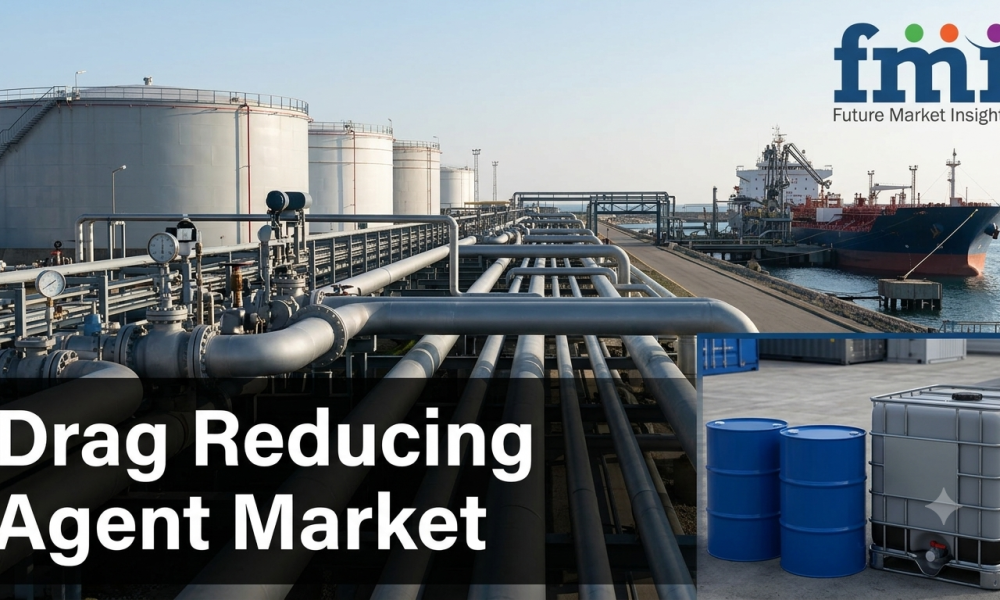
The global drag reducing agent market is estimated at USD 792.1 million in 2026 and is projected to reach USD 1,278.1 million by 2036, expanding at a CAGR of 4.9% over the forecast period. Demand is supported by pipeline debottlenecking, as operators seek to increase throughput and reduce pumping energy without investing in major infrastructure expansion. Growing attention to operating efficiency is encouraging the use of drag reducing agents across crude oil, refined product, and multiphase transport systems.
Global Segment Leaders
- Material Type: Polymers are expected to account for 50.0% of the material type segment in 2026, supported by their drag reduction performance in high-volume, long-distance pipeline operations.
- Application: Crude oil is projected to hold a 28.5% share in 2026, as pipeline operators seek to increase throughput and reduce pressure losses across existing networks.
- End-Use Industry: Oil and gas is expected to account for 33.2% of end-use demand in 2026, reflecting the importance of flow efficiency across upstream, midstream, and transportation operations.
- Flow Stream Type: Hydrocarbon transport is projected to represent 80.0% of the segment in 2026, driven by demand across crude oil, refined product, and multiphase fluid pipelines.
- Chemistry Platform: Synthetic chemistry-based systems are expected to hold a 66.7% share in 2026, supported by the use of established formulations in demanding pipeline applications.
- End-Use Cluster: Energy-linked industries are projected to account for 60.0% of the segment in 2026, reflecting the need to manage pumping costs and improve transport efficiency across energy-related operations.
Get detailed market forecasts, competitive benchmarking, and pricing trends: https://www.futuremarketinsights.com/reports/sample/rep-gb-8274
Country-Level Performance
China is projected to lead the drag reducing agent market with a CAGR of 6.6% from 2026 to 2036, followed by India at 6.1% and ASEAN at 5.9%. The United States is expected to grow at 4.7%, Germany at 4.6%, the United Kingdom at 4.4%, and Japan at 4.1%.
China’s growth outlook reflects investment in long-distance crude oil pipelines, large-scale energy transport systems, and interprovincial water transfer infrastructure. India is expected to benefit from pipeline expansion, refinery connectivity, and investment in long-distance water movement. ASEAN demand is supported by hydrocarbon transport links, refinery connectivity, and municipal water conveyance projects.
The United States is expected to maintain demand through established crude oil and refined product pipeline networks, while Germany’s industrial and chemical processing base supports demand for flow optimization. In the United Kingdom, mature pipeline assets and North Sea transport operations are expected to sustain adoption. Japan’s market is projected to expand at a comparatively moderate pace, with demand influenced by specialized industrial transport requirements, product consistency, and strict chemical handling practices.
The report covers North America, Latin America, Europe, East Asia, South Asia and the Pacific, and the Middle East and Africa, with country-level analysis including the United States, ASEAN, Japan, Germany, the United Kingdom, India, and China, alongside additional markets.
Access the Complete Report in PDF Format: https://www.futuremarketinsights.com/reports/brochure/rep-gb-8274
Competitive Landscape
The drag reducing agent market features suppliers competing through formulation performance, dosing reliability, application expertise, and field service support. Key companies profiled include Baker Hughes, Innospec, Flowchem, Lubrizol Specialty Products Inc., Oil Flux Americas, NuGenTec, Sino Oil King Shine Chemical, The Zoranoc Oilfield Chemical, China National Petroleum Corporation, and IRIS Tech.
Baker Hughes and Innospec are positioned through their drag reducing agent portfolios and technical support capabilities, while Flowchem and Lubrizol Specialty Products Inc. serve pipeline applications requiring specialized formulations and operational support. Other participants address regional demand and specific flow conditions.
The report identifies two recent developments: in March 2025, Innospec reportedly expanded proprietary drag reducing agent production capacity at its Pleasanton, Texas, facility to support midstream demand. In July 2025, Baker Hughes reportedly secured a multiyear supply agreement for drag reducing agents for Genesis Energy offshore pipeline systems along the U.S. Gulf Coast. These announcements should be independently verified before publication.
Suppliers are expected to compete on their ability to demonstrate repeatable flow improvements, optimize chemical dosing, and maintain performance under changing pipeline conditions. Opportunities also exist in water conveyance and automated dosing systems, where operators seek better control over pumping energy and operating costs.
Business Impact
FMI helps organizations transform market complexity into strategic clarity, enabling leadership teams to identify growth opportunities faster, optimize resource allocation, strengthen competitive positioning, and make high-stakes business decisions with confidence.
To explore how FMI Custom Research can support your strategic priorities, please connect with our team at – [email protected]
About Future Market Insights (FMI)
Future Market Insights, Inc. (FMI) is an ESOMAR-certified, ISO 9001:2015 market research and consulting organization, trusted by Fortune 500 clients and global enterprises. With operations in the U.S., UK, India, and Dubai, FMI provides data-backed insights and strategic intelligence across 30+ industries and 1200 markets worldwide.



