
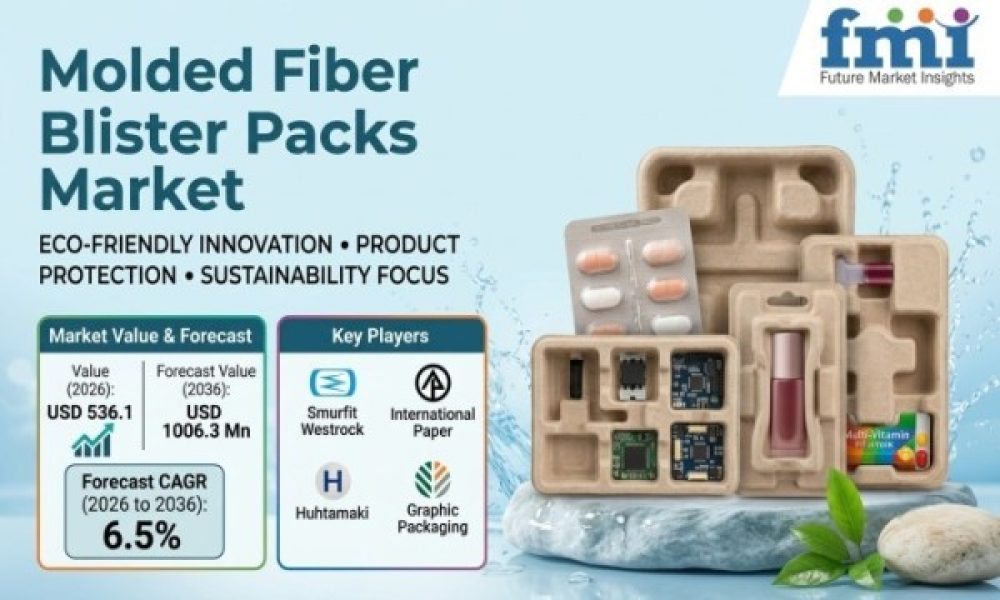
The global molded fiber blister packs market is projected to increase from USD 536.1 million in 2026 to USD 1,006.3 million by 2036, registering a compound annual growth rate (CAGR) of 6.5%, according to Future Market Insights (FMI). The market outlook reflects growing interest in fiber-based packaging formats that can reduce plastic use while retaining the product protection, dimensional consistency and processing performance required by commercial packaging operations.
For packaging manufacturers, brand owners and procurement teams, the central question is no longer limited to whether fiber can replace plastic. The commercial decision depends on whether a molded fiber structure can meet application-specific protection requirements, run on the intended packing line and qualify for its proposed material recovery route.
Get detailed market forecasts, competitive benchmarking, and pricing trends:
https://www.futuremarketinsights.com/reports/sample/rep-gb-35091
Packaging Regulations Bring Material Selection into Focus
Regulatory changes are increasing the importance of recyclability and material composition in packaging specifications. In February 2025, the European Commission confirmed that the Packaging and Packaging Waste Regulation had entered into force. The framework reinforces the need for packaging businesses to assess material use, recyclability and product design when developing new formats.
In the United States, California’s packaging producer-responsibility rules approved by CalRecycle in May 2026 introduce requirements that include reducing single-use plastic by 25% and making packaging recyclable or compostable. For companies evaluating molded fiber blister packs, these developments add to the case for testing alternatives against both operational requirements and applicable packaging rules.
However, policy pressure alone does not guarantee conversion. Moisture control, seal integrity, cavity tolerances and compatibility with existing equipment can determine whether a fiber-based design advances beyond initial trials.
Standard Formats and Virgin Fiber Materials Lead Selected Segments
FMI’s 2026 estimates identify standard formats as the leading format-type segment, with a projected 40.0% share. Familiar cavity dimensions can reduce tooling changes and limit disruption to automated loading and sealing operations.
Virgin kraft and solid bleached sulfate (SBS) are estimated to account for 39.0% of the market by material. Their stiffness and predictable converting behavior support applications that require consistent cavity geometry, surface quality and printing performance.
Standard retail formats are projected to represent 42.0% by format size in 2026. Familiar dimensions can help brands work within established shelf layouts, case configurations and packing equipment.
Food and foodservice are forecast to account for 39.0% of market demand by end use. These applications require packaging to withstand handling, moisture, grease and temperature changes while meeting relevant hygiene and recovery requirements.
Production Capability Must Be Matched with Barrier Performance
Commercial developments illustrate how packaging companies are addressing the technical requirements of fiber substitution.
Graphic Packaging launched PaperSeal Pressed in August 2025, combining a pressed structure with a high-barrier liner applied after tray forming and compatibility with existing sealing equipment. In May 2025, Metsa Group and Amcor announced a collaboration on three-dimensional molded fiber food packaging incorporating high-barrier liner and lidding technology.
In another development, Stora Enso and Heiber & Schröder documented a glueless tray line operating at up to 12,000 units per hour in May 2026. The example highlights the importance of qualifying material behavior, locking geometry and machine settings together when moving toward commercial production.
These developments do not eliminate application-specific testing. They show why tooling, sealing systems and barrier design need to be assessed as an integrated packaging solution.
Technical Qualification Remains a Key Market Constraint
Molded fiber blister packs must protect products without creating conflicts between barrier layers, sealing performance and end-of-life requirements. Additional coatings or attached components may complicate material classification, while demanding food applications can require extended trials to demonstrate moisture, grease and seal control.
For suppliers, this creates an opportunity to differentiate through documented performance and repeatable manufacturing. Early testing can help identify design changes before tooling and commercial production commitments are finalized. New manufacturing capacity may widen supply options, but its commercial value will depend on stable output, competitive pricing and repeat-order demand.
Regional Growth Outlook
FMI’s country forecasts place the United Arab Emirates at a projected CAGR of 8.1% from 2026 to 2036, followed by Saudi Arabia at 7.8% and South Korea at 7.5%. The United States is forecast to grow at 7.2%, while the United Kingdom is projected at 6.9%.
Germany and France are expected to record CAGRs of 6.6% and 6.3%, respectively, while Japan is projected at 6.0%. These forecasts indicate different growth profiles across markets where packaging regulation, retail requirements, production scale and material recovery systems influence adoption.
Competitive Landscape
Companies identified in FMI’s analysis include Smurfit Westrock, International Paper, Huhtamaki, Graphic Packaging, Stora Enso, Metsa Group, Mayr-Melnhof and Mondi Group. Their positions span formed-fiber production, pressed-paper structures, paperboard conversion and barrier-related capabilities.
Competitive differentiation depends on the ability to combine suitable cavity design with product protection, line compatibility and a credible recovery pathway. Buyers evaluating suppliers need to distinguish direct formed-fiber capabilities from adjacent paperboard and barrier expertise.
About the Report
The Molded Fiber Blister Packs Market report examines market performance from 2026 to 2036. Coverage includes format type, material, format size, end use, sales channel and region. The study covers North America, Latin America, Europe, East Asia, South Asia and Pacific, and the Middle East and Africa, with country-level forecasts and analysis of key companies.
Read the full report: https://www.futuremarketinsights.com/reports/molded-fiber-blister-packs-market
FMI Custom Research: Strategic Intelligence for Confident Decision-Making
In today’s rapidly evolving business environment, leadership teams need more than market data—they need clear, actionable intelligence tailored to their strategic objectives. FMI’s Custom Research solutions are designed around the specific business questions organizations need answered, enabling executives to evaluate growth opportunities, validate investments, assess competitive dynamics, and reduce uncertainty before making critical decisions. By combining deep industry expertise, primary research, and proprietary market intelligence, FMI delivers insights that help organizations move from assumptions to evidence-based strategies with greater speed and confidence.
Business Impact
FMI helps organizations transform market complexity into strategic clarity, enabling leadership teams to identify growth opportunities faster, optimize resource allocation, strengthen competitive positioning, and make high-stakes business decisions with confidence.
To explore how FMI Custom Research can support your strategic priorities, please connect with our team at – [email protected]
About Future Market Insights (FMI)
Future Market Insights, Inc. (FMI) is an ESOMAR-certified, ISO 9001:2015 market research and consulting organization, trusted by Fortune 500 clients and global enterprises. With operations in the U.S., UK, India, and Dubai, FMI provides data-backed insights and strategic intelligence across 30+ industries and 1200 markets worldwide.



