
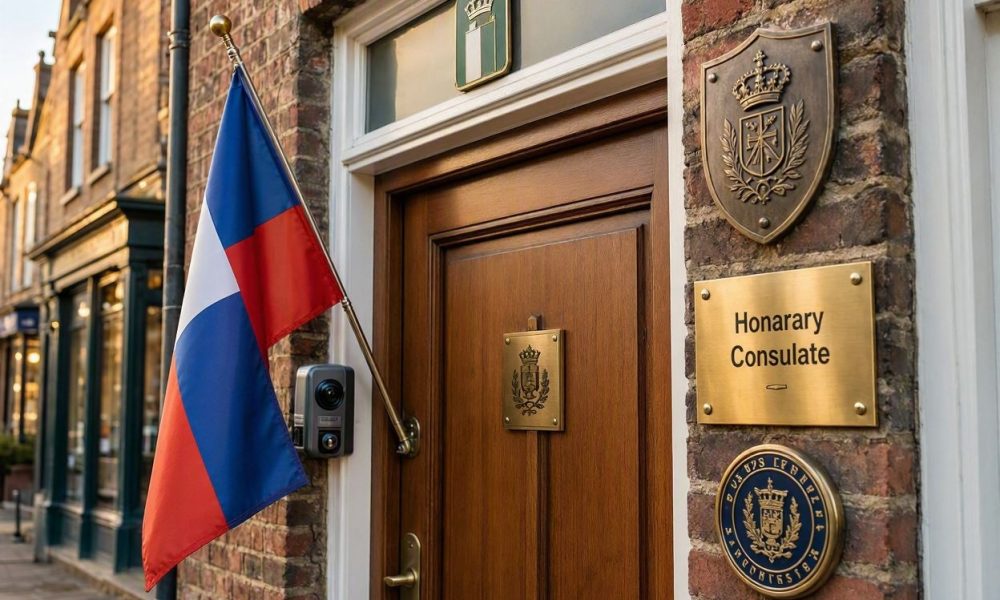
Honorary consular posts may display the sending country’s national flag and coat of arms under the Vienna Convention, while observing applicable host-country laws and practices and keeping the public identity of the office distinct from private activities at the same address.
WASHINGTON, DC, September 21, 2026
A foreign flag or coat of arms outside an honorary consular office can help citizens identify an official point of contact, giving visible expression to a recognized governmental role that may operate within a business building or private residence.
The legal basis is more specific than a general permission to decorate a property, because the Vienna Convention on Consular Relations recognizes the sending state’s right to use its national symbols and extends the relevant provision to honorary consular posts.
That right does not make every part of the building consular premises, establish diplomatic immunity, or prove that an appointment remains current, making accurate Identification important for visitors, property managers, and authorities dealing with offices that combine different uses.
Article 29 Establishes the Right to Display National Symbols
Article 29 of the Vienna Convention on Consular Relations recognizes the sending state’s right to use its national flag and coat of arms in the receiving state, subject to the conditions set out in that article.
The provision permits the flag to be flown and the coat of arms displayed on the building occupied by the consular post and at its entrance, providing an express international basis for visible Identification of the official office.
It also addresses display at the residence of the head of post and on that person’s means of transport when used on official business, although those settings raise their own practical questions about applicable rules and permitted use.
Because the right belongs to the sending state within the consular framework, it should not be described as a personal privilege allowing any individual associated with a foreign government to mark unrelated properties or vehicles as official.
The Same Display Provision Applies to Honorary Posts
Although Article 29 appears in the Convention’s chapter addressing career consular posts and officers, Article 58 expressly applies it to posts headed by honorary consular officers, making the cross-reference essential to an accurate explanation of honorary offices.
That distinction prevents an overly narrow reading under which only career consulates could display official national symbols, while also avoiding the opposite assumption that every protection in the career-post chapter automatically applies to an honorary consular office.
The Convention selectively extends particular provisions and supplies additional rules for honorary posts, so the right to display a flag must be examined alongside the specific regime governing premises, archives and other aspects of the honorary role.
An honorary office can therefore be visibly official while having a narrower legal status than a career consulate, a combination that is consistent with the treaty rather than evidence that the office’s title or national emblem is misleading.
Recognition Must Exist Independently of the Sign
The establishment of a consular post requires receiving-state consent, while appointment of its head and admission to exercise functions involve decisions by the sending and receiving governments, meaning that physical signage cannot perform those governmental acts by itself.
A plaque, flag or coat of arms can identify an existing official arrangement, but installing one does not create a consular post or entitle a private individual to exercise functions that the responsible governments have not authorized.
Visitors should consequently confirm current recognition through the relevant foreign ministry or supervising mission when the status of an office is uncertain, especially if public information is inconsistent or someone claims authority extending beyond the services normally advertised.
This verification does not diminish the practical value of national symbols, which help people find the correct location, but recognizes that a visible marker and documentary confirmation of official status answer different questions about the office.
Host-Country Laws and Practices Remain Relevant
Article 29 expressly requires regard to the laws, regulations and usages of the receiving state when exercising the display right, so its international foundation must be read together with the applicable local framework rather than treated as unlimited discretion.
Depending on the location and proposed installation, questions may arise about building alterations, signage, structural safety or use of shared areas, with the relevant requirements needing confirmation rather than an assumption that every country imposes the same permit.
The existence of a domestic rule also does not automatically resolve how it interacts with the treaty obligation, making it important for the responsible authorities to address any conflict through the applicable legal and diplomatic channels.
An accurate account should therefore avoid both extremes: the claim that consular symbols override every local requirement and the claim that the treaty right is merely a discretionary advertising permission that any private building manager can conclusively determine.
Shared Buildings Require Clear Identification of the Office
Honorary consuls often continue private professional activities, and their official work may take place at an address also used by a company or household, but neither arrangement establishes that all honorary posts worldwide follow an identical premises model.
The Convention defines consular premises by their exclusive use for the purposes of the post, allowing attention to the relevant part of a building instead of automatically assigning consular status to every room or occupant at the address.
In a hypothetical commercial building, a plaque identifying an honorary consular office on one floor would not by itself make the other tenants’ offices part of the post or place their ordinary business records within the consular framework.
Clear directions and an accurate office designation can help visitors understand where official services are provided, while the sending mission and host authorities should resolve any uncertainty about the recognized arrangement rather than relying solely on how signs appear.
Australian Guidance Explains the Practical Purpose of Display
Australia’s Department of Foreign Affairs and Trade advises honorary consuls that displaying the represented country’s flag and coat of arms can help clients and local authorities identify consular premises, providing a national example of the symbols’ practical function.
The guidance connects visible Identification with an accredited role and published contact information, illustrating how a recognizable office can assist public access without implying that every visitor already knows the limits of the honorary consul’s assigned responsibilities.
A sensible implementation would make the office’s identity easy to understand while directing visitors toward accurate opening hours and service information, especially where the building also receives customers attending unrelated businesses or residents entering their private accommodation.
Those operational choices should follow applicable instructions, but they should not be presented as treaty requirements for a particular plaque size, wording, or position unless a separate national rule actually prescribes those details for the post.
Display at a Residence Does Not Create Residential Immunity
Article29’ss reference to the residence of the head of post permits an official display in that setting. Still, it does not itself grant the residence the protections associated with the home of an accredited diplomatic agent.
A flag at an honorary consul’s home may therefore identify the officeholder’s official connection without transforming every domestic room into consular premises, a distinction especially relevant where household life and limited official work occur at the same property.
The legal treatment of a particular area depends on the applicable rules and its use, rather than on the visibility of a national emblem from the street or the representative’s personal description of the property as diplomatic.
Residents, visitors and service providers should understand that distinction, since official symbolism does not independently settle questions concerning entry, contractual obligations or other private matters that may arise at a building associated with an honorary appointment.
Vehicle Displays Have a Separate Official-Business Condition
The Convention also addresses national symbols on the head of post’s means of transport when used for official business, making the connection to official use important rather than treating a vehicle display as an unrestricted everyday entitlement.
Australia’s honorary consul guidance provides a more specific national example, limiting car pennants to particular occasions involving official use and prior police agreement, which shows why local instructions need checking before applying general treaty language to vehicles.
Those Australian arrangements should not be recast as a worldwide requirement, but neither should the treaty provision be presented as permission for an honorary consul to display official pennants during any private journey regardless of the circumstances.
A vehicle’s symbol also does not independently establish immunity from traffic enforcement or confer priority on the road, because those questions involve the applicable national framework and cannot be answered simply by pointing to a flag.
A National Emblem Does Not Confer Embassy-Level Protection
The receiving state has obligations to protect honorary consular premises, including measures against intrusion and damage under Article 59. Still, the honorary regime does not import the full premises-inviolability rules applicable to posts headed by career consular officers.
The distinction between protection and inviolability remains important even when a building is clearly marked, because a national emblem helps identify the official presence without independently expanding the legal restrictions on police action or other lawful authority.
Likewise, the premises remain within the host country’s territory, and displaying another state’s symbols does not transfer sovereignty, create a foreign enclave, or remove unrelated private activities from the jurisdiction of the receiving country’s institutions.
Any incident involving the office therefore requires attention to its actual status and the governing law, rather than an assumption that a flag either blocks every official intervention or gives outsiders unrestricted access to rooms and records.
Official Archives Are Protected Through Their Own Rules
Article 61 protects an honorary post’s consular archives and documents when kept separate from private correspondence and professional or commercial materials, making the nature and separation of the records central to the protection rather than the building’s exterior appearance.
A room displaying a coat of arms does not automatically turn every document inside it into a consular record, just as qualifying official archives do not depend solely on whether a flag is visible outside their location.
In a shared office, sound record handling can help maintain the distinction between public responsibilities and private business, while particular legal questions about files or access require assessment under the applicable framework and any relevant national instructions.
The display right and the archive rule should consequently be explained separately, allowing the public and officeholders to understand that visible Identification, recognized premises, and protected records are related subjects with different legal conditions and practical consequences.
Official Symbols Should Not Blur Private Commercial Activity
An honorary consul’s business experience may contribute to the public role, but displaying a national emblem beside commercial services can create confusion if visitors interpret the association as government endorsement of a company, product or proposed transaction.
Clear separation of official information from private advertising is therefore sensible practice, helping people identify whether they are requesting consular assistance, seeking a commercial service or attending a meeting that involves both settings but different responsibilities.
A prospective customer should not infer from an official plaque that the represented government guarantees a private contract, and an honorary appointment does not eliminate the ordinary need to verify qualifications, terms and the identity of the contracting party.
Any specific restrictions on commercial use of national symbols should be checked under the relevant national rules, rather than invented from the treaty, while the general aim remains accurate communication about whose authority and interests are being represented.
Current Status Matters When an Appointment Ends
Australia’s published guidance requires honorary consuls to notify the department and remove official signage from their home and office when their appointment ends, illustrating how a national administration addresses the risk of outdated displays continuing to suggest active authority.
Other countries’ procedures need their own verification. Still, an expired appointment and an old plaque should never be treated as sufficient evidence that the person remains authorized to provide official services or represent the sending government.
The ICIJ Shadow Diplomats investigation examined honorary consuls accused of wrongdoing or involved in controversy, highlighting oversight concerns that reinforce the value of checking official recognition without assuming that visible symbols alone establish current authority or professional integrity.
Those findings do not justify suspicion of every honorary office, but they support a straightforward distinction between respecting legitimate representation and relying on verifiable government information when an individual’s status, claims, or requested services are unclear.
Practical Guidance Should Start With the Recognized Post
Readers seeking Background can consult Amicus International Consulting’s honorary consul overview, while obtaining authoritative instructions about official symbols, premises and the scope of a particular appointment from the sending government and the competent authorities in the receiving country.
The company’s information about second-passport services concerns a separate planning subject, and neither citizenship documentation nor private engagement with an adviser creates a consular post, authorizes official representation or gives a property the legal status associated with recognized consular functions.
For an established honorary office, the practical task is to exercise the treaty-recognized display right consistently with applicable host-country requirements, official instructions and the actual use of the premises, while ensuring that visitors receive accurate information about the office.
A national flag and coat of arms can make an honorary consular presence visible and accessible, with their value resting on a genuine governmental appointment and clear public Identification rather than any assumption that symbolism creates broader authority or immunity.




