
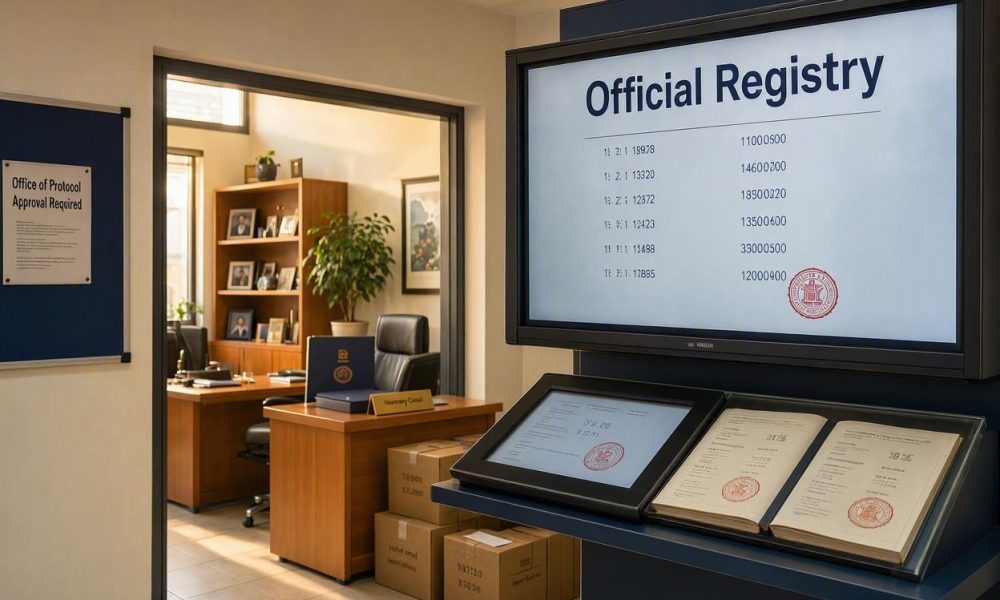
Host governments may publish consular directories and require notice or approval when offices relocate. Still, the applicable procedures depend on national rules and the proposed change, while international law separately addresses consent to posts and protection of official archives.
WASHINGTON, DC, September 21, 2026
Honorary consular offices need accurate official contact information and clearly defined premises, particularly when public functions share an address with a private business or residence. Stilng registration and relocation rules differ across host countries.
The Vienna Convention on Consular Relations does not impose a universal requirement to publish a verified street-address registry, nor does it establish a blanket approval procedure for every transfer of archives between rooms, suites or buildings.
The distinction matters because a public directory, governmental recognition of a post, and protection of official records serve different functions, and combining them into a single supposed worldwide rule can misstate both the authority of host governments and the protections involved.
The Treaty Requires Consent to Establish a Post
Article 4 of the Vienna Convention on Consular Relations requires receiving-state consent to establish a consular post and approval of its seat, classification and district, placing the basic arrangement within a formal relationship between the governments concerned.
The same article requires consent for subsequent changes in the post’s seat, classification or district, and prior express consent for an office forming part of an existing post to open elsewhere than at the seat of that post.
Those provisions establish important controls over the location and organization of consular representation. Still, they should not automatically be paraphrased as an identical worldwide process covering every internal office rearrangement or street-address change within the same city.
Whether a proposed move requires advance approval, notification, or additional documentation must therefore be checked against the receiving country’s procedures and the recognized arrangement for the post, rather than inferred solely from a general reference to Article 4.
Public Directories and Official Recognition Are Different
A published consular directory helps citizens find a representative and can provide useful evidence of an officially listed office, but publication is not the same governmental act as consenting to the post or admitting its head to exercise functions.
The Convention requires notification of appointments and admission, including communication to the competent authorities of a consular district. Still, it does not require every receiving country to maintain a publicly searchable register containing the exact address of every honorary office.
A government may impose additional national requirements or publish detailed contact information as part of its administrative practice, making it important to identify the actual rule and its jurisdiction before presenting that practice as mandatory under international law.
Conversely, an incomplete or outdated public entry does not by itself prove that a post is unauthorized, since the responsible foreign ministry or supervising mission may need to clarify whether an administrative update is pending or the appointment has ended.
Australia Provides a Concrete Address-Notification Example
Australia’s Department of Foreign Affairs and Trade tells honorary consuls to notify it promptly when contact information changes, including physical addresses, telephone numbers, email addresses, and office hours so that it can update entries in its Consular List.
The guidance also describes formal accreditation, identity cards, and the publication of contact details, illustrating a national system that links recognition of the individual with information that lets members of the public reach the relevant honorary consular office.
That published instruction supports a clear statement about notifying changes in Australia. Still, it should not be rewritten as evidence that the same page requires advance approval for every archive transfer or every move between suites in a building.
Other applicable requirements may still affect a particular relocation, so an honorary consul should confirm with the relevant authorities rather than treat a contact-update instruction as either a universal approval requirement or comprehensive permission to move.
A Change of Suite May Raise Different Questions From a New Post
An office moving from one suite to another within the same building presents different practical facts from a post moving to another city, changing its consular district or establishing an additional office outside its existing seat.
In a hypothetical same-building move, officials may need an updated address and information identifying the space used for consular work. In contrast, a move affecting the approved seat or district directly raises the consent requirements set out in Article 4.
The governing procedure should determine which submissions are required and whether approval must precede occupation, because neither the small physical distance involved nor the consul’s private lease arrangements independently resolve the host government’s requirements for the official premises.
Describing the proposed change precisely is therefore more useful than asking generally whether consulates may relocate, with the old address, new location, intended use and effect on the recognized post helping authorities identify the correct process.
Sharing a Building Does Not Extend Protection to Everything Inside
The Convention defines consular premises by their exclusive use for the post, encompassing buildings or parts of buildings and associated land, rather than treating an entire property as consular simply because an honorary consul works there.
That distinction is particularly relevant when the representative also operates a private company or lives at the same address, because official functions and ordinary private activities may occupy different areas even though they share an entrance or postal location.
A business sign, national flag or public directory entry does not independently transform private offices, family rooms or commercial records into protected consular space, and any claim about the premises must be assessed under the applicable legal framework.
Clear descriptions of the official area can reduce uncertainty for the sending government, host authorities and other occupants. However, a specific requirement for floor plans, photographs or declarations should be attributed to the national procedure that actually imposes it.
Honorary Premises Have Different Protections From Career Posts
The Convention applies a distinct regime to posts headed by honorary consular officers, requiring the receiving state to protect their premises against intrusion, damage and disturbances without importing the full premises-inviolability rules applicable to posts headed by career consular officers.
Australia’s guidance reflects that distinction by stating that honorary consular premises are not immune from search, while separately recognizing the government’s obligation to protect the premises and the conditional protection applying to official papers kept apart from private materials.
This does not mean any landlord, auditor or other visitor may enter whenever they choose, because a lawful basis for access must still be established under the relevant domestic rules and any applicable international protections must be respected.
An accurate account therefore needs to distinguish the absence of a particular immunity from the existence of an independent power to enter, inspect or search, since those are separate legal questions requiring attention to the circumstances.
Official Archives Follow a Separate Treaty Rule
Article 61 states that the archives and documents of a post headed by an honorary consular officer are inviolable at all times and wherever located, provided they remain separate from private correspondence and professional or commercial records.
The wording makes separation central to the treaty protection and prevents the archive rule from being reduced to a simple proposition that documents are protected only while they remain inside a particular office listed in a public directory.
It does not create a general right to store official records anywhere regardless of other obligations, since national requirements, the sending government’s instructions and any relevant arrangements may still affect where and how those materials should be maintained.
Equally, the provision does not establish a universal host-government permit for every movement of the files, so a claim that moving archives always requires approval from an Office of Protocol needs a specific additional legal or administrative source.
Separation Is a Legal Requirement, While Storage Methods Can Vary
Keeping consular records apart from private and business papers is expressly relevant under Article 61. Still, the treaty does not prescribe one universal cabinet, safe or room that every honorary consul must use to satisfy that condition.
A dedicated storage area and controlled access may be practical ways to maintain clear separation. At the same time, the appropriate arrangement depends on the material, office circumstances, and any more detailed instructions imposed by the responsible governments or applicable national rules.
In a hypothetical shared law office, placing consular correspondence among client files would raise questions about maintaining clearly separated official records, even if both sets of papers sit within the same physical premises.
The objective is to preserve an identifiable distinction between official archives and unrelated materials, rather than assume a cabinet label can automatically resolve every legal issue concerning its contents or how they are handled.
Relocation Planning Should Address Records and Public Access
Once the applicable procedure is established, a relocation plan should identify who is responsible for communicating with the authorities, maintaining official records, and ensuring that citizens can still reach the appropriate service during any interruption caused by the move.
Practical preparation may include confirming the effective date, arranging suitable storage and updating approved contact channels, with these steps understood as operational recommendations rather than an invented treaty checklist binding every honorary consular post in every jurisdiction.
Public information should distinguish a temporary service interruption from a post closure. At the same time, any remaining limitations on appointments or document handling should be explained accurately so that visitors do not travel unnecessarily to an unavailable office.
The sending mission and receiving authority should also have consistent information about the change, because updating a commercial website or forwarding postal mail alone does not establish that the relevant governmental notification or approval procedure is complete.
Transparency Gaps Undermine Claims of a Universal Public Register
As part of its Shadow Diplomats reporting, ICIJ examined access to honorary consul information and reported in November 2022 that 78 countries did not publish the names of their honorary consuls, demonstrating substantial differences in public transparency.
That finding concerned the availability of names at the time of the investigation, rather than proving that those governments lacked internal records or establishing the current accuracy of every country’s directory, distinctions necessary when interpreting the reported gap.
It nevertheless provides useful context for evaluating an assertion that all host countries maintain complete public address registries, since such an assertion requires a legal basis and current evidence rather than an assumption drawn from selected national examples.
Where public information is limited, confirmation from the relevant ministry or supervising mission becomes especially important. However, a response about recognition should still be distinguished from confirmation of the exact premises and services currently available at a listed location.
National Procedures Need to Be Identified by Name
The responsible institution may be a protocol department, foreign ministry, foreign missions office, or another designated authority, so using Office of Protocol as if it were the universal title can obscure which agency actually administers the relevant requirement.
Similarly, a rule governing the acquisition or use of foreign mission property may address questions beyond a routine directory update, so it is important to establish whether the proposal concerns premises recognition, real estate arrangements, district boundaries, or contact information.
Anyone preparing guidance should identify the country, the relevant authority and the precise obligation, distinguishing a mandatory advance authorization from a prompt notification requirement and from practical advice intended to help officials keep reliable records about the post.
Where the published materials do not answer a particular question, seeking written clarification is more accurate than asserting a universal prohibition or assuming silence amounts to permission, especially when official archives and private premises occupy the same property.
Private Advice Does Not Establish Official Status
Readers exploring the role can consult Amicus International Consulting’s honorary consul overview for Background, while relying on the appropriate government authorities to confirm the status of a particular post, the recognized address and any requirements governing a proposed relocation.
A commercial adviser may help organize questions or supporting information. Still, neither a private engagement nor a recommendation can substitute for host-country consent where required or determine the legal treatment of rooms, records and activities within shared premises.
The company’s separate information about second-passport services concerns personal mobility planning, which should be assessed independently of consular premises rules because citizenship documentation does not establish an honorary office or change the legal status of a private property.
For a consul planning a move, the dependable approach is to identify the applicable national procedure, obtain required consent, provide required notifications, and preserve proper separation of official archives, while treating public-directory updates as an important but distinct administrative task.




