
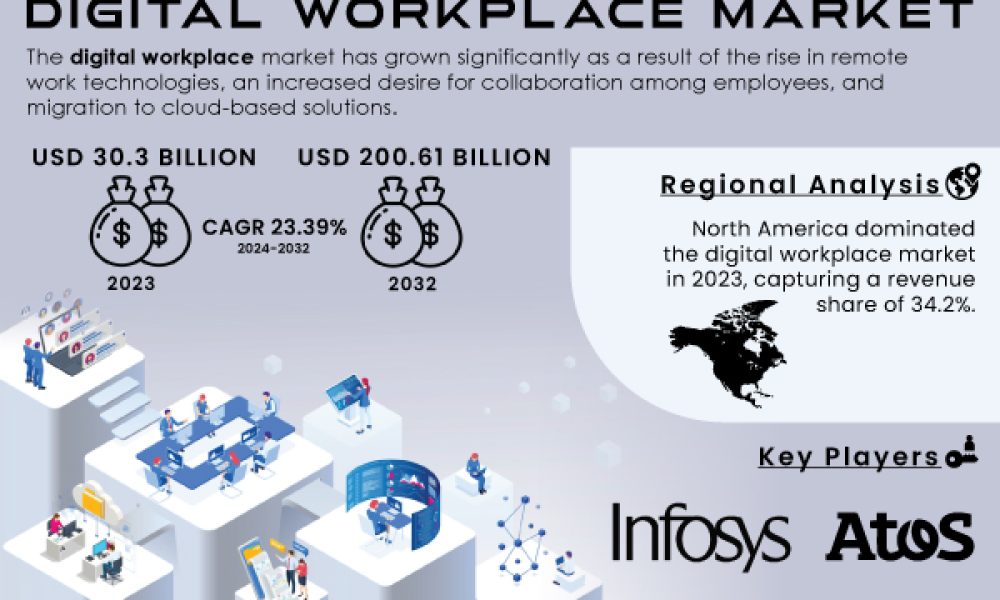
Digital Workplace Market Size
The rapid digitization of enterprises, coupled with the surge in remote and hybrid working models, is transforming traditional work environments. The increasing reliance on cloud-based tools, communication platforms, and mobile technologies is catalyzing the demand for digital workplace solutions. As businesses seek agility and employees prioritize flexibility, the need for integrated digital workplaces is becoming vital for operational efficiency, employee engagement, and long-term scalability.
Market Sizing
The Digital Workplace Market was USD 30.03 billion in 2023 and is expected to reach USD 200.61 billion by 2032, growing at a CAGR of 23.39% over the forecast period of 2024–2032.
Get Sample Copy of Report: https://www.snsinsider.com/sample-request/3014
Market Scope
The global digital workplace market has gained remarkable momentum over recent years, largely due to a combination of technological evolution and workplace transformation. This evolution is being driven by a significant rise in remote working technologies, growing expectations for real-time collaboration among employees, and widespread migration to cloud-based infrastructures. Organizations are no longer confined by traditional office boundaries—communication software, cloud collaboration platforms, and virtual desktop infrastructures (VDIs) have emerged as core tools in enabling remote productivity.
The digital workplace now encompasses a broad spectrum of platforms, including project management tools, cloud storage services, virtual meeting solutions, and social intranet systems. Businesses are increasingly prioritizing the integration of these tools to improve agility, accelerate decision-making, and ensure seamless communication. This shift is not merely about convenience; it’s a strategic imperative for ensuring resilience and continuity in unpredictable market environments.
Additionally, the bring-your-own-device (BYOD) movement and enterprise mobility strategies are gaining traction. These solutions not only reduce IT infrastructure costs but also enhance workforce flexibility and mobility. Emerging technologies such as artificial intelligence (AI), virtual reality (VR), and the Internet of Things (IoT) are further accelerating the evolution of digital workplaces by automating repetitive tasks, supporting immersive experiences, and driving predictive insights. As companies continue to embrace these advancements, the global digital workplace market is poised for sustained growth throughout the next decade.
Market Analysis
Technological Advancements and Changing Dynamics Fueling the Rise of Digital Workplaces
The digital workplace market is undergoing a transformational phase, driven by technological innovation, shifting employee expectations, and a growing emphasis on operational resilience. Organizations are rapidly adopting digital workplace solutions to meet the demands of a dispersed workforce, enhance productivity, and stay competitive in a dynamic business landscape.
One of the most significant drivers of this trend is the rise of cloud computing. Cloud platforms offer scalable, secure, and cost-effective solutions that allow businesses to deploy collaborative tools without investing in expensive infrastructure. When coupled with AI, these platforms unlock powerful capabilities such as automation, predictive analytics, and virtual assistance—helping teams work smarter and more efficiently.
In addition, the IoT has found its way into the digital workplace, enabling seamless device connectivity, real-time data sharing, and intelligent decision-making. These capabilities are especially crucial in industries that require rapid responsiveness and data accuracy, such as healthcare, manufacturing, and finance.
Workforce expectations are also evolving. Millennials and Gen Z professionals, who comprise a growing segment of the global workforce, demand flexible work options, intuitive user experiences, and access to digital tools that align with their personal technology habits. This generational shift is prompting businesses to revamp their workplace strategies with digital-first solutions.
Moreover, the digital workplace is playing a critical role in addressing business challenges. Through workflow automation, enhanced communication, and resource optimization, organizations are improving operational efficiency and cutting costs. Companies are also prioritizing customer satisfaction by leveraging digital tools that ensure faster responses, personalized service, and streamlined interactions.
Lastly, data privacy regulations and security mandates have made robust workplace security non-negotiable. Digital workplace solutions now come equipped with integrated compliance features, end-to-end encryption, and secure access controls to safeguard sensitive information. Together, these dynamics are fueling an unprecedented rise in the adoption of digital workplace platforms.
Enquiry Before Buy: https://www.snsinsider.com/enquiry/3014
Segment Analysis
In 2023, the solutions segment dominated the market with a commanding share of 67.6%. These solutions include essential tools such as collaborative software, cloud-based content management, and virtual communication platforms. Their rapid adoption by enterprises stems from their ability to enhance productivity and streamline communication. A notable example is Trianz PULSE, which integrates social networking and team collaboration features, providing a unified digital workspace. The platform also facilitates IT self-service options, improving internal support efficiency and user experience.
The services segment—encompassing consulting, training, and integration—has shown impressive growth prospects and is expected to register a CAGR of 23.5% through 2032. As organizations move toward workplace digitalization, these services are essential for seamless implementation and cost-effective management of IT infrastructure. They also ensure minimal downtime and facilitate employee adaptation to new systems.
From an organizational perspective, large enterprises led the market with 61.5% revenue share in 2023. These companies are at the forefront of adopting AI-powered digital workplace solutions such as Tata Consultancy Services’ Cognix platform, which leverages technologies like AR, VR, and cognitive automation. These tools provide real-time business intelligence and streamline enterprise-wide collaboration.
Meanwhile, small and medium-sized enterprises (SMEs) are experiencing the fastest growth, projected at a CAGR of 24.3%. SMEs are increasingly turning to cloud-based digital workplace tools due to their scalability and affordability. These platforms reduce capital expenditure, eliminate hardware costs, and improve operational efficiency—key advantages for resource-constrained businesses.
By end-use, the IT & telecom sector took the lead with a 22.8% share in 2023, fueled by SaaS proliferation, BYOD adoption, and the increasing need for remote work solutions. Digital workplaces are essential for maintaining agility and service continuity in this fast-paced industry.
The healthcare and pharmaceutical sector is projected to grow rapidly with a CAGR of 24.3%. Healthcare institutions are adopting digital workplace solutions to reduce paperwork, streamline information sharing, and ensure real-time collaboration among staff, regardless of location. These benefits are critical in emergency scenarios and for delivering patient-centric care.
Buy Complete Report: https://www.snsinsider.com/checkout/3014
Regional Insights
North America dominated the digital workplace market in 2023, accounting for a 34.2% revenue share. The region’s strong performance is attributed to widespread BYOD adoption, rapid deployment of enterprise mobility solutions, and an advanced IT infrastructure. Major players such as IBM have spearheaded innovation in this space; for instance, IBM’s Talent & Transformation platform uses AI to help businesses close skills gaps and empower employees in digital environments. Furthermore, robust demand from the manufacturing, automotive, and retail sectors is further driving adoption of intelligent workplace solutions across the region.
Meanwhile, the Asia Pacific region is anticipated to experience exponential growth, boasting a projected CAGR of 23.6% over the forecast period. Rapid digitalization across industries and growing cloud adoption are at the core of this regional expansion. Enterprises in China, India, Japan, and Southeast Asia are investing heavily in digital transformation strategies. Regional players are also pursuing strategic collaborations and innovations to secure competitive advantages, positioning Asia Pacific as a hotbed for emerging digital workplace solutions.
Recent Developments
- Microsoft 365 Copilot, launched in 2024, integrates AI-powered productivity tools across Microsoft’s suite of applications, streamlining workflows and enhancing decision-making for users worldwide.
- Google Workspace introduced several upgrades in 2024, including enhanced AI-based collaboration tools, smart scheduling features, and robust data protection measures—making it more appealing to businesses seeking secure, flexible digital workplace environments.
Contact Us:
Jagney Dave – Vice President of Client Engagement
Phone: +1-315 636 4242 (US) | +44- 20 3290 5010 (UK)




