
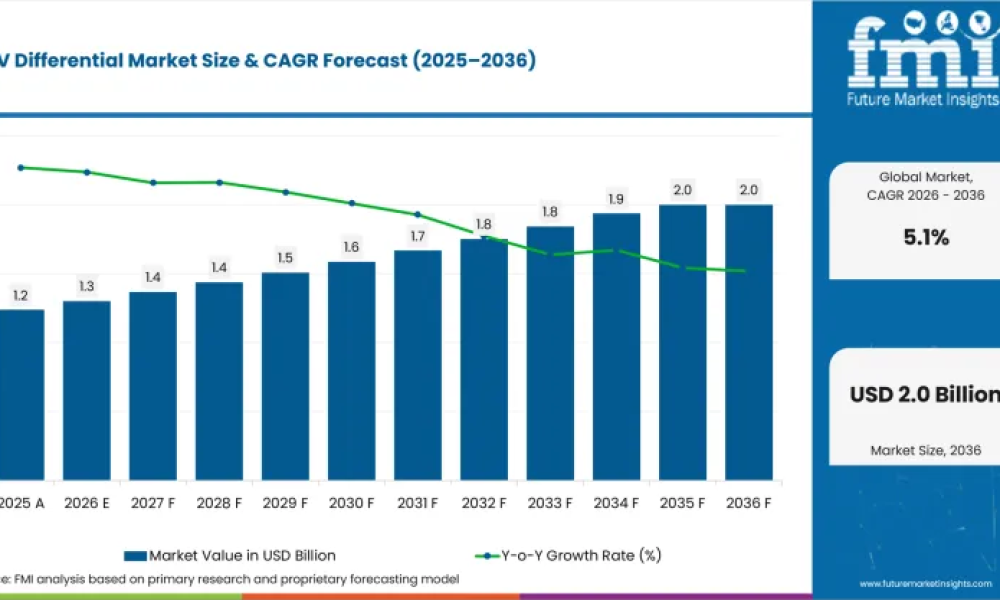
The global ATV differential market is projected to grow from USD 1.3 billion in 2026 to USD 2.0 billion by 2036, advancing at a 5.1% CAGR from 2026 to 2036. Demand is supported by repeated ATV and UTV use across designated off-road routes, utility operations, towing, and recreational applications where changing wheel grip places continuous demands on traction-transfer hardware.
Differentials play an important role in distributing torque between driven wheels while allowing wheel-speed differences during turns and uneven terrain operation. On loose, muddy, sandy, or mixed surfaces, locking and limited-slip configurations can influence traction behavior and vehicle controllability. This makes differential type, housing geometry, gear ratios, and engagement hardware important considerations during vehicle development and replacement.
Off-road route conditions also support replacement requirements over the operating life of vehicles. National Park Service guidance updated in May 2026 lists 388 miles of designated roads at Glen Canyon, including 304 unpaved miles. Such road conditions illustrate the varied surfaces encountered by off-road vehicles and the resulting importance of dependable driveline components.
What Are the Key Segments in the ATV Differential Market?
- Locking Differentials — 25.0% share: Locking differentials are estimated to lead the differential type segment in 2026, supported by positive axle coupling when vehicles operate on loose or traction-limited surfaces.
- UTVs — 36.0% share: UTVs are projected to account for the leading vehicle-type share because work-oriented platforms can impose higher drivetrain loads through repeated utility cycles.
- OEM Direct — 42.0% share: OEM direct sales are expected to lead the channel segment as vehicle-level validation establishes platform-specific differential fitment before production.
- Complete Assemblies: Complete differential assemblies can simplify replacement decisions by reducing uncertainty associated with rebuilding individual internal components.
- Traction Transfer Applications: Differential systems remain central to trail riding, towing, mud or sand operation, racing, and heavy-duty commercial use where wheel-grip conditions can vary significantly.
Get detailed market forecasts, competitive benchmarking, and pricing trends:
https://www.futuremarketinsights.com/reports/sample/rep-gb-34952
Which Countries Are Showing the Strongest Growth in ATV Differentials?
Norway is projected to record the highest CAGR among the profiled countries at 6.2% through 2036. Market development is influenced by utility vehicle applications and service routes where off-road platforms operate under varied terrain and working conditions. Statistics Norway recorded 329,345 registered tractors in 2025, with national registrations increasing 2.1% from 2024. While the tractor fleet does not directly measure ATV demand, the data illustrates the commercial relevance of established utility-vehicle registration and service networks.
Mexico is expected to expand at a 5.5% CAGR, supported by recreational and utility applications requiring dependable driveline performance across varied terrain. Platform-specific component requirements make accurate fitment and replacement availability important considerations for distributors and service providers.
Canada is projected to grow at a 5.2% CAGR. The country’s extensive recreational and utility off-road environment creates applications for ATV and UTV driveline systems, with differential durability and traction behavior remaining relevant across changing operating surfaces.
The United States is expected to record a 4.9% CAGR. Demand is supported by the country’s established ATV and UTV ecosystem spanning recreation, agriculture, utility work, towing, and other off-road applications. Replacement requirements also remain important as vehicles experience repeated operation on designated trails and work routes.
Japan is projected to grow at a 4.1% CAGR, representing the lowest growth rate among the profiled countries. Demand remains connected to specialized off-road vehicle applications and the need for platform-specific differential components that maintain reliable engagement and torque-transfer behavior.
How Is Off-Road Usage Shaping the ATV Differential Market?
ATV and UTV differentials operate in environments where wheel grip can change quickly. Loose soil, mud, sand, uneven trails, and mixed surfaces can place different demands on axle components as the vehicle moves between high- and low-traction conditions.
This operating variability makes differential configuration an important part of vehicle specification. Locking differentials can provide positive axle coupling where additional traction is required, while limited-slip and open configurations address different handling and drivetrain requirements. Manufacturers therefore need to match gearsets, housings, bearings, seals, and engagement hardware to the intended vehicle platform.
What Is Changing the Competitive Landscape?
The competitive landscape includes TEAM Industries, The Hilliard Corporation, Yamaha Motor Corporation, U.S.A., BRP Inc., Polaris Inc., Kawasaki Motors Corp., U.S.A., Suzuki Motor USA, LLC, and GKN Automotive.
Competition is increasingly centered on platform-specific engineering. Differential housings, gear ratios, engagement systems, and axle interfaces must match the vehicle architecture, limiting interchangeability across models and increasing the importance of accurate engineering documentation.
OEM direct sales remain significant because differential systems are validated at the vehicle level before production. Early integration allows manufacturers to establish the required traction behavior, packaging, gear ratio, and engagement characteristics before vehicles reach customers.
The aftermarket presents a different commercial requirement. Dealers and distributors must manage multiple vehicle configurations without creating excessive inventory of similar internal components. Complete differential assemblies can reduce rebuild uncertainty while helping service providers restore vehicle functionality more efficiently.
What Does the Analyst Say About the ATV Differential Market?
“ATV differential programs are won at the fitment level because housing geometry and engagement behavior must match a named vehicle platform. Aftermarket margin improves once complete assemblies reduce rebuild uncertainty without forcing dealers to stock several near-identical internal parts.”
— Nikhil Kaitwade, Principal Consultant, Future Market Insights
Drive Your Business Growth Strategy: Checkout the Report for Key Insights!
https://www.futuremarketinsights.com/checkout/34952
What Is Driving Demand for ATV Differentials?
Variable Terrain Increases Traction Requirements
ATVs and UTVs routinely operate across surfaces with different levels of wheel grip. Differential systems must therefore maintain predictable torque transfer while accommodating changes in terrain. Locking systems can become particularly relevant where additional axle coupling is required.
Utility Applications Increase Drivetrain Loading
UTVs are used for towing, hauling, agricultural activities, and other utility applications that can place greater loads on drivetrain components. Repeated work cycles increase the importance of differential durability, gearset integrity, bearing performance, and sealing.
Platform-Specific Engineering Supports OEM Demand
Differential housings and engagement hardware are closely matched to individual vehicle platforms. OEM programs therefore require component validation before production, supporting direct sales and creating opportunities for suppliers with strong engineering and integration capabilities.
Replacement Demand Creates Aftermarket Opportunities
Differentials operate under repeated mechanical loads and changing traction conditions. Over time, gears, bearings, seals, carriers, and engagement components can require service or replacement. Complete assemblies provide an alternative to rebuilding individual internal parts and can reduce uncertainty for dealers.
What Are the Key Market Restraints?
Platform-specific ratios, housing dimensions, and engagement mechanisms limit interchangeability across ATV and UTV models. This increases inventory complexity for aftermarket suppliers and requires distributors to maintain accurate vehicle-to-component cross-references.
The technical requirements of differential systems can also increase replacement complexity. Incorrect gear ratios, housing dimensions, or engagement components can affect drivetrain performance, making fitment accuracy important for both OEM and aftermarket channels.
What Opportunities Exist for ATV Differential Manufacturers?
Complete replacement assemblies represent an opportunity for suppliers seeking to simplify aftermarket service. Providing preconfigured assemblies can reduce rebuild uncertainty and help dealers avoid carrying numerous near-identical internal components.
Manufacturers can also strengthen their position through platform-specific engineering support. Detailed fitment records covering housing geometry, ratios, engagement behavior, bearings, and seals can help OEMs and distributors reduce installation errors and improve replacement efficiency.
How Is the ATV Differential Market Segmented?
The ATV differential market is analyzed by differential type, vehicle type, sales channel, component, application, and region.
By Differential Type
The market covers locking, limited-slip, open, and electronic limited-slip differentials. Locking differentials lead with an estimated 25.0% share in 2026.
By Vehicle Type
Vehicle types include UTVs, ATVs, side-by-sides, utility vehicles, and youth ATVs. UTVs are projected to account for 36.0% share in 2026, reflecting higher drivetrain loading across work-oriented applications.
By Sales Channel
Sales channels include OEM direct, aftermarket, and distributor routes. OEM direct is expected to lead with 42.0% share in 2026 because vehicle-level validation establishes component fitment during platform development.
By Component
Components include complete assemblies, carriers, gearsets, bearings and seals, and actuation hardware. Complete assemblies can support replacement efficiency where dealers seek to minimize rebuild complexity.
By Application
Applications span trail riding, towing, mud or sand, racing, and heavy-duty commercial use. These applications impose different requirements on traction transfer and differential engagement.
What Are the Drivers, Restraints and Opportunities in the ATV Differential Market?
The ATV differential market is increasingly shaped by changing terrain, higher utility-vehicle drivetrain loads, platform-specific fitment, and the need to simplify aftermarket servicing.
- Driver: Variable wheel-grip conditions increase the importance of reliable traction-transfer and differential engagement systems.
- Restraint: Platform-specific housings, gear ratios, and engagement hardware restrict interchangeability and increase inventory complexity.
- Opportunity: Complete assemblies and detailed fitment documentation can reduce rebuild uncertainty and strengthen aftermarket service efficiency.
What Is the ATV Differential Market Demand Outlook?
The market outlook remains connected to continued ATV and UTV use across recreational trails, utility operations, towing, and commercial applications. As vehicles encounter varied terrain, differential systems must provide consistent torque transfer while accommodating different wheel-speed and traction conditions.
UTV applications are expected to remain particularly important because work-oriented vehicles can experience repeated drivetrain loading. This creates demand for differential components designed around specific vehicle platforms and operating cycles.
How Fast Are Key Countries Growing in the ATV Differential Market?
Norway is projected to lead the profiled countries with a 6.2% CAGR, followed by Mexico at 5.5%, Canada at 5.2%, the United States at 4.9%, and Japan at 4.1% through 2036. Country-level demand is expected to reflect differences in utility-vehicle usage, off-road recreation, registration frameworks, terrain, and service infrastructure.
About Future Market Insights
Future Market Insights (FMI) is a leading provider of market research and consulting services, offering syndicated and customized research across automotive, industrial, energy, technology, and other global markets. FMI provides market forecasts, competitive intelligence, demand analysis, and strategic insights to support business and investment decisions.



