
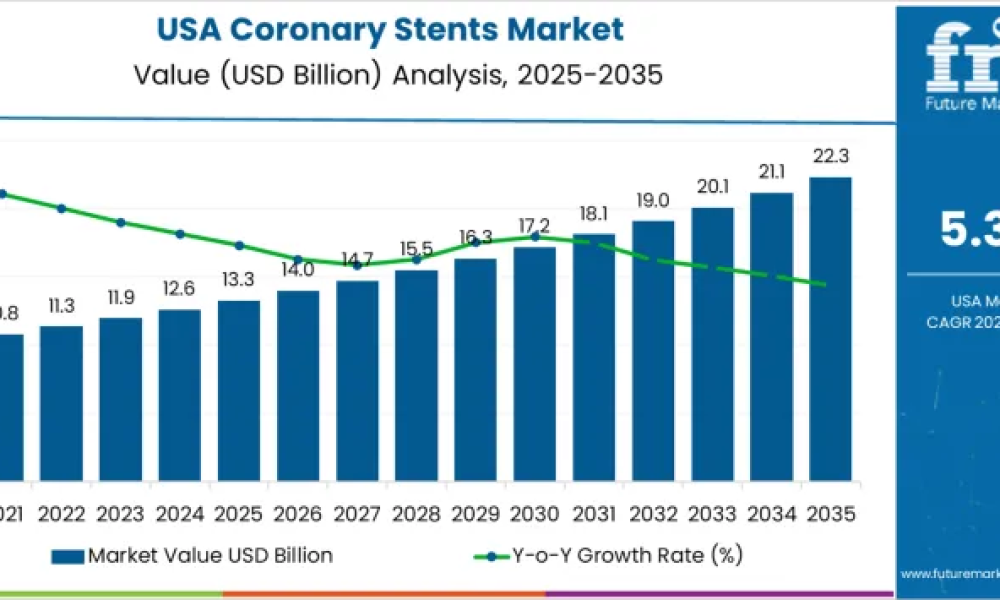
The United States coronary stents market is on a robust growth trajectory, projected to expand from $13.3 billion in 2025 to $22.3 billion by 2035, achieving a compound annual growth rate (CAGR) of 5.3%. This forecast, drawn from comprehensive analysis by Future Market Insights (FMI), underscores the escalating demand for advanced cardiovascular interventions in response to the nation’s mounting burden of coronary artery disease (CAD). As industry leaders navigate this evolving landscape, the insights highlight opportunities for innovation, strategic partnerships, and targeted investments to address unmet needs in patient care.
CAD remains a leading cause of mortality in the U.S., affecting an estimated 18 million Americans. Driven by an aging population, sedentary lifestyles, obesity, poor dietary habits, and comorbidities such as hypertension and diabetes, the prevalence of this condition is fueling the need for effective treatments. Percutaneous coronary intervention (PCI) procedures, which utilize coronary stents to restore blood flow in narrowed arteries, are becoming increasingly vital. Annually, approximately 1.2 million stents are implanted across the country, reflecting the critical role these devices play in reducing cardiac events and improving long-term outcomes.
At the forefront of this market’s expansion are groundbreaking advancements in stent technology. Drug-eluting stents (DES), which command a dominant 33.2% market share, are particularly noteworthy for their ability to release medication that prevents restenosis—the re-narrowing of arteries post-procedure. These stents are especially beneficial for high-risk patients, including those with diabetes or complex CAD profiles. Meanwhile, bioresorbable vascular stents (BVS) or scaffolds (BVS/BRS) are gaining traction as they dissolve over time, minimizing long-term complications and aligning with the industry’s shift toward more biocompatible solutions. Bare metal stents (BMS) continue to serve specific applications, but the trend leans heavily toward enhanced designs that prioritize patient safety and efficacy.
Material innovations further bolster market dynamics. Cobalt-chromium leads with a 35.0% share, prized for its strength, durability, radiopacity, and fracture resistance. Other materials like stainless steel, platinum-chromium, nickel-titanium (nitinol), and polymers for bioresorbable options provide diverse choices, enabling cardiologists to tailor treatments to individual needs. This personalization extends to procedural approaches, with a growing emphasis on minimally invasive techniques that reduce recovery times and hospital stays.
From an end-user perspective, hospitals remain the primary hub for PCI procedures, supported by ambulatory surgical centers and cardiac catheterization laboratories. These settings benefit from improved healthcare infrastructure, advanced diagnostic tools, and broader insurance coverage, which enhance accessibility to life-saving interventions. However, challenges persist, including the high costs of procedures that can deter uninsured or underinsured patients, potential complications like stent thrombosis requiring follow-up care, and a preference among some for non-invasive alternatives such as lifestyle modifications or medications for milder cases. Additionally, the complexity of implantation demands highly skilled professionals, which may limit availability in underserved regions.
Regionally, growth varies across the U.S., with the West leading at a 6.1% CAGR, followed by the South at 5.5%, Northeast at 4.9%, and Midwest at 4.3%. These disparities reflect differences in population demographics, healthcare access, and prevalence of risk factors. For instance, urban centers in the West and South are witnessing rapid adoption of cutting-edge technologies, while the Northeast’s established medical hubs drive innovation through research and development.
The competitive landscape is concentrated among key players who are shaping the future of cardiovascular care. Boston Scientific Corporation holds approximately 21% of the market, offering a portfolio that includes metallic stents, DES, BMS, and next-generation devices designed for superior performance. Other prominent companies, such as TERUMO CORPORATION, Medtronic, Vascular Concepts, and B. Braun Melsungen AG, are intensifying competition through R&D investments, regulatory adherence, and expansive distribution networks. Success in this arena hinges on product efficacy, material quality, procedural safety, and the ability to cater to diverse patient profiles. As these leaders vie for dominance, collaborations and mergers could accelerate the introduction of cost-effective, high-efficiency solutions.
Looking ahead, the market narrative is one of resilience and opportunity. Industry executives and decision-makers are encouraged to focus on preventative care, early detection, and personalized medicine to mitigate CAD’s impact. Enhancements in diagnostic techniques and a push toward lower-cost stents will democratize access, while ongoing innovations promise to reduce complications and improve outcomes. “The U.S. coronary stents market exemplifies how technological progress can transform patient lives amid a public health challenge,” notes an FMI analyst. “Leaders who invest in R&D and strategic expansions will not only capture market share but also contribute to healthier communities.”
Subscribe for Year-Round Insights → Stay ahead with quarterly and annual data updates: https://www.futuremarketinsights.com/reports/brochure/rep-gb-29650
Request for Sample Report | Customize Report |purchase Full Report – https://www.futuremarketinsights.com/reports/sample/rep-gb-29650
This decision-grade analysis equips stakeholders with actionable insights for strategic planning. By leveraging trends like the adoption of DES and BVS, companies can position themselves as pioneers in a market poised for sustained growth. For healthcare providers, the data underscores the importance of integrating advanced stents into protocols to optimize patient results. Policymakers, too, can draw from these findings to advocate for expanded coverage and infrastructure improvements.
As the U.S. grapples with rising cardiovascular risks, the coronary stents sector stands as a beacon of hope, blending human-centered innovation with data-driven strategies. With a projected valuation of $22.3 billion by 2035, the market invites bold leadership to drive progress, ensuring that advancements reach those who need them most.
About Future Market Insights (FMI)
Future Market Insights, Inc. (FMI) is an ESOMAR-certified, ISO 9001:2015 market research and consulting organization, trusted by Fortune 500 clients and global enterprises. With operations in the U.S., UK, India, and Dubai, FMI provides data-backed insights and strategic intelligence across 30+ industries and 1200 markets worldwide.
Why FMI: Decisions that Change Outcomes- https://www.futuremarketinsights.com/why-fmi
Contact Us:
Future Market Insights Inc.
Christiana Corporate, 200 Continental Drive,
Suite 401, Newark, Delaware – 19713, USA
T: +1-347-918-3531
Website: https://www.futuremarketinsights.com
LinkedIn| Twitter| Blogs | YouTube
Have a specific Requirements and Need Assistant on Report Pricing or Limited Budget please contact us – [email protected]



