
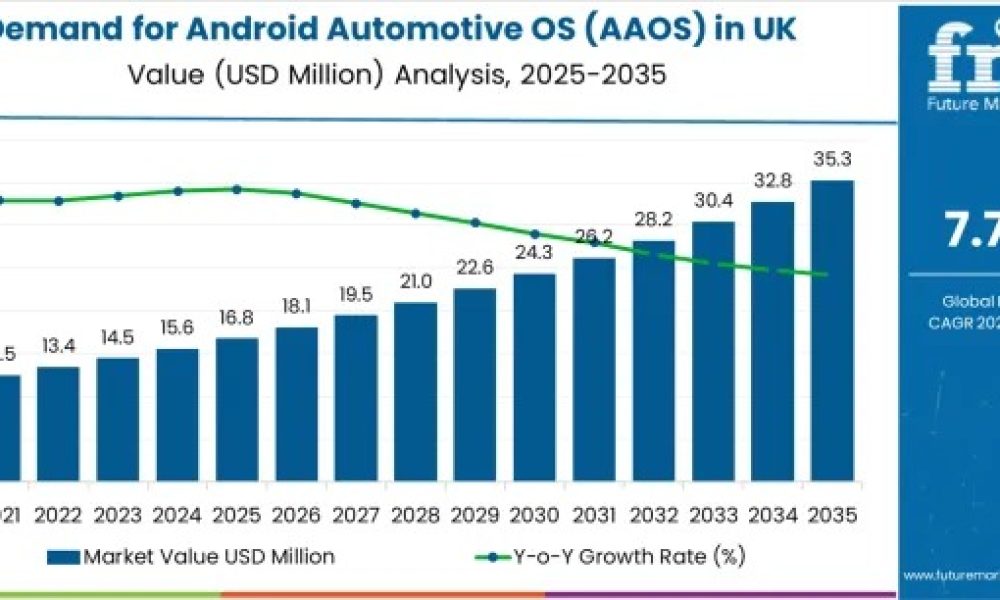
The demand for Android Automotive Operating System (AAOS) in the United Kingdom is set to more than double over the next decade, reflecting the rapid evolution of connected vehicle ecosystems and the growing strategic importance of unified, embedded software platforms in modern automotive design. The UK AAOS market is forecast to grow from USD 16.8 million in 2025 to approximately USD 34.2 million by 2035, representing an absolute value increase of USD 17.4 million. This trajectory translates into total growth of 103.6%, with demand expanding at a compound annual growth rate (CAGR) of 7.7% between 2025 and 2035.
This sustained expansion is being driven by accelerating adoption of connected vehicle technologies, deeper integration of advanced infotainment systems, and OEMs’ increasing preference for scalable, centralized software architectures. As vehicles evolve into software-defined platforms, Android Automotive OS is gaining prominence as a foundational layer enabling seamless infotainment, diagnostics, over-the-air (OTA) updates, and integration with broader digital ecosystems.
Get access to comprehensive data tables and detailed market insights – request your sample report today!
OEM-Centric Adoption Shapes Market Structure
OEMs and Tier-1 suppliers dominate demand, accounting for 74.2% of total AAOS adoption in 2025. This reflects a decisive shift toward embedded software strategies that centralize user experience, vehicle intelligence, and lifecycle management within production vehicles. Automotive manufacturers are increasingly prioritizing operating systems that reduce fragmentation, lower long-term integration risk, and support continuous feature evolution throughout the vehicle lifecycle.
Rather than focusing on standalone software licensing, competitive positioning in the UK AAOS market is defined by platform engineering capability, integration expertise, certification readiness, and long-term technical support. Suppliers with established automotive-grade development processes and service networks are best positioned to meet stringent quality, safety, and regulatory requirements.
Basic AAOS Leads by Share, Supporting Scalable Deployment
By type, the Basic Android Automotive OS segment accounts for 59.3% of market demand in 2025, making it the leading category. Its dominance reflects proven platform stability, ease of integration, and suitability for large-scale production programs. In a market where many manufacturers are upgrading software capabilities without fully redesigning vehicle architectures, Basic AAOS provides a practical pathway to enhance connectivity while maintaining operational continuity.
Customized, ROM-based, and Super App variants play a growing role in premium and specialized vehicle applications, where differentiated user interfaces, brand-specific features, and advanced connectivity functions are required. However, the Basic segment remains the backbone of mass deployment due to its reliability and compatibility with existing automotive infrastructure.
Phased Growth Reflects Technology Maturity and System Complexity
Between 2025 and 2030, UK AAOS demand is expected to rise steadily as connected vehicle applications expand across automotive manufacturing centers. During this phase, manufacturers are investing heavily in software development capabilities to manage increasing system complexity and integration requirements. The growing penetration of AAOS in premium vehicle lines and infotainment upgrades is a key contributor to early-stage growth.
From 2030 to 2035, demand is forecast to increase from USD 23.4 million to USD 34.2 million, adding USD 10.8 million, which represents 62.1% of total ten-year expansion. This later phase will be characterized by integration of next-generation connectivity technologies, artificial intelligence-driven interfaces, and deeper alignment with electric vehicle (EV) architectures. As EV platforms and connected services converge, AAOS is expected to play a more central role in vehicle intelligence and user interaction.
Regional Momentum Led by England
Regionally, England leads UK demand with an 8.1% CAGR, supported by strong automotive manufacturing clusters, advanced technology ecosystems, and early adoption of premium connectivity solutions. England’s concentration of OEMs, software development hubs, and innovation capital positions it as the primary growth engine for AAOS deployment.
Scotland follows with a 7.8% CAGR, driven by established automotive operations and favorable conditions for software integration across manufacturing and technology corridors. Wales, growing at 7.4%, benefits from automotive modernization and connectivity engineering initiatives, while Northern Ireland, at 7.0%, continues to expand adoption through regional technology development and coordinated automotive programs.
Tailor Your Solution: Request Customization for Your Unique Needs!
Drivers, Trends, and Market Dynamics
The UK AAOS market is being shaped by several structural drivers. Rising connected vehicle performance standards and quality expectations are pushing manufacturers toward standardized, robust operating systems capable of supporting advanced features without excessive customization cost. Electrification trends further reinforce demand, as EV platforms rely more heavily on software-defined functionality and continuous updates.
At the same time, challenges remain. Competition from alternative automotive operating systems, integration complexity, and the need for specialized infrastructure can influence deployment timelines. However, industry-wide movement toward collaborative platforms, shared validation frameworks, and centralized software management is reducing these barriers and accelerating adoption.
A key trend is the integration of advanced connectivity and performance monitoring systems, enabling real-time diagnostics, predictive maintenance, and improved system reliability. These capabilities are becoming essential as vehicles increasingly operate as connected nodes within broader mobility and digital ecosystems.
Competitive Landscape Focused on Capability and Services
The competitive landscape features a mix of specialized automotive software providers and established technology firms. Companies such as HaleyTek, RTSoft, Tata Elxsi, Visteon Corporation, Lotus Cars, and Green Hills Software are strengthening their positions through investments in platform development, integration services, and certification pathways aligned with automotive standards. Market leadership is closely tied to the ability to deliver end-to-end solutions spanning development, testing, validation, and long-term support.
Outlook
With demand expected to surpass USD 34 million by 2035, the UK Android Automotive OS market represents a strategically important segment within the broader connected vehicle ecosystem. The combination of strong growth fundamentals, OEM-led adoption, and increasing reliance on software-defined vehicle architectures positions AAOS as a critical enabler of future automotive innovation. The full market report provides in-depth quantitative analysis, competitive benchmarking, and strategic insights to support informed decision-making in this rapidly evolving domain.
Why Choose FMI: Empowering Decisions that Drive Real-World Outcomes: https://www.futuremarketinsights.com/why-fmi
About Future Market Insights (FMI)
Future Market Insights, Inc. (FMI) is an ESOMAR-certified, ISO 9001:2015 market research and consulting organization, trusted by Fortune 500 clients and global enterprises. With operations in the U.S., UK, India, and Dubai, FMI provides data-backed insights and strategic intelligence across 30+ industries and 1200 markets worldwide.



