
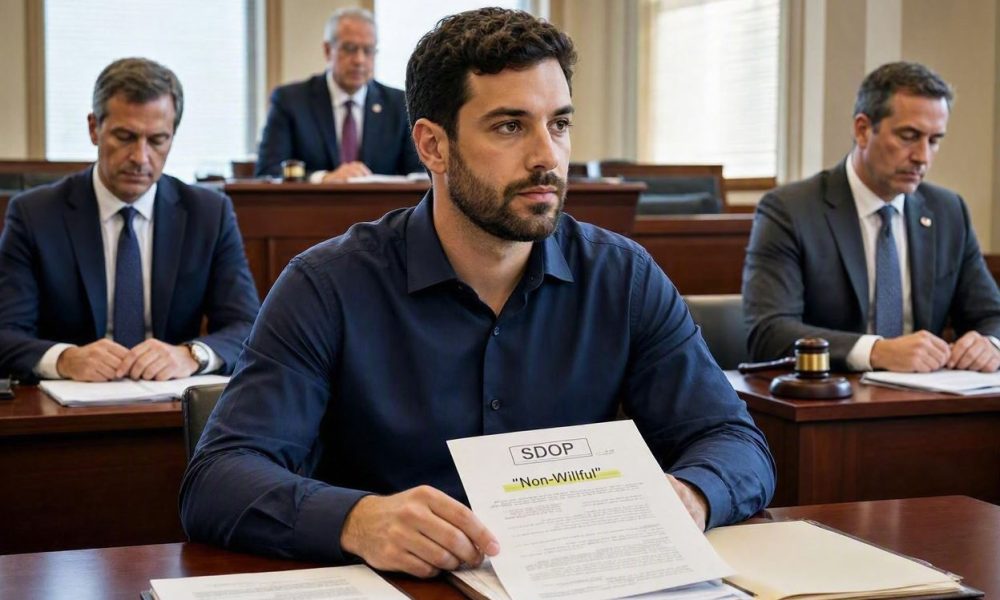
Federal prosecutors outline potential prison exposure for FBAR, false statement, and IRS filing counts.
WASHINGTON, August 26, 2026 — Former certified public accountant Brian Nelson Booker has appeared in federal court following his July 24 arrest at a Miami airport, bringing a long-dormant offshore tax prosecution back into an active courtroom after his detention and expulsion from Belarus.
The proceeding places Booker before the United States justice system nearly ten years after prosecutors say he left the country upon learning about a criminal investigation involving foreign financial accounts, allegedly incomplete tax returns, and a disputed Internal Revenue Service streamlined disclosure.
Federal authorities describe substantial statutory exposure, including maximum five-year prison terms for each charged FBAR failure and false statement, together with maximum three-year terms for each count involving false documents allegedly filed with the Internal Revenue Service.
According to the United States Department of Justice, a July 2021 second superseding indictment charges Booker with failing to file Reports of Foreign Bank and Financial Accounts, submitting false IRS documents, and making false statements to the United States.
Those maximum penalties do not represent a sentence, and Booker remains presumed innocent because an indictment contains allegations that prosecutors must prove beyond a reasonable doubt through admissible evidence, negotiated admissions, or findings reached after a constitutionally fair trial.
A federal case returns to the courtroom
Booker’s court appearance changes the prosecution from a fugitive matter awaiting physical jurisdiction into an active adversarial case where defense counsel can seek discovery, challenge charges, examine evidence, litigate pretrial motions, negotiate with prosecutors, and prepare for trial.
Publicly available Justice Department information confirms the appearance but does not identify the presiding judge, the plea entered, bond conditions, the custody determination, or the schedule for future hearings, making any specific account of those procedural outcomes premature.
An initial federal appearance ordinarily addresses identity, the pending charges, representation by counsel, custody, and scheduling, while a later arraignment may include a formal plea and other steps required to move the case toward motions or trial.
Because Booker returned after years abroad and an existing indictment, prosecutors may raise concerns involving appearance risk, international connections, financial resources, and prior absence, while defense counsel can propose conditions intended to ensure attendance without unnecessary detention.
The court must make any custody decision under governing law and the evidence presented by both parties, rather than inferring it from the dramatic circumstances of Booker’s Belarusian expulsion or airport arrest.
The Miami arrest ended years outside American jurisdiction
Prosecutors say Booker departed the United States during 2016 after learning about the investigation, lived in Russia without being ordered extradited, and was later arrested in Belarus during May 2025 before authorities there eventually ordered his expulsion.
Belarus reportedly detained him for approximately fourteen months, after which his July 24 return placed him within the direct authority of federal agents who could execute the domestic arrest process without obtaining a separate American extradition ruling.
The International Enforcement Law Reporter described Booker’s federal court appearance after the Belarusian expulsion and identified the pending allegations involving FBARs, false documents, and statements submitted to federal tax authorities by the former accountant.
His return appears to have followed an expulsion rather than a conventional treaty extradition, an important distinction because immigration removal and sovereign administrative action can place a wanted person into American custody even when no foreign court orders surrender under an extradition agreement.
Booker’s experience demonstrates that living in countries without United States extradition treaties can delay enforcement without eliminating a pending indictment, particularly when cross-border travel or a host government’s immigration decision changes the individual’s legal position.
What the court must now manage
Once a defendant is present, the federal court must establish an orderly process for counsel, discovery, motions, scheduling, evidence disputes, trial preparation, and potential resolution while respecting constitutional protections that apply regardless of how long the defendant remained abroad.
The defense will need access to records underlying allegations spanning many years and several jurisdictions, potentially including banking documents, corporate files, insurance agreements, tax returns, FBARs, professional communications, transfer instructions, witness statements, and foreign evidence investigators obtained.
Prosecutors must organize that material around each count, identifying the specific form, filing year, alleged omission, disputed statement, legal obligation, and evidence of intent rather than relying upon a generalized accusation that offshore finances appeared suspicious.
Pretrial motions may address evidentiary authenticity, foreign records, translations, expert testimony, privilege, delay, legal sufficiency, or the admissibility of Booker’s international departure, although the public record does not yet establish which challenges his counsel will actually pursue.
The court may also need to balance a complex financial record against the need to present allegations clearly enough that jurors can distinguish corporate ownership, beneficial interests, signing authority, income reporting, and the separate requirements attached to each form.
Three charging categories create different legal questions
The case includes alleged FBAR failures, false documents filed with the Internal Revenue Service, and false statements to the United States, categories that may arise from related conduct but require their own statutory elements and proof.
An FBAR charge can focus upon whether Booker possessed a reportable financial interest or signature authority over foreign accounts and knowingly failed to provide the information required for the identified calendar year under applicable federal law.
A false-document count may examine statements made on an income tax return or certification signed under penalties of perjury, requiring prosecutors to establish falsity, materiality, the defendant’s knowledge, and any other mental state specified by the governing statute.
False-statement allegations can involve representations concerning past noncompliance, including Booker’s alleged claim that failures to report income, pay tax, and submit required information returns resulted from non-willful conduct rather than intentional financial concealment.
The government can present a unified chronology, but jurors must assess each count separately because proof that one FBAR was inaccurate does not automatically establish that every tax return or later explanation was knowingly false.
The FBAR counts and five-year maximums
Reports of Foreign Bank and Financial Accounts provide federal authorities with information about qualifying interests or authority over accounts maintained outside the United States, where ordinary domestic banking records may not reveal the American person connected with the funds.
Prosecutors allege that Booker failed to disclose interests associated with Switzerland, Singapore, and Panama on annual FBARs for calendar years 2011 through 2013, despite requirements governing reportable foreign financial relationships held by United States persons.
The Justice Department says each charged FBAR failure carries a maximum potential prison term of five years, but the government must still establish the relevant account connection, filing duty, willfulness, timing, and other statutory elements beyond a reasonable doubt.
Maximum exposure should not be calculated simply by multiplying the number of counts by five because sentencing law, guideline grouping, concurrent or consecutive treatment, acquitted conduct limitations, judicial findings, and case-specific factors can materially change the final result.
Even after a conviction, the sentencing court would consider advisory guidelines and statutory factors rather than automatically imposing the highest term available, ensuring that punishment reflects the proven conduct and individual circumstances instead of a headline calculation.
False statements carry separate exposure
False-statement offenses are treated seriously because federal enforcement depends upon truthful information from taxpayers and regulated parties, particularly when officials cannot independently verify every international account, transaction, corporate relationship, or explanation during routine processing.
Booker’s case includes allegations that he made false representations while attempting to characterize his past reporting failures as non-willful, potentially converting a compliance submission into affirmative evidence supporting a separate and consequential criminal charge.
The government says each charged false statement can carry a maximum potential term of five years, although prosecutors must connect the exact representation with Booker’s knowledge, materiality, and intent rather than showing only that the underlying financial conclusion was mistaken.
Defense counsel may argue that ambiguous offshore regulations, company accounts, insurance-linked assets, professional advice, or a genuine misunderstanding created an inaccurate but noncriminal explanation, while prosecutors may use the broader account history to challenge that assertion.
The distinction between mistake and deception will likely become one of the case’s most contested questions because the streamlined program was designed specifically for taxpayers whose prior failures resulted from negligence, inadvertence, or good-faith misunderstanding.
False IRS documents carry three-year maximums
The Justice Department separately states that each count involving false documents filed with the Internal Revenue Service carries a maximum potential three-year prison term, reflecting allegations connected with tax filings rather than only the foreign-account report itself.
Prosecutors say Booker filed individual income tax returns for 2010 through 2012 that did not report all his foreign bank accounts, raising questions about account ownership, schedules, declarations, related income, and what information he provided to return preparers.
They also challenge his Streamlined Domestic Offshore Procedures submission, which allegedly certified that failures involving all income, tax, FBARs, and required information returns arose from non-willful conduct qualifying for favorable federal compliance treatment.
The defense can dispute whether the forms contained false material statements, whether Booker knew the statements were false, whether advisers influenced their preparation, and whether complicated foreign ownership arrangements created reasonable uncertainty about what information belonged on each filing.
Each three-year maximum remains a ceiling rather than a prediction, and the actual effect of any conviction would depend on the count structure, sentencing analysis, tax calculations, evidence of loss, and the court’s assessment of the entire case.
Why statutory maximums can mislead readers
Criminal announcements frequently list the highest punishment authorized for each count, but those numbers describe legal boundaries and do not account for charging outcomes, plea negotiations, acquittals, dismissed counts, guideline calculations, or concurrent sentencing decisions.
Federal sentencing generally begins with advisory guidelines that consider offense characteristics and relevant conduct, followed by statutory factors addressing seriousness, deterrence, public protection, personal history, available alternatives, and the need to avoid unwarranted disparities.
In a tax case, disputed calculations may involve tax loss, account values, sophisticated means, obstruction, acceptance of responsibility, professional status, and the relationship among multiple filings, although no specific adjustment should be assumed before evidence and arguments are presented.
A defendant may receive substantially less than the combined statutory ceilings, while aggravating facts can still produce significant punishment, making responsible reporting dependent upon separating possible maximum exposure from any estimate of the likely sentence.
Booker has not been convicted, so sentencing analysis remains entirely hypothetical until the prosecution proves charges or he enters a valid plea admitting conduct sufficient to support one or more federal criminal offenses.
The Panamanian company behind the allegations
Booker allegedly owned Zaandam Trading Company, a cocoa trading business incorporated under Panamanian law and operated from Venezuela, Panama, and his former Fort Lauderdale residence, giving the prosecution a corporate framework connecting several disputed foreign accounts.
Company accounts can trigger individual reporting duties when an owner holds specified financial interests or signature authority, but corporate property does not automatically become personal income simply because a closely held business lets its founder control banking activity.
Prosecutors must therefore demonstrate how Booker’s ownership and authority fit each applicable reporting rule, while the defense can distinguish legitimate commercial funds, corporate transactions, insurance structures, and business accounts from allegedly hidden personal wealth.
Evidence may include account agreements, corporate resolutions, signing records, payment instructions, ownership charts, customer invoices, tax filings, and testimony explaining who controlled Zaandam’s money and how the international cocoa business actually operated commercially.
The court must ensure Panama’s reputation as an offshore center does not replace evidence, because forming or operating an international company remains lawful when owners satisfy the tax, disclosure, anti-money-laundering, and corporate requirements applying to their circumstances.
The disputed streamlined submission
Booker allegedly filed delinquent foreign-account reports and later submitted a streamlined certification during 2015, stating that he learned about FBAR duties in 2008 but mistakenly believed only personal financial accounts required federal reporting.
Prosecutors contend that explanation was false, potentially relying upon his previous FBAR filings, former accounting credentials, disclosed Venezuelan accounts, allegedly omitted higher-value interests, banking correspondence, and documented movement of assets among foreign structures.
The defense can argue that business and insurance accounts created genuine classification uncertainty, that subsequent disclosure demonstrated good faith, or that Booker relied upon professional guidance when distinguishing personal holdings from accounts formally maintained under foreign entities.
Because the certification was signed under penalties of perjury, its words can become direct evidence of Booker’s asserted state of mind, allowing both sides to compare the narrative with contemporaneous documents and actions.
The jury would still need to decide whether any incorrect statement was knowingly false because administrative ineligibility, incomplete legal understanding, or an inaccurate conclusion does not automatically satisfy the mental state required for criminal conviction.
Counsel and discovery become decisive
Booker’s return gives defense counsel an opportunity to examine government evidence that accumulated while he remained abroad, including materials obtained from foreign institutions, cooperating banks, tax authorities, business associates, and financial professionals across several countries.
Complex offshore cases often require tax lawyers, criminal defense attorneys, forensic accountants, banking specialists, professional translators, and experts who can clearly explain foreign corporate or insurance law to an American judge and jury.
Counsel must also determine whether evidence was obtained lawfully, whether foreign certifications satisfy admissibility rules, whether translations are accurate, and whether documents attributed to Booker actually demonstrate the control or intent asserted by prosecutors.
Amicus International Consulting’s overview of Interpol Red Notices and extradition emphasizes the value of coordinated international legal assistance when detention or return intersects with domestic proceedings, because cross-border events can raise evidentiary, procedural, and human-rights questions that require specialized review.
Although Booker was expelled rather than publicly described as extradited, his attorneys may still examine the Belarusian detention and transfer history if those events produced statements, records, searches, or other evidence the government seeks to use.
Offshore banking is not criminal by definition
Booker’s prosecution should not be interpreted as a general indictment of foreign accounts because American individuals and companies lawfully use international banking for commerce, investment diversification, retirement, currency management, family support, relocation, and legitimate asset protection.
Amicus International Consulting’s explanation of offshore banking services describes tax identification and regulatory compliance as essential components of international financial planning, reinforcing that lawful privacy and diversification must coexist with accurate cross-border reporting.
The criminal allegations concern what Booker disclosed, omitted, and stated about particular accounts, not simply whether he incorporated a company in Panama, maintained assets in Switzerland, or used a Singapore-linked international insurance product.
Jurors must therefore separate lawful structure from alleged misuse, asking whether each account triggered a duty, whether Booker understood that duty, whether the filing was false, and whether the government has proven criminal intent.
That account-specific analysis protects legitimate international finance while preserving enforcement against taxpayers who knowingly use otherwise lawful entities or products to hide ownership, income, or control from authorities entitled to receive the information.
The presumption of innocence governs every stage
The Justice Department expressly notes that an indictment is an allegation and every defendant remains presumed innocent unless proven guilty beyond a reasonable doubt, a principle carrying particular importance when dramatic international facts surround technical financial charges.
Booker’s years in Russia, arrest in Belarus, expulsion, and Miami detention may influence public perception, but none establishes that he willfully omitted an account or knowingly made a false statement on a federal filing.
The government must prove the financial counts through documents, witnesses, expert analysis, and reliable inferences, while Booker can challenge every element, present alternative explanations, decline to testify, and require prosecutors to carry the entire burden.
Pretrial publicity should avoid describing alleged concealment as established fraud because the courtroom process exists to test whether the government’s narrative survives evidentiary rules, cross-examination, defense evidence, and neutral judicial oversight during formal proceedings.
Likewise, present statutory maximums alongside the absence of a conviction, so readers understand that potential exposure signals seriousness without predicting guilt, sentencing, or the case’s eventual federal judicial resolution.
What happens next remains case-specific
The federal prosecution may proceed through discovery, motions, status conferences, plea discussions, evidentiary hearings, and trial preparation, although timing will depend on the court’s schedule, the complexity of the records, custody status, and requests made by counsel.
Both sides may need substantial time to review years of financial information and foreign documentation, particularly if records require authentication, translation, expert interpretation, or comparison with reporting rules that changed across the charged periods.
The parties could negotiate a resolution, but Booker also has the right to contest the indictment and demand a trial, while prosecutors retain discretion subject to court approval and applicable Justice Department policies.
If the case reaches sentencing after convictions, the court would receive guideline calculations, factual objections, financial evidence, personal history, victim or government submissions where applicable, and competing recommendations before imposing any lawful punishment.
Until those steps occur, the most accurate description is that Booker faces serious federal allegations carrying substantial possible penalties, not that any particular term of imprisonment has already been established or is inevitable.
Miami becomes the starting point for the legal reckoning
Booker’s airport arrest ended the international phase of the government’s effort and began the domestic litigation phase, where allegations shaped through years of investigation must now satisfy formal rules of evidence, procedure, and constitutional fairness.
For prosecutors, his presence permits the long-pending indictment to move forward and creates an opportunity to present the offshore account history, tax filings, streamlined certification, and alleged international flight as one evidentiary narrative.
For the defense, the court appearance opens access to discovery and judicial review, allowing counsel to test whether foreign records prove beneficial ownership, whether statements were materially false, and whether prosecutors can establish willfulness beyond a reasonable doubt.
For internationally connected taxpayers, the case warns that offshore structures require meticulous reporting, and that correcting historical problems demands candid legal analysis before submitting any sworn narrative to federal authorities.
As Booker’s case proceeds in Miami, the listed prison maximums underscore the prosecution’s seriousness, but the decisive questions will concern evidence, intent, and count-by-count proof rather than the dramatic arithmetic of combined statutory ceilings.




