
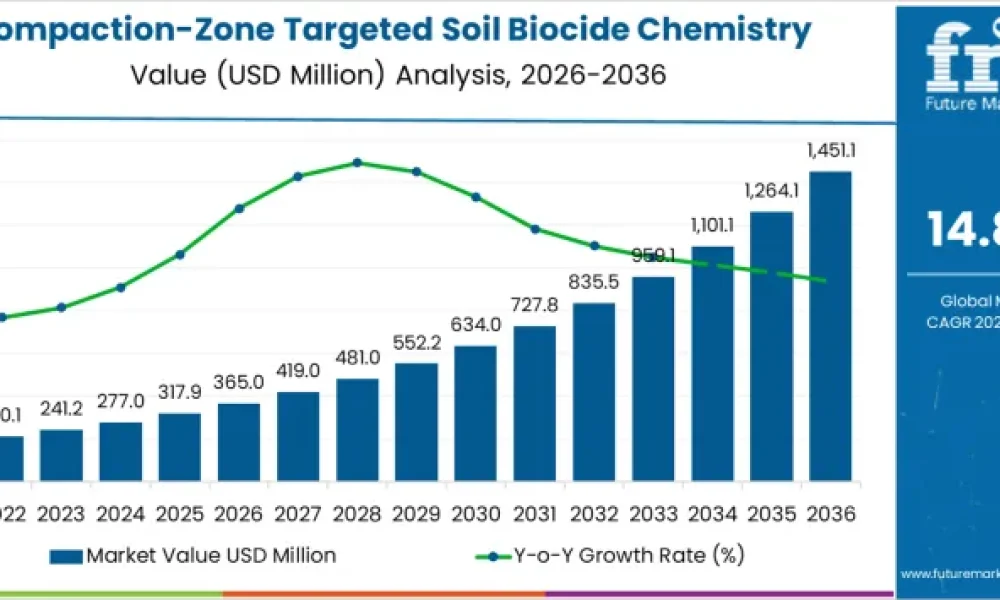
The global Compaction-Zone Targeted Soil Biocide Chemistry Market is on a robust growth trajectory, expected to expand from USD 365 million in 2026 to USD 1,451.1 million by 2036, representing a CAGR of 14.8% over the forecast period. This rapid expansion reflects escalating demand for advanced soil health solutions that deliver biocides deep into compacted soil layers to combat soil-borne pathogens and improve crop productivity while reducing environmental impact. Key drivers include precision application technologies, the rising adoption of subsurface injection techniques, and a shift toward targeted fumigant-release chemistries that enhance efficacy and sustainability in agricultural practices. This data underscores the market’s evolution as growers prioritize efficient pest management solutions that support both yield and soil ecosystem health.
Key Market Insights at a Glance
The compaction-zone targeted soil biocide chemistry sector is being reshaped by a combination of technological advancements and evolving farming needs. Targeted fumigant-release chemistries hold a commanding share of the market, driven by their ability to localize active agents where pathogens concentrate. Application techniques focusing on subsurface injection in compacted zones capture 42% of the market, emphasizing the value placed on deep placement to maximize contact with pests while minimizing chemical dispersion and off-target effects. Growth is geographically diverse, with significant contributions from the United States, India, Brazil, China, and Germany, each reflecting unique agricultural challenges and adoption patterns.
Segment Overview
The market segmentation highlights the dominance of specific biocide chemistry types and application methods. Targeted fumigant-release chemistries account for approximately one-third of industry revenue, due to their precision and environment-aligned performance. Other chemistry segments include micro-encapsulated soil biocides, bio-derived antimicrobial compounds, and metal-ion chelated biocidal systems, each offering differentiated benefits in terms of stability, controlled release, and tailored efficacy. Application techniques are evolving as well; while subsurface injection leads, alternatives such as deep-band placement, precision strip-till integration, and controlled soil drench methods provide flexibility for different crop systems and soil conditions, enabling producers to optimize biocide distribution based on field data and agronomic strategy.
Regional Overview
Across regions, the market demonstrates varied yet consistent growth dynamics. India’s market is poised to grow fastest, reflecting significant demand driven by soil compaction challenges in intensive irrigation and tillage systems, along with increasing focus on sustainable yield enhancement. The United States follows closely, where widespread row crop production facing compaction issues accelerates adoption of advanced biocide chemistry and precision delivery platforms. Brazil’s growth is powered by its extensive agricultural footprint and adoption of integrated soil health practices. China and Germany also show strong expansion, supported by national priorities in soil productivity and eco-friendly farming practices. These regional trends illustrate the broad relevance of compaction-zone targeted solutions across agricultural systems and regulatory environments.
To access the complete data tables and in-depth insights — Request Your Sample Report Now
Competitive Landscape
The competitive landscape features a mix of established agrochemical players and specialized biocide innovators. Leading firms such as Certis Europe, Sharda Cropchem, Arysta LifeScience, Helm AG (Agrochemicals), and AMVAC Chemical Corporation anchor the market with diverse portfolios and technical expertise. These companies differentiate through product formulation performance, support services that help growers optimize depth and timing of applications, and collaborative efforts that integrate soil health insights with delivery technologies. Competition is increasingly shaped by the ability to provide data-backed solutions that balance efficacy with reduced chemical footprints and compatibility with conservation tillage and precision agriculture systems.
Market Outlook: Powering the Next Decade
Looking ahead, the compaction-zone targeted soil biocide chemistry market is poised for accelerated innovation and adoption through 2036. Precision agriculture tools, including soil compaction mapping, sensor-guided dosing, and automated application systems, are expected to further enhance placement accuracy and reduce inputs. There is growing interest in blending biocide chemistries with soil conditioners and beneficial microbes to improve soil structure and biological resilience concurrently. Coupled with regulatory shifts favoring targeted, low-volume applications over broad-area fumigants, the outlook underscores a decade of transformation toward smarter, more sustainable soil protection strategies.
Key Players of Sustainable Label Industry
The market’s direction toward sustainable and precision-aligned products underscores the strategic roles played by innovators such as Certis Europe, Sharda Cropchem, Arysta LifeScience, Helm AG (Agrochemicals), and AMVAC Chemical Corporation, among others. These organizations are investing in research and education to bridge the gap between traditional soil health approaches and next-generation biocide technologies, positioning themselves as partners in driving efficient and environmentally compliant agriculture.
Recent Strategic Developments
Recent industry developments point toward greater integration of advanced delivery systems and formulations designed to address specific soil compaction and pathogen profiles. Partnerships between agrochemical firms and agritech companies are facilitating products that synergize chemical precision with data-driven field insights. Enhanced focus on regulatory compliance and reduced environmental impact has prompted the development of controlled-release and encapsulated solutions, positioning the sector for sustained growth and positive agronomic outcomes in the coming decade.
Have a specific Requirements and Need Assistant on Report Pricing or Limited Budget please contact us – [email protected]
About Future Market Insights (FMI)
Future Market Insights, Inc. (FMI) is an ESOMAR-certified, ISO 9001:2015 market research and consulting organization, trusted by Fortune 500 clients and global enterprises. With operations in the U.S., UK, India, and Dubai, FMI provides data-backed insights and strategic intelligence across 30+ industries and 1200 markets worldwide.
Why Choose FMI: https://www.futuremarketinsights.com/why-fmi



