
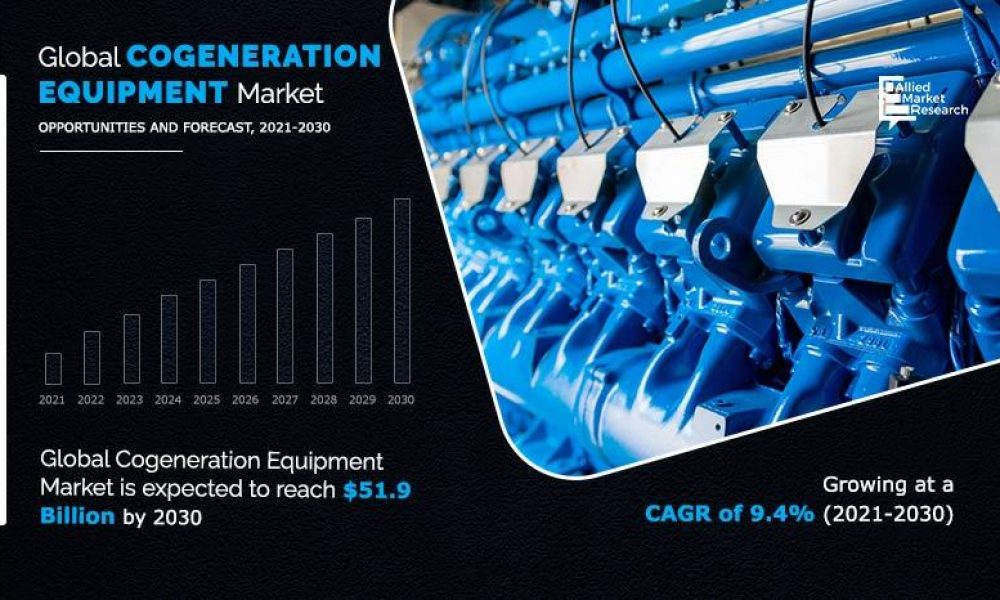
According to a new report published by Allied Market Research titled, “Cogeneration Equipment Market by Fuel, Capacity, Technology, and Application: Global Opportunity Analysis and Industry Forecast, 2020–2030,” the global cogeneration equipment market size was valued at $21.2 billion in 2020, and is projected to reach $51.9 billion by 2030, growing at a CAGR of 9.4% from 2020 to 2030.
Cogeneration equipment refers to systems that simultaneously produce electricity and useful thermal energy from a single fuel source, such as natural gas, biomass, or coal. Also known as combined heat and power (CHP) systems, cogeneration units enhance energy efficiency by utilizing the heat that would otherwise be wasted in traditional power generation. These systems are widely adopted in industrial facilities, commercial buildings, hospitals, and district heating applications where there is a continuous demand for both electricity and heat. By maximizing energy output from fuel inputs, cogeneration helps reduce operational costs and carbon emissions.
The growing emphasis on energy efficiency and the reduction of greenhouse gas emissions is significantly driving the demand for cogeneration equipment. Rising electricity costs and stricter environmental regulations are pushing industries and utilities to adopt CHP systems as a more sustainable and cost-effective alternative to conventional energy generation. In addition, advancements in cogeneration technologies and supportive government policies promoting distributed energy generation are further boosting market growth. As the global energy landscape transitions toward cleaner and more resilient systems, cogeneration equipment is becoming an integral component of modern energy infrastructure.
Download PDF Brochure: https://www.alliedmarketresearch.com/request-sample/A08051
One of the primary drivers of the cogeneration equipment market is the rising global demand for energy efficiency. Cogeneration, or combined heat and power (CHP), systems are highly efficient because they simultaneously generate electricity and useful heat from a single fuel source, typically achieving efficiency levels of 70% to 90%, compared to conventional systems that operate at around 50%. This improved efficiency helps reduce fuel consumption and operating costs, making cogeneration an attractive option for industries, utilities, and commercial sectors looking to optimize energy use and reduce waste.
Another key growth factor is the increasing implementation of stringent environmental regulations aimed at reducing greenhouse gas emissions and improving air quality. Governments across the globe are promoting cogeneration technology as a cleaner and more sustainable energy solution. The use of CHP systems reduces reliance on traditional fossil-fuel-based power plants and decreases carbon emissions by utilizing the waste heat generated during electricity production. Incentives such as tax benefits, grants, and subsidies are further encouraging adoption, particularly in countries aiming to meet their climate commitments.
The rising adoption of decentralized power generation systems also contributes significantly to the growth of the cogeneration equipment market. Industries and commercial establishments are increasingly turning to on-site CHP systems to ensure a reliable and uninterrupted power supply while lowering transmission losses. This trend is particularly prominent in remote areas, hospitals, universities, and industrial zones where grid access is limited or where energy independence is crucial. The flexibility and scalability of cogeneration systems make them well-suited for both large and small-scale installations.
Finally, technological advancements in cogeneration equipment, including improved turbine and reciprocating engine designs, have significantly enhanced system efficiency and durability. Innovations in digital monitoring, automation, and predictive maintenance have made these systems more accessible and manageable for a broader range of end-users. Moreover, the integration of renewable fuels such as biogas and biomass into cogeneration units is opening new avenues for market expansion by aligning with global sustainability goals and supporting the transition toward low-carbon energy systems.
For Purchase Inquiry: https://www.alliedmarketresearch.com/purchase-enquiry/A08051
The cogeneration equipment market forecast is segmented based on technology, fuel, capacity, application, and region. By technology, it includes steam turbine, gas turbine, reciprocating engine, and others. Based on fuel, the market is divided into natural gas, biomass, coal, and others. By capacity, it is categorized into less than 30 MW, 30–60 MW, and above 60 MW. The application segment covers commercial, industrial, and residential sectors. Region-wise, the market is analyzed across North America, Europe, Asia-Pacific, and LAMEA.
The cogeneration equipment market exhibits strong growth across Europe and North America, driven by stringent emission regulations, rising energy efficiency demands, and supportive government incentives. In Europe, countries such as Germany, the U.K., and the Netherlands are prioritizing combined heat and power (CHP) systems to meet climate goals and reduce reliance on conventional fossil fuels. Policies promoting decentralized energy production, particularly in the industrial and commercial sectors, have significantly contributed to the market expansion. North America, especially the U.S., is also experiencing increased adoption of cogeneration systems due to a growing focus on sustainable energy practices and modernization of aging power infrastructure.
In the Asia-Pacific region, rapid urbanization, population growth, and increasing energy needs are fueling demand for cogeneration systems in countries like China, Japan, and India. The region’s focus on energy conservation and enhancing grid reliability is accelerating investments in CHP installations across manufacturing, healthcare, and district heating sectors. Meanwhile, emerging markets in Latin America and the Middle East & Africa are gradually adopting cogeneration technology to improve energy security and reduce operational costs, particularly in industries such as oil & gas, chemicals, and food processing.
The global cogeneration equipment market analysis covers in-depth information of the major industry participants. The key players operating and profiled in the cogeneration equipment industry report include Tecogen, Inc., Siemens, General Electric, Kawasaki heavy industries Ltd., Robert BOSCH Gmbh, Clarke Energy, Mitsubishi heavy industries Ltd., A.B. Holding S.P.A., 2G Energy AG,
The global cogeneration market is analyzed and estimated in accordance with the impacts of the drivers, restraints, and opportunities. The period studied in this report is 2020–2030. The report includes the study of the market with respect to the growth prospects and restraints based on the regional analysis. The study includes Porter’s five forces analysis of the industry to determine the impact of suppliers, competitors, new entrants, substitutes, and buyers on the market growth.
The cogeneration equipment market is analyzed in accordance with the impacts of the drivers, restraints, and opportunities. The period studied in this report is 2024–2033. The report includes the study of the cogeneration equipment market with respect to the growth prospects and restraints based on the regional analysis. The study includes Porter’s five forces analysis of the industry to determine the impact of suppliers, competitors, new entrants, substitutes, and buyers on the market growth.
Key Findings Of The Study:
- On the basis of fuel, the natural gas segment emerged as the global leader around 58.7% of the global cogeneration equipment market share in 2020, and is anticipated to be the largest markets during the forecast period.
- On the basis of capacity type, the high-capacity segment emerged as the global leader by acquiring around 43.6% of the global market share in 2020, and is anticipated to be the largest markets during the forecast period.
- On the basis of technology, the steam turbine segment registered the highest market share of around 56.9% and is projected to maintain the same during the forecast period.
- On the basis of application, the commercial segment registered the highest market share of around 60.32% and is projected to maintain the same during the forecast period.
- On the basis of region, Europe registered the highest market share of around 39.89% and is projected to maintain the same during the forecast period.




