
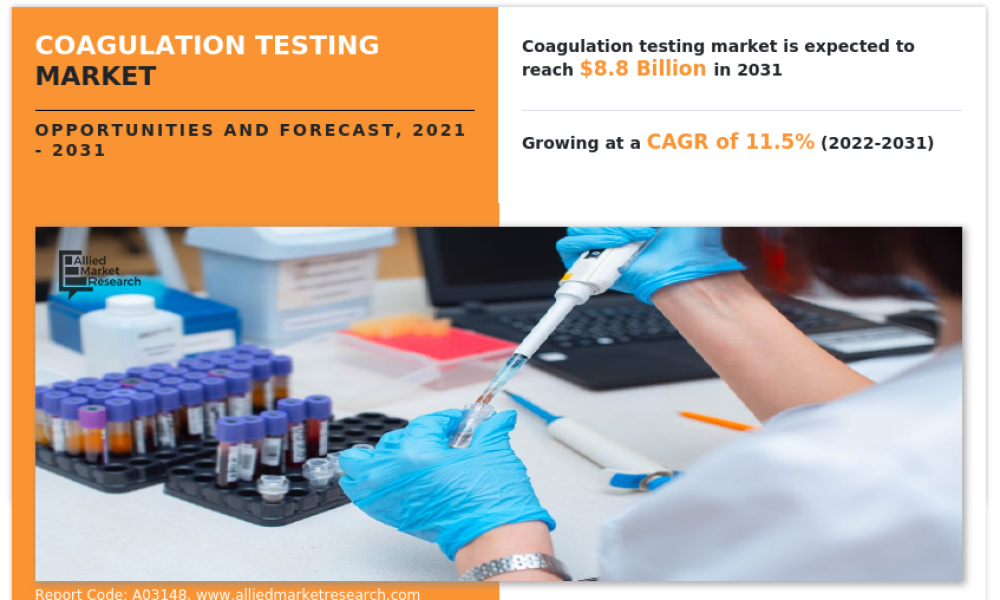
The global demand for advanced hematology and diagnostic solutions is surging as the prevalence of blood disorders and cardiovascular diseases continues to rise worldwide. According to Allied Market Research, the global coagulation testing market size was valued at $3.1 billion in 2021 and is projected to reach $8.8 billion by 2031, expanding at a CAGR of 11.5% from 2022 to 2031.
Coagulation testing, a cornerstone of hematology diagnostics, evaluates the blood’s ability to clot and the time it takes for clot formation. These tests are vital in detecting the risk of excessive bleeding or thrombosis, helping physicians manage conditions such as hemophilia, liver disease, deep vein thrombosis, and cardiovascular disorders. With innovations in diagnostic tools and point-of-care (POC) devices, the market is set for rapid expansion in the coming decade.
Get a Sample Copy of this Report: https://www.alliedmarketresearch.com/request-sample/3488
Rising Burden of Blood Disorders Driving Demand
The prevalence of chronic blood-related illnesses is one of the most significant drivers of the coagulation testing market. Millions of patients worldwide require regular monitoring of clotting factors due to conditions such as atrial fibrillation, hemophilia, and ischemic heart disease. According to the World Health Organization (WHO), cardiovascular diseases account for approximately 17.9 million deaths annually, many of which are linked to abnormal blood clotting events such as strokes and heart attacks.
Coagulation tests such as prothrombin time (PT), activated partial thromboplastin time (aPTT), thrombin time (TT), and activated clotting time (ACT) remain critical for both diagnostics and monitoring therapeutic interventions. These tests enable healthcare providers to manage anticoagulant therapies effectively and prevent life-threatening complications.
Technological Advancements Boosting Market Growth
The introduction of point-of-care coagulation testing devices is revolutionizing the industry. Leveraging cutting-edge technologies such as microfluidics, fluorescence microscopy, electrochemical sensing, and photoacoustic detection, POC systems allow faster and more accurate results, often outside of traditional laboratory settings.
One of the most notable innovations is the rise of smartphone-enabled coagulation testing devices. These portable tools empower patients undergoing anticoagulant therapy to test their blood clotting at home, improving convenience and compliance while reducing hospital visits. Such advancements are expected to significantly expand market penetration and patient adoption rates.
Additionally, the integration of AI and digital health platforms with coagulation analyzers enhances data accuracy, supports predictive analytics, and allows clinicians to tailor treatment strategies more effectively.
Market Challenges
Despite strong growth prospects, the market faces several challenges. The high cost of coagulation analyzers and consumables, combined with a shortage of trained laboratory professionals, may restrict adoption in resource-limited regions. Developing nations often struggle with insufficient infrastructure for specialized hematology and coagulation labs, which could slow market expansion.
To address these barriers, industry leaders are focusing on affordable device innovation, technician training programs, and cloud-based diagnostic platforms that make testing more accessible and efficient.
Market Segmentation Insights
The coagulation testing market is segmented into product type, application, end user, and region.
By Product Type
Consumables (including reagents and stains) dominated the market in 2021 due to their repeated use across all testing methods.
Instruments, though more costly, are gaining demand as automation and advanced sensor technology become increasingly integral to hospital and laboratory workflows.
By Application
Prothrombin time (PT) was the leading application in 2021, widely used to monitor patients on warfarin therapy and assess overall coagulation status.
PT testing is expected to continue leading the market as perioperative monitoring and rapid turnaround diagnostic tools gain prominence in hospital settings.
By End User
Hospitals held the largest share in 2021, supported by the growing number of surgical procedures, rising cardiovascular cases, and broader adoption of advanced diagnostic tools.
Clinical laboratories and point-of-care testing centers are expected to see increased demand due to decentralization of healthcare and greater adoption of portable testing solutions.
By Region
Europe dominated the global coagulation testing market in 2021. The region’s high prevalence of cardiovascular disease, advanced diagnostic infrastructure, and government-backed screening initiatives have driven demand. According to the European Society of Cardiology, CVD causes 45% of all deaths in Europe, underscoring the need for early diagnostic tools.
North America remains a strong market due to the presence of key players, advanced healthcare systems, and high adoption of POC devices.
Asia-Pacific is projected to grow at the fastest rate during the forecast period, fueled by rising healthcare investments, growing patient awareness, and an expanding base of diagnostic laboratories in countries such as China and India.
Impact of COVID-19 on the Market
The COVID-19 pandemic had a positive impact on the coagulation testing industry. Researchers discovered a strong correlation between COVID-19 and coagulopathy, prompting increased use of coagulation tests such as D-dimer, PT, and fibrinogen levels in hospitalized patients. Elevated D-dimer levels were found to be associated with higher mortality risk, which underscored the importance of coagulation monitoring during the pandemic.
As a result, demand for coagulation testing surged globally, highlighting the critical role of these diagnostics in pandemic-era healthcare. This momentum is expected to continue post-pandemic, as hospitals and diagnostic centers integrate coagulation tests into standard protocols for high-risk patients.
Competitive Landscape
The coagulation testing market is highly competitive, with several global players driving innovation and market expansion. Key companies include:
Thermo Fisher Scientific Inc.
Helena Laboratories Corporation
Micropoint Biosciences
Medtronic
F. Hoffmann-La Roche Ltd.
Nihon Kohden Corporation
Abbott Laboratories
Sysmex Corporation
BD Biosciences
Danaher Corporation
These players are investing heavily in R&D, product innovation, mergers, and acquisitions to strengthen their market presence. The development of portable and AI-enabled coagulation devices remains a top priority for companies seeking to capture emerging opportunities.
Future Outlook
With the convergence of rising chronic disease prevalence, technological advancements, and growing demand for rapid diagnostics, the global coagulation testing market is poised for robust growth through 2031. Smartphone-enabled self-testing and POC platforms are expected to transform patient care, making monitoring more accessible and cost-effective.
While high costs and skill shortages remain challenges, the overall outlook remains highly positive. Companies that prioritize affordable innovation, global expansion, and digital integration will play a crucial role in shaping the next decade of coagulation testing.




