

Global Cladding Market Outlook, 2023–2032
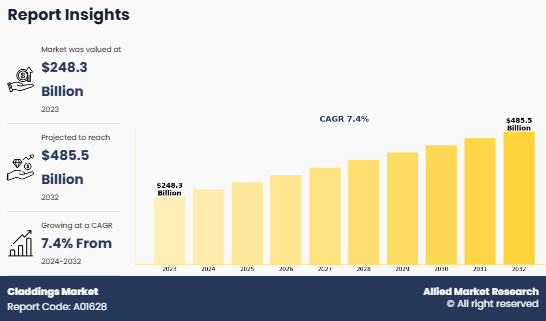
The global cladding market size at $248.3 billion in 2023, is projected to reach $485.5 billion by 2032, growing at a compound annual growth rate (CAGR) of 7.4% from 2024 to 2032. Cladding refers to non-loadbearing layers or skins attached to the exterior or interior of buildings, incorporating moisture barriers and siding materials such as wood, metal, vinyl, masonry, or composites. These systems enhance energy efficiency, durability, and aesthetic appeal, meeting both functional and design requirements. The market’s growth is driven by rising construction activities, sustainability trends, and technological advancements, despite challenges like high costs and supply chain disruptions.
𝐃𝐨𝐰𝐧𝐥𝐨𝐚𝐝 𝐏𝐃𝐅 𝐒𝐚𝐦𝐩𝐥𝐞@ https://www.alliedmarketresearch.com/request-sample/1958
Cladding Market Dynamics
The cladding market is propelled by rapid urbanization, increasing demand for sustainable building solutions, and supportive government regulations. Cladding enhances building insulation, reduces energy consumption, and improves aesthetics, making it integral to modern construction. The surge in residential and non-residential construction, particularly in emerging economies, is a primary driver. Urbanization and population growth have spurred housing developments, while infrastructure projects like commercial complexes, hospitals, and educational facilities boost demand for high-performance cladding. For instance, governments worldwide are investing in affordable housing and urban redevelopment, further driving the adoption of advanced cladding materials like fiber cement and composites.
Sustainability is a key growth factor, with rising demand for eco-friendly materials that support green building practices. Cladding systems made from recyclable materials, such as fiber cement, align with global efforts toward carbon neutrality. Technological advancements, including lightweight panels and self-cleaning surfaces, enhance cladding’s appeal by improving functionality and reducing maintenance needs. These innovations cater to modern architectural trends that prioritize energy efficiency, safety, and aesthetic versatility.
Government regulations promoting zero-energy buildings and fire safety standards significantly influence the market. In regions like North America and Europe, stringent building codes mandate the use of energy-efficient and fire-resistant materials, increasing the adoption of advanced cladding systems. However, compliance with these regulations often raises material and certification costs, posing challenges for manufacturers. Conversely, subsidies and tax incentives for sustainable construction encourage market growth by making eco-friendly cladding more accessible.
Despite these drivers, the market faces challenges. High material and installation costs, particularly for premium materials like metal composites and natural stone, limit adoption, especially among small to medium-sized enterprises and in cost-sensitive emerging markets. The labor-intensive installation process requires skilled professionals, and shortages in trained labor further escalate costs. Additionally, fluctuating raw material prices and supply chain disruptions, exacerbated by global events like the Ukraine-Russia conflict, pose risks to market growth. However, ongoing investments in research and development are addressing these challenges by introducing cost-effective manufacturing techniques and modular cladding solutions.
𝐄𝐧𝐪𝐮𝐢𝐫𝐞 𝐁𝐞𝐟𝐨𝐫𝐞 𝐁𝐮𝐲𝐢𝐧𝐠@ https://www.alliedmarketresearch.com/purchase-enquiry/1958
Cladding Market Segmentation
The cladding market is segmented by product type, application, type, and region.
By Product Type
The market is divided into fiber cement, composite material, terracotta, ceramics, and others. In 2023, the terracotta segment dominated due to its durability, natural aesthetic, and eco-friendly properties, making it a preferred choice for residential and commercial buildings. The composite material segment is expected to grow at the highest CAGR, driven by its lightweight, high-strength, and versatile properties, which cater to diverse construction needs. Fiber cement is gaining traction due to its sustainability, high tensile strength, and cost-effectiveness, with its adoption expected to increase significantly during the forecast period.
By Application
The market is categorized into residential, commercial, and industrial applications. The commercial and industrial segment led in 2023, driven by extensive construction of office spaces, retail centers, and hospitality projects that prioritize energy efficiency and aesthetics. The residential segment is projected to grow at a significant CAGR, fueled by urbanization, rising demand for modern housing, and a shift toward sustainable building practices. Cladding’s ability to enhance thermal insulation and visual appeal makes it a cornerstone of residential construction.
By Type
The market is segmented into exterior and interior cladding. Exterior cladding dominated in 2023, accounting for over half the market share, due to its widespread use in protecting buildings from environmental factors, improving insulation, and enhancing aesthetics. The interior cladding segment is expected to grow rapidly, driven by increasing demand for decorative and functional solutions in residential and commercial spaces, such as accent walls and interior insulation panels.
By Region
The market is analyzed across North America, Europe, Asia-Pacific, and LAMEA (Latin America, Middle East, and Africa). Asia-Pacific held the largest market share in 2023, driven by rapid urbanization, infrastructure development, and government initiatives in countries like China, India, and Southeast Asia. The region’s construction boom and demand for energy-efficient materials fuel market growth. Asia-Pacific is also projected to grow at the highest CAGR, supported by increasing investments in sustainable construction. North America and Europe follow, driven by stringent regulations and green building trends, while LAMEA shows potential due to emerging infrastructure projects.
Competitive Landscape
Key players in the cladding market include:
- Acme Brick Company
- Alcoa Inc.
- Axiall Corporation
- Boral Limited
- CSR Limited
- Etex Group
- Armstrong Metalldecken AG
- James Hardie Plc
- Nichiha Corporation
- Tata Steel Limited
These companies focus on acquisitions, partnerships, and product launches to maintain competitiveness. For example, in 2024, James Hardie Plc launched an innovative fiber cement cladding solution designed for enhanced durability and aesthetics, targeting both residential and commercial markets.
Impact of External Factors
The cladding market faced disruptions during the COVID-19 pandemic, with supply chain issues and reduced construction activities impacting demand. Recovery began in 2022 as construction resumed, but ongoing inflation, driven by geopolitical tensions and raw material price volatility, continues to challenge manufacturers. Despite these hurdles, the market is rebounding, supported by technological advancements and growing demand for sustainable solutions.
𝐔𝐩𝐝𝐚𝐭𝐞 𝐎𝐧 𝐃𝐞𝐦𝐚𝐧𝐝@ https://www.alliedmarketresearch.com/request-for-customization/1958
Market Trends and Opportunities
Several trends are shaping the cladding market:
- Sustainability: Increasing demand for recyclable and low-carbon materials aligns with global green building goals.
- Technological Advancements: Lightweight panels and self-cleaning surfaces enhance functionality and reduce maintenance costs.
- Urbanization: Rapid urban growth in Asia-Pacific and LAMEA drives demand for cladding in residential and commercial projects.
- Prefabrication: The rise of prefabricated construction methods lowers installation costs and accelerates project timelines.
Opportunities include expanding into emerging markets, developing cost-effective cladding solutions, and leveraging government incentives for sustainable construction. The growing popularity of fiber cement, due to its affordability and sustainability, presents significant growth potential.
Challenges
The market faces several challenges:
- High Costs: Premium materials and skilled labor requirements increase project expenses.
- Supply Chain Disruptions: Global events like the Ukraine-Russia conflict affect raw material availability.
- Regulatory Compliance: Strict building codes raise certification and production costs.
- Labor Shortages: Limited availability of skilled installers hinders market growth in some regions.
The global cladding market is poised for robust growth, driven by urbanization, sustainability trends, and technological innovations. Valued at $248.3 billion in 2023, it is projected to reach $485.5 billion by 2032, with a CAGR of 7.4%. Despite challenges like high costs and supply chain disruptions, the market benefits from rising construction activities, government support for green buildings, and advancements in materials like fiber cement and composites. With Asia-Pacific leading and other regions catching up, the cladding market is set to play a pivotal role in shaping sustainable, aesthetically pleasing, and energy-efficient buildings through 2032.




