
Overview
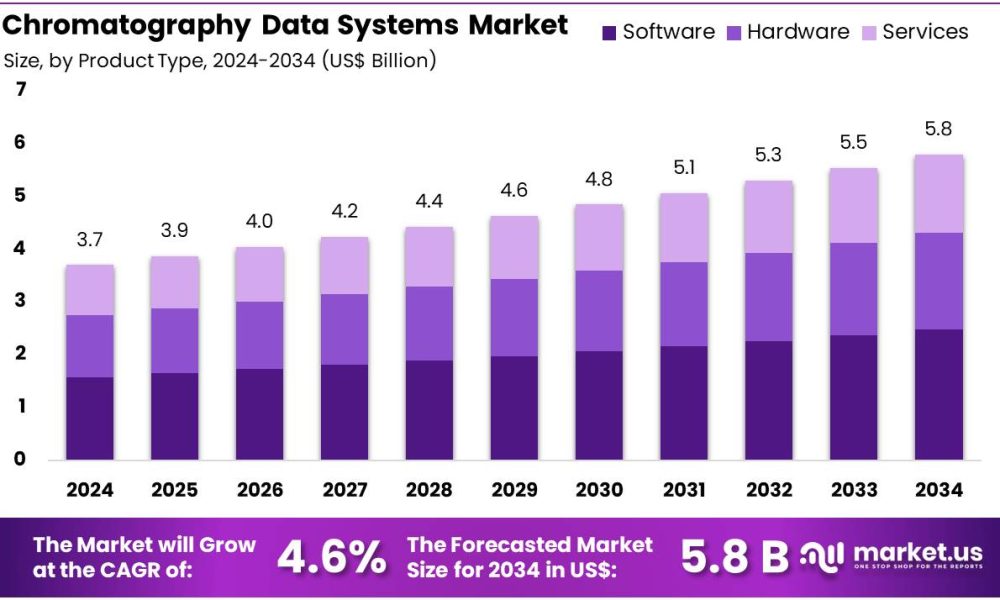
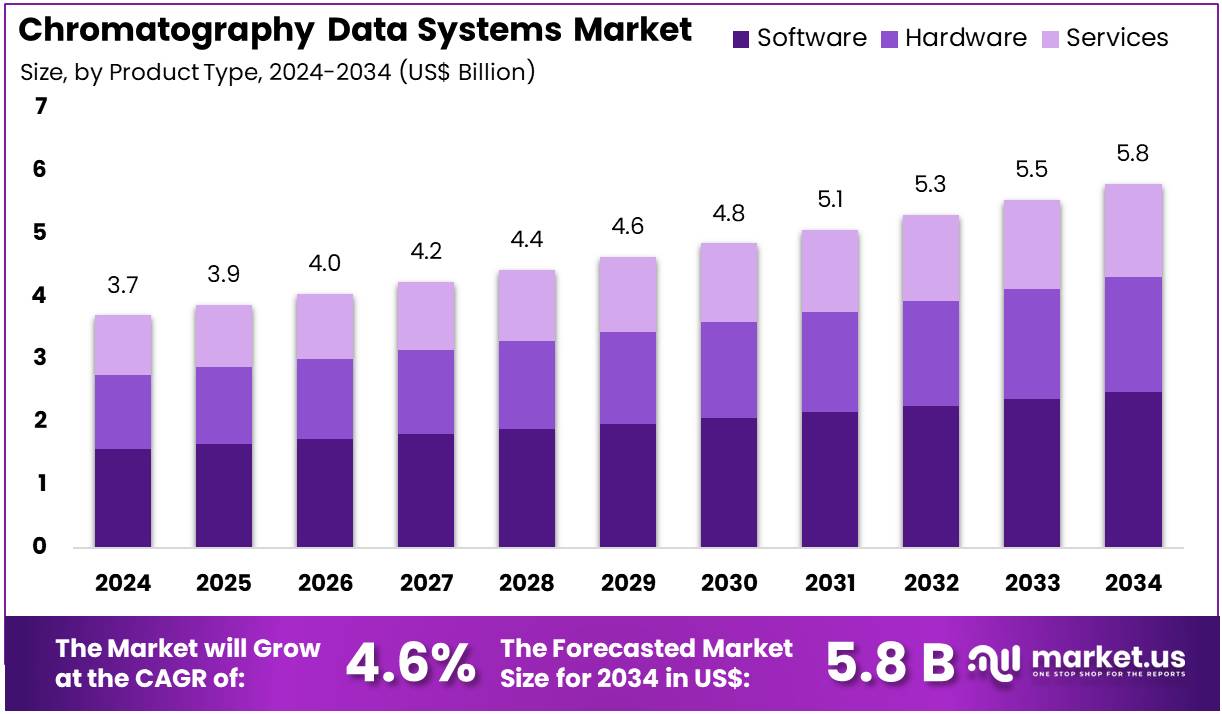
The Global Chromatography Data Systems Market is projected to grow from US$ 3.7 billion in 2024 to US$ 5.8 billion by 2034, expanding at a CAGR of 4.6% during the forecast period. This growth is driven by the increasing need for accurate and real-time analytical data across pharmaceutical, clinical, and research laboratories. CDS platforms are becoming essential for streamlining workflows, maintaining data integrity, and ensuring regulatory compliance in complex testing environments.
A major driver for this market is the rising demand for advanced analytical systems in pharmaceutical research. As drug development becomes more data-intensive, there is growing pressure on laboratories to manage large volumes of chromatographic data efficiently. CDS solutions enable precise data acquisition, management, and reporting. These tools support the identification and separation of chemical compounds—an essential process for drug safety and efficacy testing. The trend is reinforced by continued investment in R&D from pharmaceutical companies and academic institutions.
The increasing adoption of automation and digitalization in laboratory settings is also fueling market growth. Chromatography data systems help manage high-throughput workflows, allowing laboratories to handle complex datasets with speed and accuracy. Integration with chromatography instruments and laboratory information systems ensures traceability and real-time data sharing. In clinical research, these systems support data precision, essential for diagnostics, biomarker validation, and regulatory submissions.
Academic institutions and contract research organizations (CROs) are expanding their use of CDS to manage broad research portfolios. These systems provide consistency and reproducibility across multiple testing environments. According to the US National Center for Science and Engineering Statistics (NCSES), academic R&D spending reached US$ 97.8 billion in FY2022, up US$ 8.0 billion from the previous year. This growth reflects a rising focus on research capabilities that require efficient data handling tools like CDS.
Technological advancements are reshaping the CDS market. There is a clear shift toward cloud-based and hybrid deployment models that offer scalability and remote access. Vendors are integrating AI and machine learning to enhance predictive analytics and anomaly detection. These innovations help reduce analytical errors and improve decision-making. For example, Waters Corporation introduced the Arc Premier System in June 2021, aiming to boost precision and confidence in chromatography workflows.
The chromatography data systems market is expected to continue evolving with modular, customizable solutions tailored to specific workflows. These systems not only reduce manual work but also help laboratories meet growing compliance standards. As analytical needs expand across industries—from pharmaceuticals to environmental testing—the role of CDS platforms becomes even more critical. The market is poised for sustainable growth as organizations prioritize efficiency, accuracy, and data quality in analytical operations.
Key Takeaways
- In 2024, the chromatography data systems market generated revenue of US$ 3.7 billion and is projected to reach US$ 5.8 billion by 2034.
- The market is expected to grow at a steady compound annual growth rate (CAGR) of 4.6% over the forecast period from 2025 to 2034.
- Among product types, software dominated the market in 2024, accounting for 42.7% of the total revenue share in chromatography data systems.
- On-premise technology led the technology segment, capturing a significant market share of 45.3% in chromatography data systems deployment models.
- Within applications, the pharmaceutical sector held the largest share, contributing 47.9% to the chromatography data systems market revenue.
- Pharmaceutical companies emerged as the leading end-users, representing 43.8% of the total market share in 2024.
- Academic institutions, research laboratories, and contract research organizations also contributed, but lagged behind pharmaceutical firms in overall market demand.
- Regionally, North America led the global market, accounting for 37.5% of the total chromatography data systems market in 2024.
Regional Analysis
North America held the dominant position in the global chromatography data systems market, securing a revenue share of 37.5%. This growth was largely supported by the U.S. FDA’s adoption of Empower Chromatography Data Software and NuGenesis Laboratory Management Software from Waters Corporation. These systems were implemented across FDA field science laboratories. Their integration improved medical product testing and regulatory compliance. Additionally, the presence of key industry players such as Thermo Fisher Scientific, Agilent Technologies, and Waters Corporation has further driven product innovation and market expansion in this region.
The North American market continues to benefit from strong government backing and ongoing investments in research and development. These efforts ensure continuous upgrades to data systems and compliance infrastructure. This regulatory-focused approach has strengthened the demand for advanced data management solutions. Furthermore, the rising emphasis on laboratory automation and quality assurance supports the wider adoption of chromatography data systems. As a result, North America is expected to maintain its leading position over the forecast period, driven by innovation, regulation, and high R&D expenditure.
Asia Pacific is projected to witness the highest CAGR during the forecast period. India is expected to lead regional growth due to increased investment in pharmaceutical R&D and stricter drug quality regulations. Government initiatives, such as Pharma Vision 2047 and the MedTech sector scheme launched in September 2023, are key growth drivers. With a funding allocation of US$ 61 million (INR 5,000 crore), the scheme supports innovation and infrastructure in pharmaceutical technology. These developments are expected to fuel demand for chromatography data systems, particularly in drug discovery, diagnostics, and quality control.
Segmentation Analysis
Product Type Analysis
The software segment accounted for 42.7% of the chromatography data systems market share. This growth is driven by the rising need for automation, accurate data processing, and regulatory compliance. Laboratories are increasingly using software that integrates with instruments, LIMS, and electronic lab notebooks. These platforms help improve operational efficiency and ensure data integrity. Vendors are adding features like real-time analytics and remote access to support modern lab workflows. The focus on 21 CFR Part 11 compliance and audit trails further increases software demand in regulated environments.
Technology Analysis
On-premise technology held a 45.3% market share due to its relevance in tightly regulated industries. Pharmaceutical and chemical companies prefer on-premise systems for better control and enhanced data security. These systems offer low-latency performance and offline functionality, making them ideal for high-security labs. On-premise deployment allows companies to meet internal IT protocols while ensuring compliance with GMP requirements. Enterprises with legacy instruments often choose this model for compatibility. Continued investment in infrastructure and cybersecurity is expected to sustain demand in large and compliance-driven organizations.
Application Analysis
The pharmaceutical segment led the application category with a 47.9% revenue share. Increased investment in drug development and compliance drives this growth. Chromatography data systems help manage large datasets and maintain GMP-aligned documentation. Real-time reporting and audit trail functions improve transparency and regulatory readiness. Growing clinical trials and bioanalytical studies also support market expansion. These systems assist in monitoring formulation stability and conducting pharmacokinetic analysis. Integration with mass spectrometry improves lab efficiency. The segment will likely maintain strong momentum due to ongoing innovation and global regulatory mandates.
End-user Analysis
Pharmaceutical companies contributed 43.8% to the overall market due to their extensive reliance on chromatography for R&D and quality control. These firms need reliable systems to ensure traceability and data accuracy. As drug pipelines expand, demand grows for CDS platforms that reduce manual errors and support multi-site operations. Integration with enterprise systems boosts efficiency and visibility. Outsourcing trends further encourage centralized data management. Compliance with global regulatory standards remains a top priority. This segment is expected to retain its dominance as the industry advances toward digitalization and higher throughput.
- Hardware
- Software
- Services
By Technology
- On-Premise
- Cloud-Based
- Hybrid
By Application
- Pharmaceuticals
- Clinical Research
- Academic Research
- Others
By End-user
- Pharmaceutical Companies
- Academic Institutions
- Research Laboratories
- Contract Research Organizations
Key Players Analysis
Key players in the chromatography data systems market continue to shape industry growth through innovation and strategic collaborations. They invest heavily in technology to develop integrated software solutions. These tools are designed to improve laboratory workflows and enhance data accuracy. Many companies also expand their presence across key markets. To support adoption, firms offer training and technical assistance. These efforts aim to ensure smooth implementation and long-term client satisfaction. Combined, these strategies help strengthen market positioning and maintain competitive advantage in an evolving analytical landscape.
Partnerships with academic institutions and research bodies play a key role in driving innovation. By engaging with the scientific community, companies stay updated with current research needs. This enables them to design user-friendly and compliant data systems. Strong customer service, regular software updates, and customization options are also key focus areas. This approach helps meet client demands in sectors like pharmaceuticals, biotechnology, and environmental testing. As demand for real-time data grows, companies continuously evolve their product portfolios to stay relevant.
Agilent Technologies Inc. is one of the top players in this field. Headquartered in Santa Clara, California, the company provides solutions like OpenLAB CDS and ChemStation. Its offerings support various sectors, including food safety and clinical research. Other leading players include Waters Corporation, Thermo Fisher Scientific, Shimadzu Corporation, Restek Corporation, KNAUER, DataApex, Cytiva, and Bruker Corporation. These companies drive competition and shape future developments in chromatography data systems.
Conclusion
In conclusion, the chromatography data systems market is expected to grow steadily, supported by rising demand for accurate and efficient data handling in research and pharmaceutical labs. The shift toward automation, cloud technology, and integration with laboratory systems is making CDS solutions more valuable across industries. Increasing focus on regulatory compliance and data integrity further supports their adoption. Pharmaceutical firms, academic institutions, and contract research organizations are using CDS to manage large datasets with accuracy and speed. With continuous investment in R&D, innovation, and software development, the market is set to expand. The future of this market looks strong as laboratories seek smarter, faster, and more reliable data systems.
Get in Touch with Us:
Market.us (Powered By Prudour Pvt. Ltd.)
Address: 420 Lexington Avenue, Suite 300, New York City, NY 10170, United States.
Contact No: +1 718 874 1545 (International), +91 78878 22626 (Asia).
Email: [email protected]
View More
Healthcare Claims Management Solutions Market
Clinical Data Management System Market



