
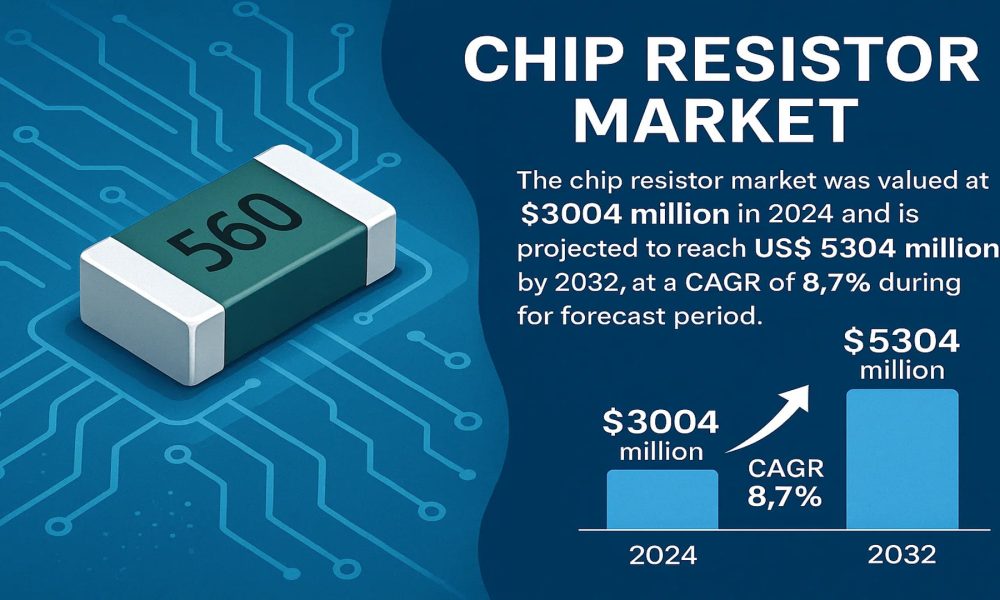
Chip Resistor Market was valued at 3004 million in 2024 and is projected to reach US$ 5304 million by 2032, at a CAGR of 8.7% during the forecast period.
A chip resistor, often denoted as “R-CHIP,” is a fundamental passive electronic component used to provide resistance within a circuit. These compact, surface-mount devices (SMDs) are characterized by their small rectangular or square ceramic package, making them ideal for high-density printed circuit board (PCB) assemblies. Their widespread adoption is driven by advantages such as miniaturization, high reliability, and excellent compatibility with automated pick-and-place manufacturing processes.
This market is experiencing robust growth, primarily fueled by escalating demand from key sectors like consumer electronics, automotive electronics, and the rollout of 5G communication infrastructure. A notable driver is the automotive industry’s electrification; a single new energy vehicle can utilize over 5,000 chip resistors, more than double the quantity found in traditional internal combustion engine vehicles, due to advanced battery management systems (BMS) and electric drivetrains. However, the industry faces headwinds from volatile raw material costs, such as ceramic substrates and ruthenium slurry, which compress profit margins, particularly for mid- to low-end products where gross margins can be below 15%. Leading players like Yageo, Vishay, and KOA dominate the landscape, with the top five companies collectively holding approximately 67% of the global market share.
Claim Your Free Sample Report- https://semiconductorinsight.com/download-sample-report/?product_id=117571
MARKET DYNAMICS
MARKET DRIVERS
Rapid Expansion of Consumer Electronics and Automotive Sectors to Fuel Market Growth
The global chip resistor market is experiencing robust growth driven primarily by the expanding consumer electronics and automotive industries. Consumer electronics, which account for approximately 38% of total chip resistor applications, continue to demonstrate strong demand with global smartphone shipments exceeding 1.4 billion units annually and the wearable technology market growing at double-digit rates. The miniaturization trend in electronic devices necessitates smaller, more efficient components like chip resistors, particularly in applications such as smartphones, tablets, and IoT devices where space optimization is critical. Furthermore, the automotive sector’s transformation toward electrification has significantly increased component requirements, with electric vehicles utilizing over 5,000 chip resistors per vehicle—more than double the quantity used in traditional combustion engine vehicles.
5G Infrastructure Deployment and Industrial Automation to Accelerate Market Expansion
The global rollout of 5G networks represents a substantial growth driver for the chip resistor market, requiring extensive infrastructure development across base stations, networking equipment, and compatible devices. 5G technology demands higher frequency operations and enhanced signal integrity, which necessitates precision components with superior performance characteristics. Concurrently, industrial automation and Industry 4.0 initiatives are driving demand for chip resistors in manufacturing equipment, robotics, and measurement instruments. The industrial segment’s requirement for high-reliability components capable of operating in harsh environments creates opportunities for advanced chip resistor products with improved temperature coefficients and stability.
Technological Advancements and Product Innovation to Stimulate Market Development
Continuous technological innovation in chip resistor design and manufacturing processes is driving market growth through improved performance characteristics and expanded application possibilities. Recent developments include ultra-precision thin film resistors with tolerance levels below 0.1% and temperature coefficients as low as 5 ppm/°C, meeting the demanding requirements of medical equipment and aerospace applications. Manufacturers are also developing anti-surge and high-voltage chip resistors capable of handling power levels up to 5 watts in miniature packages. These innovations enable electronic designers to create more compact, efficient, and reliable systems across various industries.
Additionally, the trend toward automotive electrification has prompted the development of AEC-Q200 qualified chip resistors that meet stringent automotive reliability standards, supporting the growing demand for advanced driver assistance systems and electric vehicle powertrains.
➤ For instance, leading manufacturers have introduced automotive-grade chip resistors with failure rates below 0.1% per 1,000 hours of operation at maximum rated temperature, meeting the rigorous requirements of safety-critical automotive applications.
Furthermore, the integration of advanced materials such as ruthenium-based conductive pastes and ceramic substrates with improved thermal conductivity continues to enhance product performance while addressing challenges related to power density and operating temperatures.
Recent Developments in the Chip Resistor Market:
- Advancements in High-Power Chip Resistors
- Manufacturers are increasingly focusing on high-power and high-precision chip resistors to cater to the growing demand in automotive electronics and industrial applications.
- Newer designs are capable of handling higher thermal loads while maintaining stability in harsh environments.
- Integration with IoT and Smart Devices
- Chip resistors are being optimized for miniaturization and low power consumption to support IoT devices, wearable electronics, and smart home products.
- Companies are investing in ultra-small chip resistors with high reliability for compact electronics.
- Expansion of Manufacturing Capacities
- Key players in the market, including Yageo, Murata, and KOA, are expanding their production facilities in Asia-Pacific and Europe to meet the rising demand from automotive and consumer electronics sectors.
- Investments focus on automation and advanced quality control to improve yield and consistency.
- Focus on Environmental Compliance
- Manufacturers are enhancing products to meet global environmental regulations, including RoHS and REACH compliance.
- Eco-friendly materials and lead-free resistors are being developed to reduce environmental impact.
- Strategic Partnerships and Collaborations
- Several companies have entered strategic partnerships to co-develop next-generation chip resistors for 5G, electric vehicles (EVs), and energy storage applications.
- Collaborations aim to accelerate innovation and reduce time-to-market for specialized resistor solutions.
- Technological Innovations
- Development of multi-layer and ultra-thin resistors is on the rise to enhance performance in high-frequency circuits.
- Innovations include better tolerance, improved stability, and resistance to extreme temperature variations.
MARKET OPPORTUNITIES
Emerging Applications in Renewable Energy and Medical Devices to Create New Growth Avenues
The chip resistor market stands to benefit significantly from emerging applications in renewable energy systems and advanced medical devices. The global transition toward renewable energy sources is driving demand for power electronics in solar inverters, wind turbine control systems, and energy storage solutions, all requiring robust and reliable passive components. Chip resistors with high power handling capabilities and excellent temperature stability are essential for these applications, particularly in harsh environmental conditions. Similarly, the medical device industry’s growing adoption of portable and implantable electronic systems creates opportunities for miniaturized, high-reliability components that meet stringent regulatory requirements.
Additionally, the increasing complexity of automotive electronics, particularly in electric vehicle powertrains and advanced driver assistance systems, presents substantial growth opportunities. The automotive industry’s shift toward 48-volt electrical systems and higher voltage applications requires chip resistors capable of handling increased power levels while maintaining compact form factors.
Furthermore, the ongoing digital transformation across industrial sectors creates demand for chip resistors in edge computing devices, smart sensors, and communication infrastructure, supporting the growth of IoT applications and Industry 4.0 initiatives.
Claim Your Free Sample Report- https://semiconductorinsight.com/download-sample-report/?product_id=117571
List of Key Chip Resistor Companies Profiled
- Yageo Corporation (Taiwan)
- Vishay Intertechnology, Inc. (U.S.)
- KOA Corporation (Japan)
- Panasonic Corporation (Japan)
- Samsung Electro-Mechanics (South Korea)
- Fenghua Advanced Technology (China)
- Walsin Technology Corporation (Taiwan)
- Ta-I Technology Co., Ltd. (Taiwan)
- ROHM Co., Ltd. (Japan)
- UNI-ROYAL Corporation (Uniohm) (Taiwan)
- Susumu Co., Ltd. (Japan)
- Viking Tech Corporation (Taiwan)
- Kyocera AVX (U.S.)
- Bourns, Inc. (U.S.)
- TE Connectivity (Switzerland)
Segment Analysis:
By Type
Thick Film Resistors Segment Dominates the Market Due to Cost-Effectiveness and Broad Application Range
The market is segmented based on type into:
- Thick Film Resistors
- Thin Film Resistors
- Foil Resistors
- Alloy Resistors
By Application
Consumer Electronics Segment Leads Due to High Volume Demand in Smartphones and Wearables
The market is segmented based on application into:
- Consumer Electronics
- Automotive Electronics
- Industrial and Measurement Equipment
- Communication Device
- Others
Other Topic- Crystal and Oscillators for Internet of Things Market
CONTACT US:
City vista, 203A, Fountain Road, Ashoka Nagar, Kharadi, Pune, Maharashtra 411014
[+91 8087992013]




