
The global ceiling tiles market is witnessing strong growth, fueled by rising construction activities and increasing demand for aesthetically appealing interior solutions. Ceiling tiles are widely used in residential, commercial, and industrial buildings to enhance acoustics, insulation, and visual appeal. Growing urbanization and infrastructure modernization have led to higher adoption of advanced ceiling systems that combine functionality with design flexibility. Additionally, the increasing preference for sustainable building materials is encouraging manufacturers to develop eco-friendly and recyclable ceiling tile solutions.
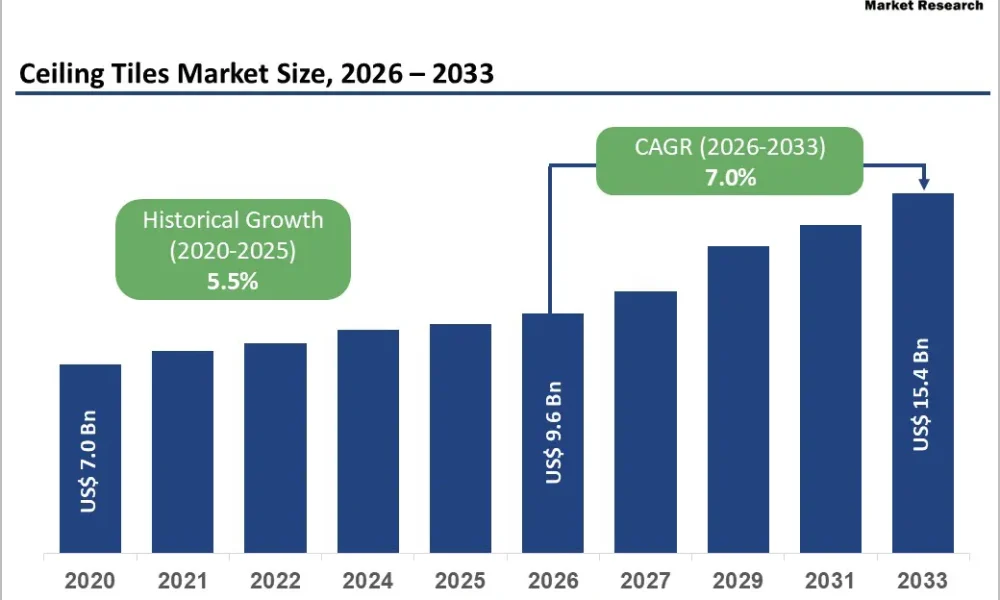
According to Persistence Market Research, the global ceiling tiles market size is expected to be valued at US$ 9.6 billion in 2026 and is projected to reach US$ 15.4 billion by 2033, growing at a CAGR of 7.0% between 2026 and 2033. This growth is driven by expanding commercial construction, rising renovation projects, and demand for energy-efficient interiors. Mineral fiber ceiling tiles remain a leading segment due to their cost-effectiveness and acoustic performance, while Asia-Pacific emerges as the leading regional market due to rapid urbanization and large-scale infrastructure investments.
Download Your Free Sample & Explore Key Insights : https://www.persistencemarketresearch.com/samples/36312
Key Highlights from the Report
➤ The ceiling tiles market is projected to grow from US$ 9.6 billion in 2026 to US$ 15.4 billion by 2033 at a CAGR of 7.0%.
➤ Increasing demand for acoustic insulation and noise reduction solutions is boosting product adoption.
➤ Rapid expansion of commercial spaces such as offices, malls, and healthcare facilities is driving demand.
➤ Rising preference for lightweight, durable, and fire-resistant ceiling materials is shaping innovation.
➤ Growth in renovation and remodeling projects is contributing significantly to market expansion.
➤ Eco-friendly and recyclable ceiling tiles are gaining traction due to sustainability regulations.
Market Segmentation
The ceiling tiles market can be segmented based on material type, application, and installation method. Common materials include mineral fiber, metal, gypsum, and wood. Among these, mineral fiber tiles dominate due to their affordability, sound absorption properties, and ease of installation. Metal and gypsum tiles are gaining popularity in premium commercial spaces due to their durability and modern appearance. Wood ceiling tiles are also seeing increased demand in high-end residential and hospitality applications where aesthetic appeal is a priority.
Based on application, the market is divided into residential, commercial, and industrial sectors. The commercial segment holds a significant share due to widespread use in offices, retail spaces, educational institutions, and healthcare facilities. Ceiling tiles are preferred in these environments for their ability to improve acoustics and maintain clean, organized interiors. The residential segment is also growing steadily as homeowners increasingly invest in interior design and home renovation projects that enhance living spaces.
Customize This Report for Your Exact Requirements : https://www.persistencemarketresearch.com/request-customization/36312
Regional Insights
Asia-Pacific dominates the ceiling tiles market due to rapid urbanization and strong infrastructure development across emerging economies. Countries such as China and India are witnessing large-scale construction of residential complexes, commercial buildings, and public infrastructure. Government initiatives supporting smart cities and affordable housing projects further contribute to the demand for ceiling tiles. The region also benefits from a growing middle-class population with rising disposable income, encouraging spending on modern interior solutions.
North America and Europe also represent significant markets due to established construction industries and increasing focus on sustainable building materials. In North America, demand is driven by renovation activities and the need for energy-efficient buildings. Europe is witnessing rising adoption of eco-friendly ceiling tiles that comply with strict environmental regulations. The presence of major manufacturers and advanced building technologies further supports market growth in these regions.
Market Drivers
The primary driver of the ceiling tiles market is the rapid growth in global construction and infrastructure development. Increasing investments in commercial spaces such as offices, shopping centers, hospitals, and educational institutions are fueling demand for ceiling tiles. These products play a crucial role in enhancing building functionality by improving acoustics, thermal insulation, and fire resistance. As construction activities continue to expand globally, the demand for efficient and cost-effective ceiling solutions is expected to rise significantly.
Another key driver is the growing emphasis on interior aesthetics and design innovation. Modern consumers and businesses prioritize visually appealing spaces that reflect contemporary design trends. Ceiling tiles are available in various textures, colors, and patterns, enabling architects and designers to create customized interiors. Additionally, the integration of advanced technologies such as suspended ceiling systems and modular designs is further boosting market growth by offering flexibility and ease of installation.
Market Restraints
Despite strong growth prospects, the ceiling tiles market faces certain restraints. One of the major challenges is the fluctuation in raw material prices, including metals, gypsum, and mineral fibers. These fluctuations can impact production costs and profit margins for manufacturers, making it difficult to maintain stable pricing. Additionally, supply chain disruptions and availability of raw materials can affect production timelines and overall market growth.
Another restraint is the availability of alternative ceiling solutions, such as drywall and exposed ceiling designs. Some modern architectural trends favor open ceilings, particularly in industrial-style buildings, which reduces the demand for traditional ceiling tiles. Furthermore, installation and maintenance costs associated with certain types of ceiling tiles may discourage adoption in cost-sensitive markets, particularly in developing regions.
Market Opportunities
The ceiling tiles market presents significant opportunities through the growing demand for sustainable and eco-friendly building materials. Increasing environmental awareness and stringent regulations are encouraging manufacturers to develop ceiling tiles made from recycled materials and low-emission components. These products not only reduce environmental impact but also appeal to environmentally conscious consumers and businesses seeking green building certifications.
Another promising opportunity lies in the expansion of smart buildings and advanced construction technologies. The integration of ceiling tiles with lighting systems, HVAC components, and acoustic solutions is gaining traction in modern infrastructure projects. Manufacturers can capitalize on this trend by offering multifunctional ceiling systems that enhance building efficiency and performance. Additionally, rising demand in emerging markets offers untapped potential for market players to expand their presence and increase revenue streams.
Secure Your Full Report – Proceed to Checkout : https://www.persistencemarketresearch.com/checkout/36312
Company Insights
Key players operating in the ceiling tiles market include:
- Armstrong World Industries
- USG Corporation
- Knauf Ceiling Solutions
- Saint-Gobain
- Rockfon
- CertainTeed
- Ecophon
- Burgess CEP
- Hunter Douglas
- DAIKEN Corporation
- OWA Ceiling Systems
- Techno Ceiling Products
- SAS International
- Lindner Group
- Ceilume
- ROCKWOOL International
- AWI Licensing LLC
- Chicago Metallic Corporation
Recent Developments
- January 2024: Armstrong World Industries launched innovative acoustic ceiling tile solutions aimed at improving sound performance in commercial spaces.
- October 2023: Saint-Gobain introduced eco-friendly ceiling tile products focusing on sustainability and reduced carbon footprint.
Future Opportunities and Growth Prospects
The future of the ceiling tiles market appears highly promising as construction activities continue to expand globally. Increasing demand for energy-efficient, aesthetically appealing, and sustainable building materials will drive innovation in ceiling tile designs and manufacturing processes. The growing adoption of smart building technologies and integrated ceiling systems is expected to further enhance product demand across commercial and residential sectors.
Moreover, emerging economies are likely to offer lucrative growth opportunities due to rapid urbanization and infrastructure development. Market players focusing on product innovation, sustainability, and strategic partnerships will be well-positioned to capitalize on these opportunities. As consumer preferences evolve and technology advances, the ceiling tiles market is set to experience sustained growth in the coming years.




