

Building-to-Grid Technology Market Overview
According to a new report published by Allied Market Research, the building-to-grid technology market size was valued at $54.9 billion in 2024 and is projected to reach $147.8 billion by 2034, growing at a CAGR of 10.5% from 2025 to 2034. This rapid growth highlights the increasing importance of smart energy solutions and grid-connected building technologies in shaping the future of sustainable urban infrastructure.
Download PDF Brochure: https://www.alliedmarketresearch.com/request-sample/A244989
Introduction
Building-to-grid (B2G) technology represents a revolutionary energy management approach, enabling a two-way flow of information and energy between smart buildings and the electrical grid. Unlike traditional setups where buildings act solely as energy consumers, B2G systems transform them into active energy participants.
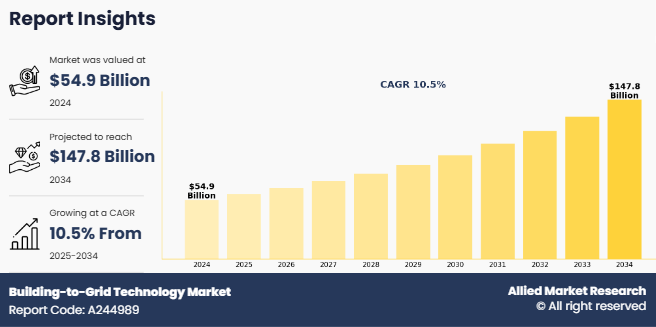
Through smart meters, IoT sensors, and energy management platforms, B2G systems allow buildings to monitor real-time consumption, supply excess electricity back to the grid, and adjust energy usage in line with grid conditions. This integration boosts grid stability, reduces peak demand pressure, and enhances overall energy efficiency.
Key Market Insights
- By Platform: Smart metering dominated in 2024, growing at a CAGR of 10.7%.
- By Component: The software segment is the most lucrative, expanding at a CAGR of 10.8%.
- By End-Use: The commercial sector led in 2024, while the industrial sector is the fastest growing.
- By Region: Asia-Pacific accounted for over one-third of market share in 2024.
Market Dynamics
✅ Growth Drivers
The rise of distributed energy resources (DERs), including rooftop solar, wind microturbines, battery storage, and combined heat and power (CHP) units, is a key driver of the building-to-grid technology market. By embedding DERs within building infrastructure, energy systems become decentralized, flexible, and resilient.
For instance, rooftop solar panels can reduce daytime grid dependence, while home batteries can store excess power for peak hours. This allows buildings to reduce costs, enhance reliability, and support grid stability.
Global policy efforts also fuel adoption. In April 2024, the UK allocated $375 million (£300 million) to clean energy initiatives, reinforcing its commitment to renewable integration and smart infrastructure.
⚠️ Market Restraints
Despite strong growth potential, data privacy and cybersecurity risks remain a major concern. With smart meters and sensors transmitting sensitive information such as occupancy data and appliance usage, connected systems can become vulnerable to cyberattacks. Breaches may lead to regulatory penalties, reputational damage, and reduced consumer trust.
Addressing cybersecurity will be crucial to ensuring the safe and reliable expansion of the building-to-grid technology market.
🌐 Opportunities
The integration of AI, IoT, and cloud-based platforms creates opportunities for scalable and intelligent B2G systems. Virtual power plants (VPPs) aggregating multiple buildings enable participation in demand response programs and wholesale energy markets.
Smart sensing, automation, and predictive analytics not only enhance operational efficiency but also help achieve sustainability goals by optimizing energy usage and reducing fossil fuel dependency.
Get a Customized Research Report: https://www.alliedmarketresearch.com/request-for-customization/A244989
Building-to-Grid Technology Market Segments Overview
The building-to-grid technology market is segmented by platform, component, end-use, and region.
- By Platform:
- Smart sensing is expected to grow at a CAGR of 11.1%, enabling real-time adjustments to HVAC, lighting, and other systems based on occupancy and grid signals.
- Large-scale initiatives such as Singapore’s Smart Nation Sensor Platform (SNSP) highlight the potential of sensor-driven energy management in urban environments.
- By Component:
- The software segment is the fastest growing at 10.8% CAGR. Cloud-based and AI-powered platforms provide building managers with real-time insights, remote control, and energy market integration.
- By End-Use:
- The industrial segment is forecasted to grow at a CAGR of 10.9%, supported by widespread adoption of energy management systems, on-site renewable generation, and demand response participation.
Building-to-Grid Technology Market Regional Analysis
The Asia-Pacific region is projected to expand at the fastest CAGR of 10.9% through 2034. Rapid urbanization, smart city development, and strong government support for decarbonization initiatives are accelerating adoption across countries such as Japan, South Korea, China, Singapore, and Australia.
Meanwhile:
- North America leads in early adoption of advanced grid-interactive buildings and strong regulatory support for smart infrastructure.
- Europe benefits from energy transition policies and cross-border renewable integration.
- LAMEA presents emerging opportunities through urban expansion and green energy investments.
Competitive Landscape
Key players in the building-to-grid technology market include:
Siemens AG, Schneider Electric, ABB Ltd., General Electric, Honeywell International Inc., Landis+Gyr Group AG, Enphase Energy, S&C Electric Company, Itron Inc., and Oracle.
These companies focus on:
- Expanding smart sensing and metering portfolios
- Investing in AI-driven B2G platforms
- Partnering with governments on smart city initiatives
- Enhancing cybersecurity measures for grid-connected infrastructure
Conclusion
The building-to-grid technology market is reshaping the global energy landscape by transforming buildings into dynamic energy hubs. With rising adoption of distributed energy resources, smart sensing, and AI-driven software, B2G solutions will play a critical role in enhancing grid resilience, energy efficiency, and sustainability.
Despite challenges around cybersecurity, the strong push from governments, technology providers, and smart city initiatives ensures a bright future for the building-to-grid technology market, driving it toward a projected $147.8 billion by 2034.
Other Trending Reports:-
Building Energy Management Systems Market
About Us
Allied Market Research (AMR) is a full-service market research and business-consulting wing of Allied Analytics LLP based in Portland, Oregon. Allied Market Research provides global enterprises as well as medium and small businesses with unmatched quality of “Market Research Reports” and “Business Intelligence Solutions.” AMR has a targeted view to provide business insights and consulting to assist its clients to make strategic business decisions and achieve sustainable growth in their respective market domain.
Pawan Kumar, the CEO of Allied Market Research, is leading the organization toward providing high-quality data and insights. We are in professional corporate relations with various companies and this helps us in digging out market data that helps us generate accurate research data tables and confirms utmost accuracy in our market forecasting. Each and every data presented in the reports published by us is extracted through primary interviews with top officials from leading companies of domain concerned. Our secondary data procurement methodology includes deep online and offline research and discussion with knowledgeable professionals and analysts in the industry.




