
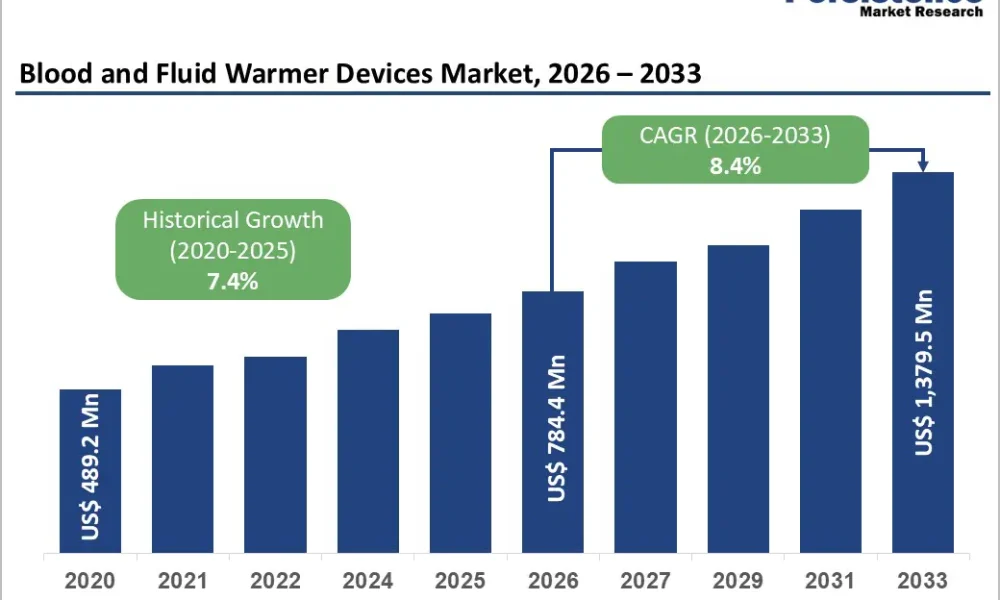
The blood and fluid warmer devices market is witnessing remarkable growth, driven by advancements in healthcare, increasing demand for critical care, and the rising prevalence of trauma and surgical cases. These devices play a critical role in managing patient body temperature, particularly during surgeries, trauma care, and emergency transfusions. This article delves into the details of the blood and fluid warmer devices market, exploring its size, trends, key drivers, and challenges, along with its segmentation and geographical insights.
Overview of the Market
The global blood and fluid warmer devices market is expected to grow significantly in the coming years, with projections indicating an increase from US$ 784.4 million in 2026 to US$ 1,379.5 million by 2033, at a compound annual growth rate (CAGR) of 8.4%. This market growth is fueled by an array of factors, including the aging population, growing surgical volumes, and an increasing demand for critical care services. North America holds the largest share of the market, thanks to its robust healthcare infrastructure, high surgical volumes, and the widespread adoption of patient temperature management protocols. Asia-Pacific, on the other hand, is the fastest-growing region, driven by improving healthcare access, local manufacturing capabilities, and rising investments in modern medical technologies.
Download Your Free Sample & Explore Key Insights: https://www.persistencemarketresearch.com/samples/12604
Key Growth Drivers
Several key factors contribute to the expansion of the blood and fluid warmer devices market. The rise in surgical procedures and trauma cases, coupled with an increased awareness of hypothermia prevention, has resulted in the growing adoption of these devices. Additionally, the aging global population necessitates better management of patient temperatures, especially in critical care settings. Technological advancements, such as the development of portable and efficient warming devices, also play a pivotal role in the market’s growth.
Leading Segment and Region
In terms of market segments, intravenous (IV) warming systems dominate the blood and fluid warmer devices market. These systems hold a substantial share due to their critical role in maintaining normothermia during surgeries, trauma care, and blood transfusions. The ability to heat fluids and blood products before or during administration reduces the risk of hypothermia, which is especially common in trauma and surgery cases.
Geographically, North America is the leading region in the market, accounting for a significant share of the global market. The region benefits from a well-developed healthcare infrastructure, high adoption of advanced technologies, and a strong focus on improving patient outcomes. The U.S. healthcare system, in particular, is a key contributor to the region’s dominance, with high surgical volumes and emergency medical services utilizing blood and fluid warmer devices extensively.
Key Highlights from the Report
• The blood and fluid warmer devices market is projected to grow from US$ 784.4 million in 2026 to US$ 1,379.5 million by 2033.
• The market is expected to record a CAGR of 8.4% from 2026 to 2033.
• North America holds the largest market share, accounting for 41.2% in 2025.
• Intravenous warming systems lead the market, with a 48.7% share in 2025.
• The Asia-Pacific region is the fastest-growing market, driven by expanding healthcare access and increasing investment.
• Technological innovations, such as portable and battery-operated warmers, present significant growth opportunities.
Market Segmentation
The blood and fluid warmer devices market can be segmented based on product type, end-user, and application.
By Product Type
The market is primarily segmented into intravenous (IV) warming systems, surface warming systems, and others. IV warming systems are the dominant segment due to their widespread use in critical care settings. These systems are integral to maintaining patient temperature during surgeries, trauma care, and blood transfusions, as they prevent hypothermia by actively heating fluids and blood before they are infused into the patient’s body. Surface warming systems, though less common, are used to maintain normothermia by heating the surface of the body.
By End-User
In terms of end-users, the blood and fluid warmer devices market is classified into hospitals, ambulatory surgical centers (ASCs), and home care settings. Hospitals represent the largest share of the market, given the extensive use of warming devices in surgical procedures, emergency departments, and intensive care units (ICUs). ASCs are also a significant segment, with the growing trend of outpatient surgical procedures increasing the demand for portable warming systems. Home care settings are an emerging segment, driven by the increasing prevalence of chronic diseases and the rising number of patients receiving medical care at home.
By Application
The primary applications of blood and fluid warmer devices are in surgery, trauma care, and critical care. Surgical applications dominate the market, as perioperative hypothermia is a common complication, affecting 30–75% of surgical patients. This makes temperature management a critical aspect of surgical safety. Trauma care follows closely, with blood and fluid warmers being vital in managing trauma-induced hypothermia, especially in emergency settings. Critical care applications, including ICU and emergency medical services (EMS), also drive the demand for these devices.
Regional Insights
North America
North America remains the largest market for blood and fluid warmer devices, accounting for a significant share of the global market. The region benefits from an advanced healthcare infrastructure, high surgical volumes, and stringent regulations governing patient care, all of which encourage the widespread use of temperature management systems. The U.S., in particular, has a robust healthcare system with extensive adoption of warming devices in hospitals, trauma centers, and operating rooms. The increasing emphasis on patient safety and quality care further supports the demand for blood and fluid warmer devices.
Europe
Europe is another key market for blood and fluid warmer devices, with countries like Germany, the UK, and France showing strong demand for these devices. The region is known for its well-established healthcare systems and high standards of clinical care. European hospitals are increasingly adopting advanced warming technologies to comply with stringent clinical guidelines and ensure the safety of surgical and trauma patients. Aging populations and rising healthcare expenditure also contribute to the steady demand for these devices.
Asia-Pacific
The Asia-Pacific region is experiencing the fastest growth in the blood and fluid warmer devices market. Countries like China, India, and Japan are investing heavily in healthcare infrastructure to meet the rising demand for medical services. The increasing number of surgeries, trauma cases, and transfusions in these countries, combined with government initiatives to improve healthcare access, has driven the demand for blood and fluid warmer devices. Additionally, the rising medical tourism in the region further fuels market growth, as patients seek high-quality healthcare services in countries with advanced medical technologies.
Get Custom Insights Designed for Your Business: https://www.persistencemarketresearch.com/request-customization/12604
Market Drivers
The growth of the blood and fluid warmer devices market is primarily driven by the increasing prevalence of perioperative and trauma-induced hypothermia. Studies have shown that intraoperative hypothermia occurs in a significant proportion of surgical patients, with complications such as impaired coagulation, increased blood loss, and extended recovery times. This highlights the importance of maintaining patient core temperature, driving the demand for blood and fluid warmer devices in surgical, trauma, and critical care settings.
Furthermore, the aging population globally contributes to the rising need for temperature management in hospitals and home care settings. As the number of elderly patients requiring surgery and critical care increases, the demand for blood and fluid warmer devices continues to grow. The advancement of portable and battery-operated warming systems also offers convenience and flexibility, especially in emergency medical services and rural healthcare settings, expanding the market further.
Market Restraints
Despite the promising growth, the market faces several challenges. One of the major restraints is the high cost of advanced blood and fluid warming devices. The high upfront cost of these devices, particularly those with sophisticated features like integrated sensors and rapid warming capabilities, can be prohibitive, especially for smaller clinics or hospitals in low- and middle-income countries. Additionally, insurance reimbursement limitations and financial constraints further hinder the adoption of these devices, as healthcare providers may delay procurement or opt for lower-cost alternatives.
Market Opportunities
The increasing demand for portable and battery-operated blood and fluid warmers presents a significant opportunity for market players. With the growing emphasis on pre-hospital care, emergency response, and home-based medical support, lightweight, user-friendly warming devices are in high demand. This trend is particularly evident in rural areas and emergency medical services, where access to centralized healthcare infrastructure may be limited. Manufacturers that innovate and provide cost-effective, portable solutions will likely capture a larger share of the market in the coming years.
Checkout Now & Download Complete Market Report: https://www.persistencemarketresearch.com/checkout/12604
Company Insights
Several global med-tech companies dominate the blood and fluid warmer devices market. These key players include:
• 3M Company
• GE Healthcare
• Stryker Corporation
• BD
• Baxter International Inc.
• Smiths Medical
• Vyaire Medical, Inc.
• Barkey GmbH & Co. KG
• Belmont Instrument
• Geratherm Medical
Recent Developments
In June 2024, MEQU received 510(k) clearance from the FDA for its °M Warmer System, a portable blood and IV fluid warming device designed for both military and civilian use.
In April 2024, BD India launched the UltraTouch™ blood collection device in India, aimed at minimizing patient pain during blood draws.
Conclusion
The blood and fluid warmer devices market is poised for steady growth, driven by the increasing prevalence of hypothermia in surgical and trauma care settings, the aging population, and technological innovations. While North America continues to lead the market, the Asia-Pacific region shows the fastest growth, with expanding healthcare access and rising investment in medical technologies. Despite challenges such as high costs, opportunities exist in the development of portable and battery-operated devices, which are likely to shape the future of the market. Key players continue to innovate, ensuring the market remains dynamic and competitive. As the demand for temperature management solutions increases, the market for blood and fluid warmer devices will expand, ultimately improving patient outcomes worldwide.




