
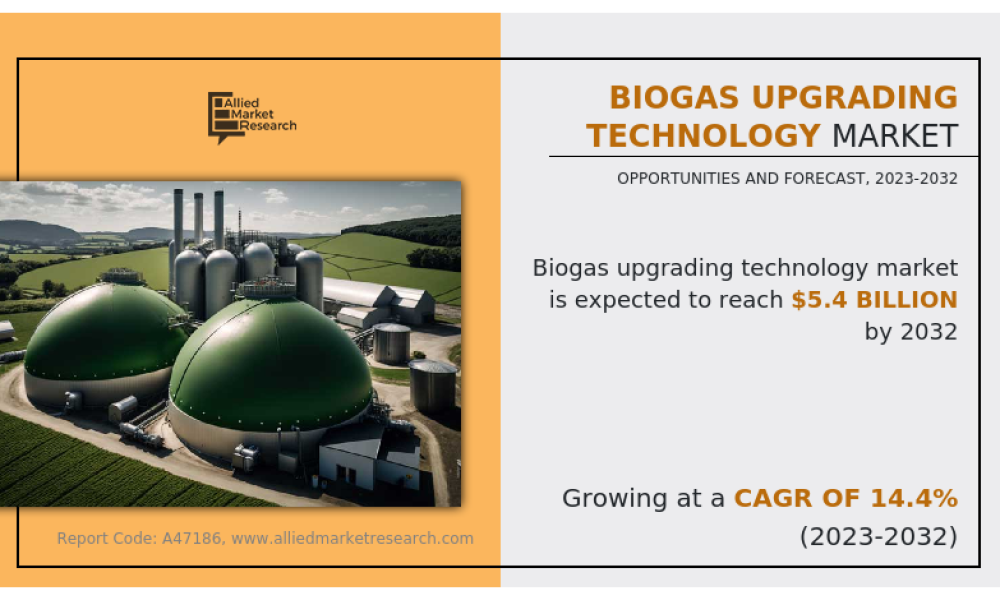
According to a new report published by Allied Market Research, titled, “Biogas Upgrading Technology Market,” The biogas upgrading technology market was valued at $1.4 billion in 2022, and is estimated to reach $5.4 billion by 2032, growing at a CAGR of 14.4% from 2023 to 2032.
The biogas upgrading technology market refers to the industry focused on the development, deployment, and commercialization of systems and solutions that refine raw biogas into high-purity biomethane. Biogas is typically produced through the anaerobic digestion of organic materials such as agricultural waste, sewage sludge, food waste, and industrial by-products. However, raw biogas contains impurities like carbon dioxide (CO₂), hydrogen sulfide (H₂S), water vapor, and other trace gases that must be removed to enhance its energy content and make it suitable for use as a renewable substitute for natural gas. Biogas upgrading technologies—including water scrubbing, pressure swing adsorption (PSA), membrane separation, and chemical absorption—are designed to efficiently purify biogas to meet stringent quality standards for injection into gas grids or use as vehicle fuel.
As the global focus on sustainable energy sources intensifies, the biogas upgrading technology market is gaining significant momentum. It plays a pivotal role in supporting circular economy initiatives, reducing greenhouse gas emissions, and promoting the use of renewable energy. The market is driven by increasing regulatory support, climate change mitigation strategies, and rising investments in clean energy infrastructure. Moreover, as countries aim to reduce their dependence on fossil fuels and utilize organic waste more effectively, the demand for advanced and scalable biogas upgrading technologies continues to grow, making it a critical component of the renewable energy transition.
Download PDF Brochure: https://www.alliedmarketresearch.com/request-sample/A47186
Biogas upgrading technology plays a critical role in enhancing the quality of biogas by continuously monitoring and optimizing the conversion process to produce high-purity biomethane suitable for safe distribution and use. This technology has broad applications across sectors that prioritize sustainability and renewable energy, aligning closely with circular economy goals and global efforts to curb carbon emissions. In regions such as the U.S. and Europe, where organic waste from agriculture is abundant, biogas upgrading is instrumental in converting residues into a valuable renewable energy source. It also supports waste-to-energy initiatives and wastewater treatment operations, helping to increase organic material utilization while minimizing environmental impact—thereby driving market growth.
The market for biogas upgrading technology is expanding due to several key factors, including growing awareness of biomethane’s environmental benefits, supportive regulations promoting renewable energy, and intensified global efforts to reduce greenhouse gas emissions. Notably, the European Union’s renewable energy directives—aimed at increasing the share of energy derived from sustainable sources by 2030—have accelerated the adoption of biogas upgrading systems across Europe. As demand for clean, renewable energy continues to rise, this technology is well-positioned to support long-term energy transition goals through its ability to transform organic waste into eco-friendly fuel.
Despite its advantages, the biogas upgrading technology market also faces several challenges. High upfront investment costs, technical complexity of system components, and the need for integration with emerging technologies—such as energy storage and IoT-based monitoring—can hinder widespread deployment. Cybersecurity risks and the ongoing need for specialized operation and maintenance further add to the cost and complexity. These barriers can pose difficulties for new adopters, especially in developing regions where financial and technical resources may be limited.
Nonetheless, the long-term environmental and economic benefits of biogas upgrading technology remain compelling. Its ability to support sustainable waste management, reduce reliance on fossil fuels, and contribute to a low-carbon economy makes it a key element of the global renewable energy landscape. With continued advancements in technology and supportive policy frameworks, the market is expected to see steady growth, reinforcing its role in the transition to clean energy solutions.
For Purchase Inquiry: https://www.alliedmarketresearch.com/purchase-enquiry/A47186
The biogas upgrading technology market scope is segmented on the basis of technology, end-use, and region. By technology, the market is segregated into absorption, vacuum pressure swing adsorption, membrane separation, and others. On the basis of end-use, it is segregated into thermal application, power generation, and biomethane bottling. Region-wise, the market is analyzed across North America, Europe, Asia-Pacific, and LAMEA.
Based on region, Europe held the highest market share in terms of revenue in 2022, accounting for more than two-fifths of the global biogas upgrading technology market share, and is likely to dominate the market during the forecast period. Furthermore, the Asia-Pacific region is expected to witness the fastest growing market during the forecast period. The Asia-Pacific region presents significant growth potential in the biogas upgrading technology industry. Emerging markets, such as India, China, and Southeast Asian countries, have witnessed rapid industrial growth which will lead to increased demand for energy resources which have a significant impact on the biogas upgrading technology market size. The increase in investment toward renewable energy resources, especially in the biogas sector, is anticipated to offer biogas upgrading technology market opportunities in Asia-Pacific during the biogas upgrading technology forecast period.
Major biogas upgrading technology market players, such as Atmos Power Pvt. Ltd., Bright Renewables B.V., Air Liquide, Dmt environmental technology, Evonik Industries AG, Pentair Plc, Malmberg Bioerdgastech GmbH, Metener Oy, Greenlane Renewables Inc., Wartsila Oyj abp, Prodeval Corp., Aemetis Inc., Clarke Energy, Acrona Projects Sarl, Clean Energy Fuels Corp., AB Holding Spa, Spectrum Renewable Energy Limited, B-Sustain Energy Projects Private Limited, Xebec Adsorption Inc., and Verbio Vereinigte Bioenergie AG are focusing their investment on technologically advanced, cost-effective, and more secure products and solutions for various applications related to purification of biogas.
The report provides a detailed analysis of these key players in the global biogas upgrading technology market forecast. These players have adopted different strategies such as new product launches, collaborations, expansion, joint ventures, agreements, and others to increase their market share and maintain dominant shares in different regions. The report is valuable in highlighting business performance, operating segments, product portfolio, and strategic moves of market players to highlight the competitive scenario.
Key Findings Of The Study:
- On the basis of technology, the others segment is projected to grow at the highest CAGR of approximately 15.5%, in terms of revenue, during the forecast period.
- On the basis of end-use, the biomethane bottling segments are projected to grow at the highest CAGR of approximately 14.7%, in terms of revenue, during the forecast period.
- Region-wise, Asia-Pacific is projected to grow at the highest CAGR, in terms of revenue, during the forecast period.




