

Biogas Market Overview
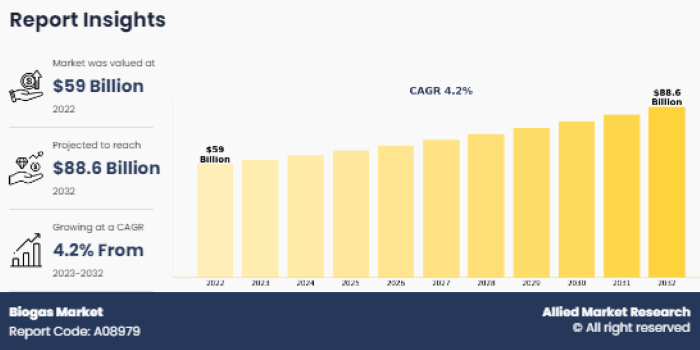
According to a new report published by Allied Market Research, the biogas market size was valued at $59.0 billion in 2022 and is projected to reach $88.6 billion by 2032, growing at a CAGR of 4.2% from 2023 to 2032. Increasing demand for renewable energy, rising focus on sustainable waste management, and growing industrial adoption of clean energy solutions are key factors supporting the expansion of the global biogas market.
Biogas has emerged as an environmentally friendly energy alternative that converts organic waste into a valuable resource. Governments and industries worldwide are increasingly adopting biogas technologies to reduce greenhouse gas emissions, improve energy security, and manage organic waste more efficiently. As a result, the global biogas market continues to gain momentum across residential, commercial, and industrial sectors.
Download PDF Brochure: https://www.alliedmarketresearch.com/request-sample/A08979
Introduction
Biogas is a renewable energy source produced through the anaerobic digestion of organic materials such as food waste, agricultural residues, and animal manure. The gas primarily consists of methane and carbon dioxide, making it suitable for several energy applications including electricity generation, heating, cooking, and transportation fuel.
The use of biogas helps reduce dependence on traditional fuels such as wood, charcoal, and fossil fuels. By replacing these conventional energy sources, biogas contributes to lower carbon emissions, improved air quality, and reduced deforestation. In many developing regions, biogas systems also provide an affordable and sustainable cooking fuel, helping households avoid harmful indoor air pollution.
Another major advantage driving the biogas market is its role in waste management. Organic waste from municipalities, farms, and industries can be processed in anaerobic digesters to generate energy while simultaneously reducing landfill waste. The remaining by-product, known as digestate, can be used as an organic fertilizer, further supporting sustainable agriculture.
Furthermore, biogas can be upgraded into biomethane, a purified form of methane that can be injected into natural gas pipelines or used as a transportation fuel. This capability expands the potential of the biogas market beyond conventional applications and supports the global transition toward cleaner energy systems.
Market Dynamics
The growth of the biogas market is strongly influenced by rising industrial and commercial demand for sustainable energy solutions. As industries seek to reduce their carbon footprint and comply with environmental regulations, biogas is becoming an attractive alternative to fossil fuels.
Industrial facilities can use biogas for heating, cooling, and steam generation in manufacturing processes. This not only reduces greenhouse gas emissions but also lowers operational energy costs. In addition, biomethane derived from biogas can be integrated into existing natural gas infrastructure, making it easier for industries to adopt renewable energy without major infrastructure changes.
In the commercial sector, businesses such as restaurants, hotels, supermarkets, and food processing facilities are increasingly utilizing biogas produced from food waste and organic residues. This approach allows companies to generate renewable energy while simultaneously reducing waste disposal costs and improving sustainability practices.
Biogas is also widely used in combined heat and power (CHP) systems. These systems generate electricity and useful heat simultaneously, significantly improving energy efficiency. Such applications further support the expansion of the global biogas market.
Despite these benefits, competition from conventional energy sources remains a major challenge. Fossil fuels such as coal, oil, and natural gas have historically dominated the global energy sector due to their established infrastructure and lower upfront costs.
Biogas production requires specialized equipment, including anaerobic digesters and gas upgrading systems, which can result in higher initial investment costs. In addition, biogas production depends on the availability of organic feedstock, which may vary by region and season. These factors can affect production consistency and limit the competitiveness of biogas compared to traditional energy sources.
However, technological innovations are creating new opportunities for the biogas market. Advances in anaerobic digestion technologies, including high-rate digestion and co-digestion processes, are improving biogas yields and system efficiency.
Improved purification and upgrading technologies are also enabling the production of high-quality biomethane suitable for grid injection or use as vehicle fuel. Such developments are expanding the commercial potential of biogas across multiple industries.
In addition, digital technologies and automation are increasingly being integrated into biogas plants. Smart monitoring systems allow operators to optimize performance, reduce downtime, and improve overall efficiency. Emerging feedstocks such as algae and industrial organic waste streams are also opening new possibilities for biogas production.
Segments Overview
The global biogas market is segmented based on source, end-use industry, and region.
Based on source, the market is categorized into municipal waste, animal waste, agricultural waste, and others. Among these, the municipal waste segment accounted for the largest market share in 2022 and is expected to continue growing due to increasing urban waste generation and government initiatives for sustainable waste management.
By end-use industry, the market is divided into electricity generation, cogeneration, and others. The electricity generation segment held the largest share in 2022, contributing to more than one-third of global revenue. Biogas-based power generation is gaining popularity due to its ability to provide reliable renewable electricity while reducing landfill emissions.
Cogeneration systems are also witnessing increasing adoption as they maximize energy efficiency by producing both electricity and heat simultaneously.
Regional Analysis
Regionally, the Asia-Pacific region accounted for the largest share of the biogas market in 2022. Rapid industrialization, growing population, and increasing energy demand are major factors driving the adoption of biogas technologies in the region.
Countries such as India, China, and Japan are investing heavily in renewable energy infrastructure and waste-to-energy solutions. Government initiatives promoting biogas plants for rural energy supply and waste management are also contributing to regional market growth.
Europe is another key market for biogas, supported by strong environmental regulations and ambitious renewable energy targets. Many European countries have implemented policies encouraging the use of biomethane in transportation and natural gas grids.
North America is also experiencing steady growth due to increasing investments in waste management technologies and renewable energy projects. Meanwhile, regions such as Latin America, the Middle East, and Africa are gradually adopting biogas technologies to address energy shortages and improve waste management practices.
Get a Customized Research Report: https://www.alliedmarketresearch.com/request-for-customization/A08979
Competitive Landscape
Leading companies operating in the global biogas market include Wärtsilä, EnviTec Biogas AG, Air Liquide USA, Hindustan Petroleum Corporation Limited, PlanET Biogas Group, BoxLNG Pvt. Ltd., Bharat Biogas Energy Ltd., Primove Engineering Pvt. Ltd., GAIL Gas Limited, and GPS Renewables Pvt. Ltd.
Other notable market participants include Green Elephant, IOT, Praj Industries, and SLPP RE. These companies are focusing on technology development, strategic partnerships, and project expansions to strengthen their market presence and capitalize on the growing demand for renewable energy.
Conclusion
In conclusion, the biogas market is set to witness steady growth through 2032, driven by increasing demand for renewable energy, sustainable waste management, and technological advancements. While competition from conventional energy sources poses challenges, supportive government policies and innovation in biogas technologies are expected to unlock significant growth opportunities, positioning biogas as a critical component of the global clean energy transition.
Other Trending Reports:-
Biogas Upgrading Technology Market
About Us
Allied Market Research (AMR) is a full-service market research and business-consulting wing of Allied Analytics LLP based in Portland, Oregon. Allied Market Research provides global enterprises as well as medium and small businesses with unmatched quality of “Market Research Reports” and “Business Intelligence Solutions.” AMR has a targeted view to provide business insights and consulting to assist its clients to make strategic business decisions and achieve sustainable growth in their respective market domain.
Pawan Kumar, the CEO of Allied Market Research, is leading the organization toward providing high-quality data and insights. We are in professional corporate relations with various companies and this helps us in digging out market data that helps us generate accurate research data tables and confirms utmost accuracy in our market forecasting. Each and every data presented in the reports published by us is extracted through primary interviews with top officials from leading companies of domain concerned. Our secondary data procurement methodology includes deep online and offline research and discussion with knowledgeable professionals and analysts in the industry.




