
Overview
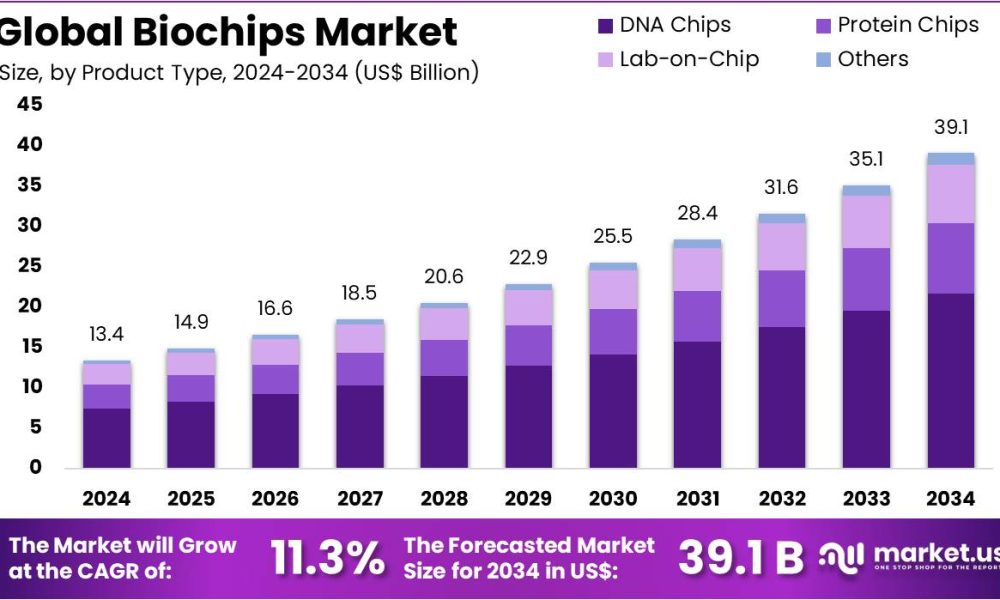
The Global Biochips Market is projected to grow from USD 13.4 billion in 2024 to around USD 39.1 billion by 2034. This reflects a strong CAGR of 11.3% during the forecast period from 2025 to 2034. The rising demand for high-throughput screening and personalized healthcare is driving this growth. Biochips combine microarray technology with molecular biology, allowing fast and accurate analysis of biological data. These devices play a critical role in diagnostics, genomics, drug discovery, and environmental monitoring due to their efficiency and precision.
The growing focus on precision medicine is opening new avenues for biochips. These technologies help in tailoring treatments based on individual genetic profiles. As a result, they enhance diagnostic accuracy and therapeutic outcomes. For example, in August 2023, Illumina Inc. opened a new Solutions Center in Bengaluru, India. This move aims to improve access to genomics and drive innovations in healthcare. The expansion shows how biochips are gaining importance across global health systems.
Biochips are increasingly used in non-invasive diagnostics such as liquid biopsies. These tools offer faster and less intrusive methods for disease detection. They are also being applied in personalized nutrition and drug monitoring. Their growing use in point-of-care diagnostics helps healthcare providers deliver rapid, cost-effective services. This expands their utility in both clinical and remote settings. Biochips thus support wider access to medical testing.
Technological convergence is further enhancing biochip performance. Integration with artificial intelligence and data analytics boosts their speed and accuracy. This makes them more useful in complex medical scenarios. Applications now extend to cancer research, genetic testing, and pathogen detection. AI-driven tools also improve result interpretation and support early disease identification. These advancements are expanding the role of biochips in clinical and research environments.
Engineering innovations are another key growth driver. New methods for cellular manipulation support the development of personalized medical tools. For instance, a March 2023 partnership between Mekonos and bit.bio focused on advancing stem cell conversion. Such collaborations strengthen biochip-based applications in drug development. The integration of microfluidics and nanotechnology is also unlocking new biochip functions. This progress is expected to support breakthroughs in oncology, immunology, and regenerative medicine.

Key Takeaways
- In 2024, the global biochips market generated US$ 13.4 billion in revenue, and it is projected to reach US$ 39.1 billion by 2034.
- The market is expected to grow at a compound annual growth rate (CAGR) of 11.3% during the forecast period from 2025 to 2034.
- Among product types, DNA chips dominated the market in 2024, capturing a substantial 55.6% share due to their extensive use in genomics research.
- The product segment also includes protein chips, lab-on-chip technologies, and other types supporting various applications in life sciences and diagnostics.
- In terms of end-use, biotechnology and pharmaceutical companies accounted for the largest share at 61.4%, driven by growing demand for drug discovery tools.
- Other end-user segments include hospitals, diagnostic centers, academic institutions, and research laboratories contributing to the biochips market expansion.
- Regionally, North America led the biochips market in 2024, commanding a 40.2% share, supported by advanced healthcare infrastructure and R&D funding.
Regional Analysis
North America currently leads the global biochips market. In 2023, the region accounted for 40.2% of total revenue. This dominance is attributed to advanced biotechnology infrastructure, a high adoption rate of personalized medicine, and increasing use of high-throughput screening technologies. Biochips are widely used in genomics, diagnostics, and drug discovery. These tools help analyze genetic materials and proteins efficiently. The rising burden of chronic diseases and the shift toward precision medicine further support the region’s growing demand for efficient and scalable diagnostic solutions.
The market in North America is also witnessing strategic investments. In September 2024, Nomic Bio completed a Series B funding round, raising US$ 42 million. This funding exceeded expectations and will expand the company’s protein profiling platform. The investment aims to increase commercial operations and meet rising demand for advanced diagnostic tools. As the healthcare industry continues to focus on personalized treatments and efficient testing platforms, such developments are expected to sustain the region’s leadership in the biochips market over the forecast period.
Asia Pacific is projected to grow at the fastest CAGR in the biochips market. Countries like China, Japan, and India are investing heavily in biotechnology research. These nations are enhancing their healthcare infrastructure and research capacities. The region is focusing on precision medicine to improve healthcare delivery. This approach supports the growing demand for biochips in disease diagnosis, drug development, and personalized care. As a result, Asia Pacific is becoming a major growth engine for the global biochips industry.
A notable milestone in the region was Japan’s regulatory approval of a new cancer drug. In September 2024, Takeda received approval from the Ministry of Health, Labour and Welfare for FRUZAQLA Capsules, a treatment based on fruquintinib. This highlights the region’s increasing ability to develop and adopt innovative healthcare solutions. Such regulatory support strengthens the ecosystem for advanced diagnostics and therapeutic technologies, including biochips. It also reflects the region’s commitment to modern, personalized treatment options.
The rising prevalence of chronic diseases in Asia Pacific is also a key growth driver. This has increased the demand for early disease detection tools and personalized therapies. Governments are supporting this demand with ongoing investments in healthcare innovation. Initiatives in genomics, digital diagnostics, and clinical research are helping expand the use of biochips. As these technologies become more accessible, the regional biochips market is expected to see rapid and sustained growth throughout the forecast period.
Segmentation Analysis
The DNA chips segment dominated the biochips market in 2024, accounting for a 55.6% share. This growth is mainly due to the rising need for high-throughput genomic tools. DNA chips are widely used for gene expression profiling, disease diagnostics, and genetic variation analysis. Their role in personalized medicine is becoming more important. As the demand for efficient genomic data analysis increases, DNA chips are expected to gain more traction across clinical and research settings, offering both speed and cost-effectiveness in data processing.
Advancements in microarray technology and the increasing incidence of genetic disorders are further fueling the demand for DNA chips. These chips enable simultaneous analysis of multiple genes. This function is essential for both medical diagnostics and academic research. Their use reduces the time and cost associated with traditional testing methods. Moreover, the expanding global focus on genomics and precision health is set to support long-term growth. DNA chips are positioned as a cornerstone technology in the molecular diagnostics field.
Biotechnology and pharmaceutical companies held the highest end-user market share of 61.4% in 2024. This dominance is due to their growing reliance on biochips in drug development and research. Biochips help in fast, accurate screening of drug candidates and biomarker identification. These functions support faster decision-making in clinical trials. With the pharmaceutical industry shifting toward targeted therapies, the value of biochips in R&D processes continues to increase.
The integration of biochips into clinical research and diagnostic workflows is also contributing to segment growth. These technologies provide precise molecular-level insights. As a result, they help biotech and pharma firms improve treatment development. The adoption of biochips supports advancements in biologics and precision medicine. This aligns with the global push for more effective and personalized healthcare solutions. Consequently, demand from biotech and pharmaceutical companies is expected to rise steadily over the coming years.
By Product Type
- DNA Chips
- Cancer Diagnosis & Treatment
- SNP Genotyping
- Genomics
- Gene Expression
- Drug Discovery
- Agricultural Biotechnology
- Others
- Protein Chips
- Proteomics
- HTS
- Expression Profiling
- Drug Discovery
- Diagnostics
- Others
- Lab-on-chip
- Genomics
- Proteomics
- IVD & POC
- Drug discovery
- Others
- Others
By End-use
- Hospitals & Diagnostic Centers
- Biotechnology & Pharmaceutical Companies
- Academic & Research Institutes
- Others
Key Players Analysis
Key players in the biochips market are focused on advancing microarray and lab-on-a-chip technologies. These innovations meet the growing needs of genomics, proteomics, and diagnostics. Companies are investing in research and development to create multifunctional platforms. These platforms aim to streamline testing and improve accuracy. Collaborations with pharmaceutical firms and research institutions are increasing. Such partnerships help expand the use of biochips in drug discovery and personalized medicine. Additionally, many firms are targeting regions with improved healthcare infrastructure and research funding to support market growth.
Cost-effective solutions are also a key focus area for these companies. Affordable options increase adoption in both academic and clinical settings. Agilent Technologies, Inc. stands out as a leading player in this space. The company offers innovative biochip solutions for genomic and diagnostic applications. Agilent’s microarray platforms are known for their user-friendly design and high reliability. Its strong global presence and consistent innovation have built industry trust. By aligning product development with market demand, Agilent continues to strengthen its leadership in the biochips market.
- Bio-Rad Laboratories, Inc
- Boston Micro Fabrication
- GE HealthCare
- Illumina, Inc
- PerkinElmer Inc
- QIAGEN
- Randox Laboratories Ltd
- Standard BioTools
Conclusion
In conclusion, the biochips market is growing steadily due to strong demand for fast and accurate diagnostic tools. These devices are widely used in genomics, drug discovery, and personalized healthcare. Their ability to deliver high-throughput results makes them essential in both research and clinical settings. Technological advancements, including integration with artificial intelligence and microfluidics, are expanding their use. Companies are focusing on cost-effective solutions and forming strategic partnerships to drive innovation. The rising focus on precision medicine and early disease detection is also supporting market expansion. As healthcare systems invest more in modern tools, biochips are expected to play a bigger role in shaping the future of medical diagnostics and research.
Get in Touch with Us:
Market.us (Powered By Prudour Pvt. Ltd.)
Address: 420 Lexington Avenue, Suite 300, New York City, NY 10170, United States.
Contact No: +1 718 874 1545 (International), +91 78878 22626 (Asia).
Email: [email protected]
View More
Blockchain Technology in Healthcare Market
Patient Engagement Solutions Market



