
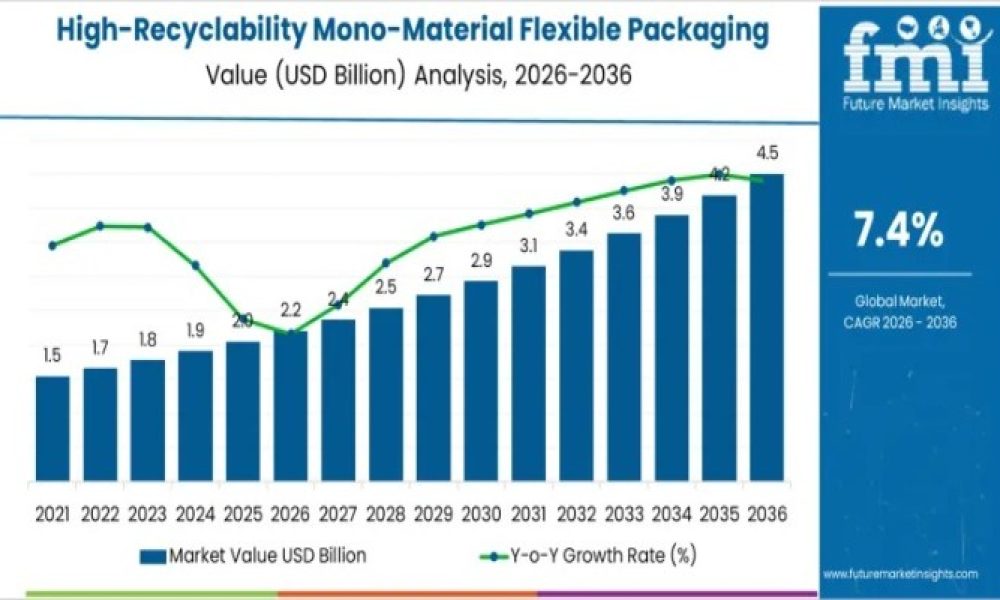
The global high-recyclability mono-material flexible packaging market is entering a decisive growth phase as brand owners, converters, and regulators converge around recyclable-by-design packaging strategies. Valued at USD 2.2 billion in 2026, the market is projected to reach USD 4.5 billion by 2036, expanding at a compound annual growth rate (CAGR) of 7.4%. This sustained growth reflects not only rising demand for recyclable packaging formats, but also the structural integration of mono-material solutions into mainstream flexible packaging operations.
Unlike short-term sustainability trends, mono-material flexible packaging is demonstrating long-term value accumulation. The market’s growth curve shows steady incremental gains in the early forecast years, followed by accelerated value creation as adoption scales across global FMCG portfolios.
Discover Market Opportunities – Get Your Sample of Our Industry Overview Today!
Market Growth Outlook: 2026 to 2036
Between 2026 and 2031, the market grows from USD 2.2 billion to approximately USD 3.0 billion, representing a foundational adoption phase. During this period, growth is led by early adopters in food, beverage, snacks, and personal care packaging, where recyclability commitments and regulatory pressure drive selective deployment. Adoption remains measured as converters validate material performance, adjust barrier properties, and align mono-material films with existing filling lines.
From 2031 to 2036, cumulative market value accelerates sharply, adding USD 1.5 billion to reach USD 4.5 billion. This second phase reflects scaled implementation across multi-SKU portfolios, private-label packaging, and repeat procurement by established brands. Cost efficiencies, standardized production processes, and improved recycling infrastructure contribute to faster annual value additions.
By 2036, the market’s value reflects both direct revenue growth and indirect benefits, including material efficiency, operational simplicity, and alignment with circular economy frameworks.
Quick Market Highlights
- Market Value (2026): USD 2.2 billion
- Forecast Value (2036): USD 4.5 billion
- Forecast CAGR (2026–2036): 7.4%
- Leading Packaging Format: Stand-up pouches (40% share)
- Key Growth Regions: India, China, USA, Brazil, Germany, Japan
- Leading Players: Amcor, Mondi, Sealed Air, Bischof + Klein, Huhtamaki (flexibles), UFlex, Klabin
How Demand Is Evolving
Early demand for high-recyclability mono-material flexible packaging emerged as a response to the recycling limitations of traditional multi-layer laminates. Conventional flexible films often combine incompatible polymers, resulting in low recovery rates. Mono-material alternatives were initially adopted through pilot programs, primarily in snacks and pouch packaging, where recycling claims influenced retailer acceptance.
Looking ahead, future demand is shifting from experimentation to compliance-driven adoption. Regulatory frameworks across major economies are introducing recyclability criteria, recycled content mandates, and reporting obligations. At the same time, packaging developers are enhancing mono-material structures using engineered polymers and advanced sealing technologies to improve barrier performance.
Recycling infrastructure is also evolving. Investments in collection and processing systems are improving mono-material film recovery, reinforcing their environmental value proposition. As cost premiums decline, adoption is broadening across consumer packaged goods categories.
End-Use Applications Driving Demand
Demand formation is closely tied to packaging volume intensity rather than premium positioning.
- Snacks and confectionery account for 35% of total demand, driven by high unit volumes and short consumption cycles.
- Pet food relies on mono-material formats for durability and portion control.
- Ready meals require controlled barrier performance and heat compatibility.
- Retail and FMCG products adopt mono-material structures to meet retailer packaging guidelines.
- Dairy alternatives leverage flexible packaging for chilled distribution and rapid product innovation.
These segments demonstrate steady demand, as flexible packaging remains integral to product delivery models rather than discretionary format choices.
Packaging Format Trends
Packaging format selection favors compatibility with existing machinery and recycling systems:
- Stand-up pouches lead with a 40% market share, valued for versatility and shelf presence.
- Flow wrap and pillow packs remain essential for high-speed snack and confectionery lines.
- Spouted pouches serve liquids and semi-liquid applications.
- Mono-material laminate lookalikes preserve brand aesthetics while improving recyclability.
- Sachets and small pouches support portion control and sampling formats.
Producers prioritize formats that minimize capital disruption, reinforcing demand stability.
Regional Growth Dynamics
- India: Fastest growth at 12.0% CAGR, driven by organized food manufacturing and urban retail expansion.
- China: 11.0% CAGR, supported by industrial scale, e-commerce growth, and domestic film production.
- USA: 8.0% CAGR, reflecting steady adoption across branded food, beverage, and personal care packaging.
- Brazil: 8.0% CAGR, shaped by organized retail growth and sustainability awareness.
- Germany: 7.0% CAGR, anchored by stringent recycling regulations and mature infrastructure.
- Japan: 5.0% CAGR, reflecting stable, replacement-driven demand in a mature packaging market.
Competitive Landscape
Competition centers on material engineering, seal integrity, and machinability rather than visual differentiation.
- Amcor, Mondi, and Sealed Air lead with mono-PE and mono-PP flexible structures for food and household applications.
- Huhtamaki (flexibles) focuses on reformulated packs balancing performance and recyclability.
- Bischof + Klein serves European markets with region-specific recyclable films.
- UFlex targets emerging markets with scalable mono-material solutions.
- Klabin supports selected applications through paper-based and hybrid flexible structures aligned with mono-material principles.
Local converters play a crucial role by adapting films to national recycling guidelines and operational requirements.
Why FMI: https://www.futuremarketinsights.com/why-fmi
About Future Market Insights (FMI)
Future Market Insights, Inc. (FMI) is an ESOMAR-certified, ISO 9001:2015 market research and consulting organization, trusted by Fortune 500 clients and global enterprises. With operations in the U.S., UK, India, and Dubai, FMI provides data-backed insights and strategic intelligence across 30+ industries and 1200 markets worldwide.



